Five PFAS-related engineering RFPs from Florida water utilities in a single month. That is six times the trailing 12-month average of roughly one per month, and more than double the prior single-month record of two. October 2026 is not an outlier, it is the acceleration point of a procurement sprint that Florida utilities could no longer delay.
The proximate trigger is a confluence of deadlines and dollars. On May 19, 2026, EPA announced $37.4 million in Emerging Contaminants in Small or Disadvantaged Communities grant funding specifically for Florida, a direct-grant stream targeting smaller and disadvantaged water systems, separate from the roughly $83.8 million Florida DEP already holds in active EPA Drinking Water State Revolving Fund grants across three IIJA tranches earmarked for PFAS capital projects. Those SRF funds, committed between 2023 and 2025, flow from EPA to DEP and then out to utilities as forgivable loans or grants for construction. The EC-SDC grants are a parallel, distinct mechanism aimed at communities that may not have the creditworthiness or engineering staff to access the SRF pipeline. Both funding streams are now live. Neither pays for inaction.
The regulatory pressure underneath them is the April 2024 PFAS National Primary Drinking Water Regulation, which set enforceable maximum contaminant levels of 4 parts per trillion for PFOA and PFOS, the first legally binding federal drinking water limits for any PFAS compound. The rule gives public water systems until April 26, 2027 to complete initial monitoring, and until April 26, 2029 to achieve full MCL compliance. EPA proposed in May 2026 to extend that compliance deadline to 2031 for systems that opt in, while retaining the PFOA/PFOS limits and rescinding MCLs for four other compounds. As of October 2026, no final modification rule has issued, meaning all six original MCLs remain in effect and the 2029 deadline is still the operative legal obligation.
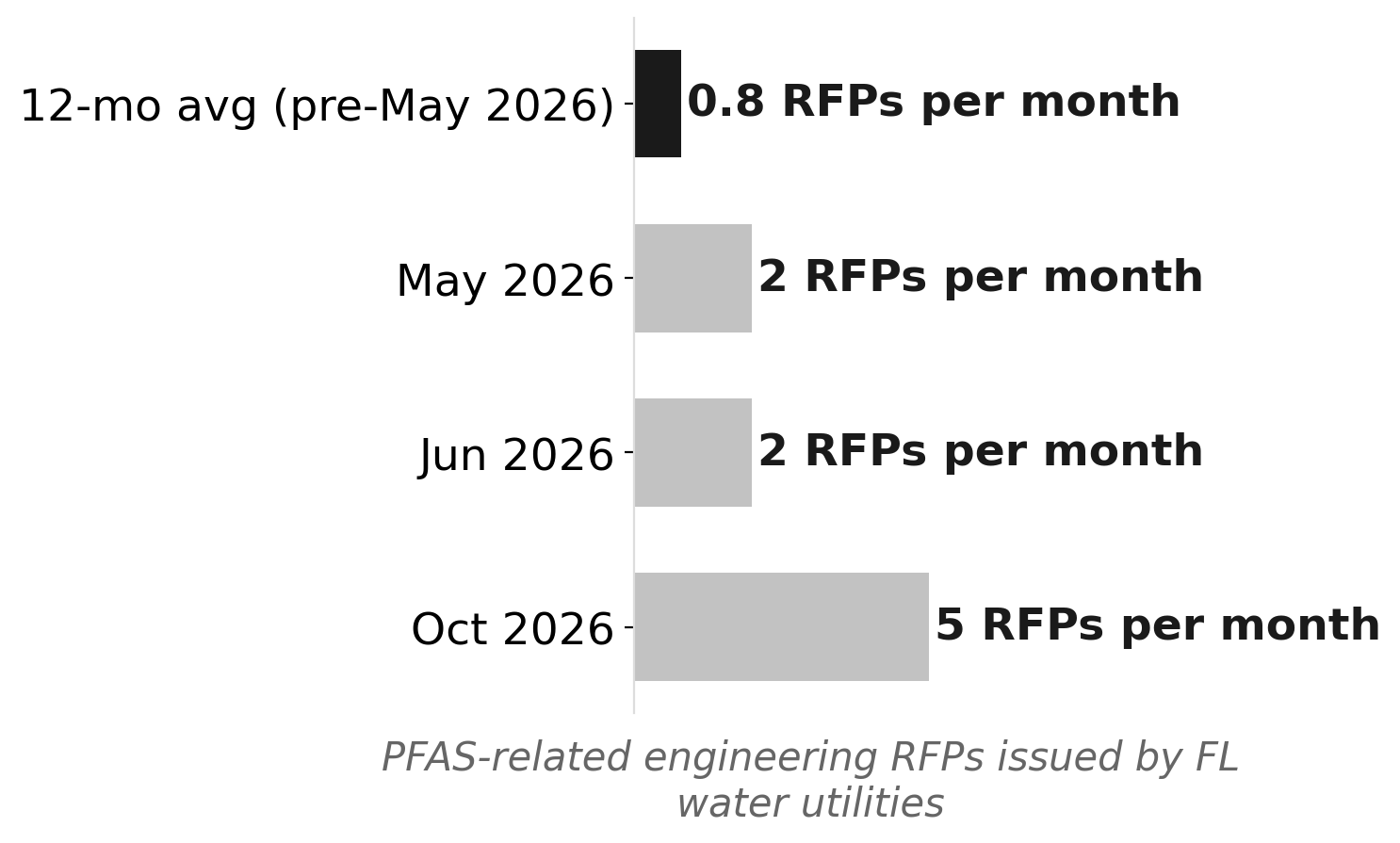
Source: NationGraph.
Florida's position is acutely uncomfortable. A University of Florida study found PFOA or PFOS levels exceeding 4 ppt in 23 of the state's 67 counties, with the most contaminated freshwater springs clustered in the Deltona area. Florida draws heavily on groundwater and springs for drinking water, making aquifer contamination difficult to route around. And unlike Michigan or New Jersey, which moved early under their own state-level PFAS standards, Florida historically waited for federal guidance before acting, a posture the Florida Water and Pollution Control Operators Association acknowledged in April 2026, noting the state is now moving rapidly to catch up.
The October RFPs show where that catchup is happening. Toho Water Authority in Osceola County issued a final-design RFQ for PFAS treatment at its Northwest Water Treatment Plant. The City of Temple Terrace in Hillsborough County went to market for nanofiltration and concentrate management engineering, nanofiltration being the capital-intensive membrane technology most commonly specified for PFOA/PFOS removal, and concentrate disposal being the problem that follows. Tampa Bay Water in Pinellas County and Broward County both issued procurement documents in the same window. The geographic concentration in the Tampa Bay metro and South Florida corridors is not random: those are areas with documented groundwater contamination and large enough utility footprints to move first.
Broward County is the clearest illustration of what this pipeline looks like further along. The county contracted Carollo Engineers and CDM Smith in January 2026 to design PFAS treatment upgrades at two plants with combined capacity of 46 million gallons per day, targeting compliance ahead of the proposed 2031 extended deadline. That contract was awarded before the October procurement spike, meaning the utilities now flooding the RFP market are roughly one procurement cycle behind the early movers, compressing demand for engineering and vendor capacity into a narrower and narrower window.
That compression is the practical story for anyone living inside a Florida water service area. The 2027 initial-monitoring deadline is 18 months out. Engineering a nanofiltration system, permitting it, and constructing it takes longer than that for a treatment plant of any size. Utilities that are only now scoping engineering contracts will be racing against a compliance clock with less margin than they may have anticipated when they were waiting for federal certainty on the rules. Whether the 2029 deadline shifts to 2031 matters enormously to project timelines, but betting on a regulatory extension that has not yet been finalized is a risk utilities and their bond counsels are actively weighing.
The next signal to watch is Florida DEP's FFY2026 Emerging Contaminants Intended Use Plan, which will show which utilities have formally entered the SRF queue for PFAS capital funding. Projects not addressing emerging contaminants were explicitly deprioritized in prior IUPs. The list of utilities that do appear, and the gap between their engineering timelines and the compliance deadlines, will determine whether October's procurement sprint was the start of an orderly buildout or the beginning of a capacity crunch.