North Carolina has pulled in $66.7 million in federal wildfire grants over the past 90 days, a 5,904% increase from the $1.1 million it received in the same window a year ago, and the single event driving that number is a $64.5 million USDA Forest Service Good Neighbor Authority agreement signed September 10, 2026, between the federal agency and the N.C. Forest Service. The state now leads the country in wildfire-grant receipts for the period, ahead of Virginia ($39.4 million) and Colorado ($15 million). That ranking would have been unthinkable before Hurricane Helene.
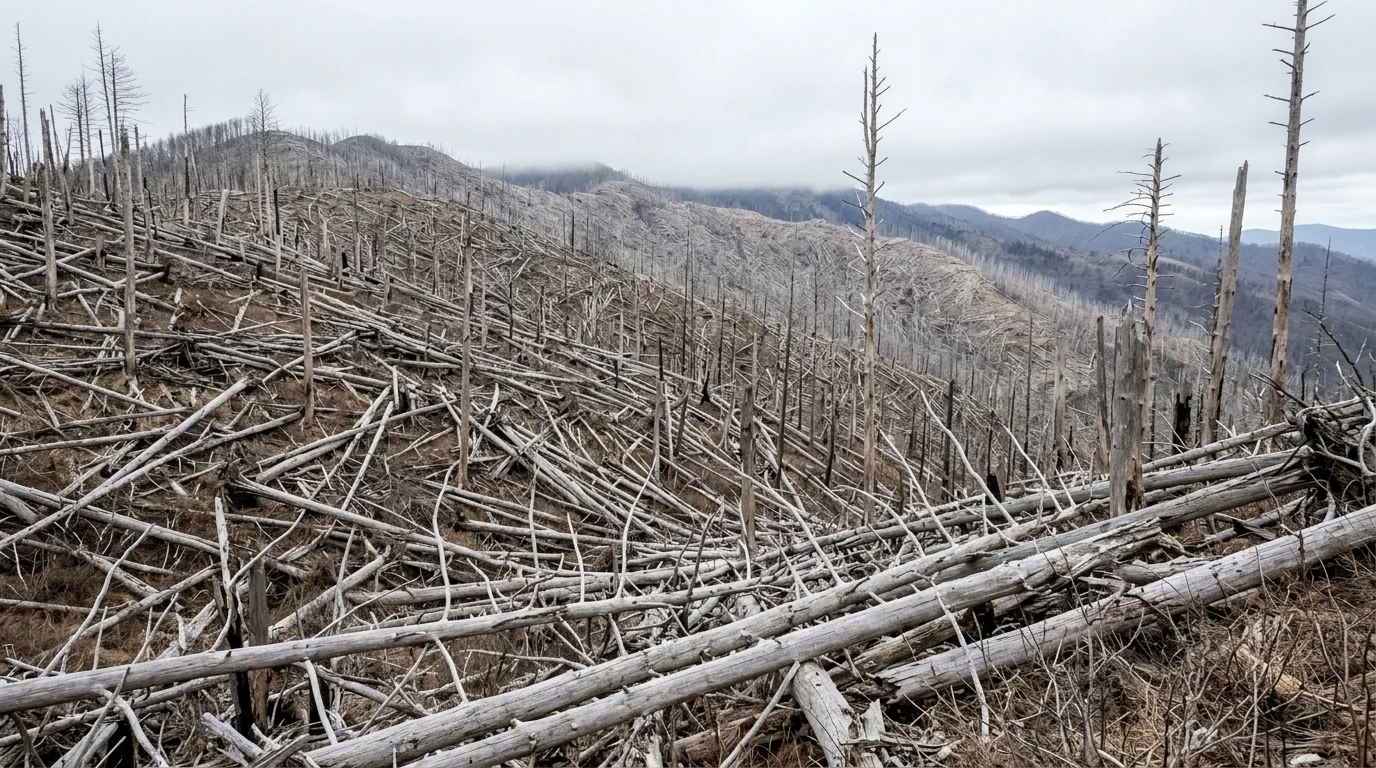
Helene made landfall in September 2024. What it left behind in the mountains of western North Carolina was not just flood damage but a slow-motion accelerant: an estimated 800,000 to 822,000 acres of damaged or killed timber, roughly 78% of it on private land. Dead trees don't burn the week they fall. They cure. And as N.C. Forest Service public information officer Philip Jackson told WLOS, that cured-wood fire environment could persist for 'ten, if not 20 years.' The federal government has spent most of the past two years moving at the speed of bureaucracy. The GNA agreement is the first financial commitment scaled to match what Jackson and his colleagues have been warning about since the storm passed.
The Good Neighbor Authority is a congressional mechanism, authorized in 2001 and expanded in the 2018 Farm Bill, that lets the Forest Service contract state forestry agencies as operational partners on National Forest System lands. What makes the North Carolina version unusual is its geographic reach: the agreement explicitly authorizes hazardous-fuel work on adjacent private lands in Helene-declared disaster counties, an extension of the federal tool well beyond its typical national-forest boundary. That matters because the blowdown is overwhelmingly private. Pisgah and Nantahala can be cleared if the surrounding ridgelines are still stacked with dead timber, and fire does not stop at a property line.
The 10-year term, running through 2036, is itself a policy signal. The Forest Service is not treating this as an emergency cleanup job with a fiscal-year deadline. According to the N.C. Department of Agriculture and Consumer Services, the agreement will fund fuel-break construction, prescribed fire, debris clearing, and landscape recovery across the two national forests and the counties around them, with the N.C. Forest Service serving as the on-the-ground implementing agency.
The GNA is the largest piece of the current funding surge, but it is not operating alone. The N.C. Forest Service launched a separate Disaster Mitigation Program in June 2026, offering no-cost wildfire-risk treatments to private and public landowners across all 39 federally declared Helene-disaster counties. That program's funding source, whether state appropriation, FEMA Hazard Mitigation Grant Program dollars, or another mechanism, has not been publicly confirmed, and it is a distinct program from the GNA. Governor Josh Stein has simultaneously requested $17 million in state wildfire-mitigation aid, a budget ask that is not yet enacted. Three tracks, three funding streams, the same physical objective: get dead wood out of the wildland-urban interface before it burns.
The urgency is not theoretical. As of the N.C. Forest Service situation report dated September 8, 2026, the state had recorded 5,846 wildfires and 16,468 acres burned year-to-date, already approaching a typical full-year total of roughly 4,500 fires. Fires in the blowdown zones have reached hundreds of acres on events that would historically have been held under 50, because the ladder fuels created by downed timber let ground fire climb into the canopy. In March 2026, the state issued a statewide burn ban; in April, the U.S. Forest Service extended fire restrictions to all four North Carolina national forests. Governor Stein toured a fuel-break project near Weaverville in Buncombe County this year and noted that storm-killed trees take 20 years to fully degrade.
For the roughly 500,000 people who live in western North Carolina's wildland-urban interface, where homes and farms sit at the edge of Pisgah and Nantahala land, the practical effect of the GNA is that crews can now legally work and be paid to remove hazardous fuel on private property that borders or is near national forestland. That has not historically been part of what a federal forestry agreement can do in North Carolina.
The next signal to watch is how quickly the N.C. Forest Service can stand up the operational capacity to spend $64.5 million over a decade while simultaneously managing an already-elevated fire season. The agreement authorizes the spending; the hiring, equipment procurement, and landowner outreach to mobilize 822,000 acres of scattered private timberland is the harder problem. Whether Governor Stein's $17 million state request clears the legislature, and whether the Disaster Mitigation Program can reach the most isolated private parcels in the 39 disaster counties, will determine how much of the fuse actually gets cut before the next dry spring.