Seventeen opioid-response solicitations appeared in DC's procurement feed in a single 30-day window this fall, six times the monthly baseline of roughly 2.7. The number looks like a policy mobilization. It is not. Sixteen of those 17 postings originate from one institution: the DOJ Office of Justice Programs, which is headquartered in Washington and registers its federal solicitations to a DC address. The city's local government is not the buyer here. The federal government is essentially procuring from itself.
The October spike reflects BJA's annual release of its FY2026 Notices of Funding Opportunity. The BJA Comprehensive Opioid, Stimulant, and Substance Use Program, known as COSSUP, anchors the batch. The site-based awards carry a minimum of $7 million each and target state and local law enforcement, courts, and reentry programs. A separate COSSUP Training and Technical Assistance cooperative agreement, worth up to $2 million, funds providers who serve COSSUP grantees nationally. OJJDP added two youth-focused opioid solicitations to the pile. Many of these NOFOs were then reposted as updated versions, which is why a batch of roughly a dozen distinct programs registered as more than 20 entries in a single month.
These are three distinct programs with different authorizing statutes, different eligible applicants, and different purposes. COSSUP is a justice-system program: it funds law enforcement, treatment courts, and reentry, not clinical care. SAMHSA's State Opioid Response grants, authorized under the 21st Century Cures Act, fund treatment, harm reduction, and medication-assisted recovery through state behavioral health agencies. The OJJDP youth grants fund community mentoring for young people affected by family opioid use. The fact that all three cycles landed in DC's feed in the same window is a quirk of federal geography, not a coordinated local initiative.
Source: NationGraph.
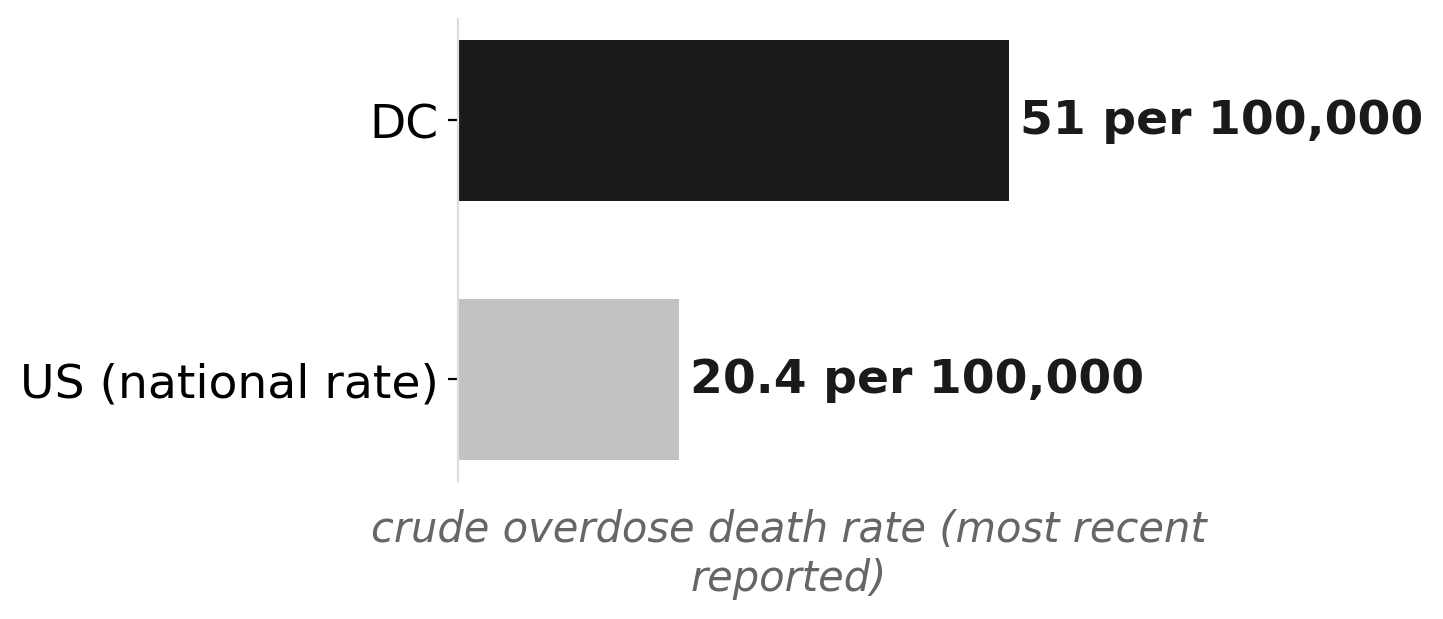
What makes the data artifact worth examining is the backdrop behind it. DC has the highest crude overdose death rate of all 51 US jurisdictions: 51.0 per 100,000, roughly two and a half times the national average. That figure comes after a 44.3 percent decline from DC's 2023 peak, meaning the current rate still leads the country at what is already a historic low for the city. Fentanyl is involved in approximately 94 percent of DC opioid overdose cases. Nationally, CDC provisional data shows a 12.1 percent decline in overdose deaths for the year ending February 2026, suggesting a possible turning point, but DC's position at the top of the mortality ranking has not changed.
Against that backdrop, the more consequential number in DC's opioid data may not be the RFP count. It is the spending pace on funds already obligated. DC's Department of Behavioral Health holds an active $76.2 million SAMHSA Opioid STR grant, running from September 2024 through September 2027. As of the most recent data, $15.1 million has been outlayed, roughly 20 percent of the total with one of three grant years complete. Across all active HHS opioid-related grants to DC institutions, $103.5 million has been obligated and $29.1 million spent. The gap between obligation and outlay is not automatically a problem: state behavioral health agencies routinely spend on a lagged cycle, and three-year grants are designed to allow ramp-up time. But in a city with the worst overdose rate in the country, the question of whether money is reaching people is at least as important as whether money has been awarded.
In September 2025, SAMHSA disbursed $25.2 million to DC's Department of Behavioral Health as part of the FY2025 State Opioid Response continuation round, which totaled $1.48 billion nationally. DC has also qualified for SAMHSA's set-aside pool for the 25 highest overdose-mortality jurisdictions, which provides a 15 percent bonus on top of base formula allocations. The funding infrastructure around DC's opioid crisis is substantial. The annual federal solicitation batch that caused October's RFP spike is part of that same infrastructure.
What changes the picture going forward is the national trend. A 12 percent year-over-year decline in overdose deaths nationally gives Congress and federal agencies a potential rationale for normalizing emergency-level investment. That would intensify competition for COSSUP site-based awards and future SOR cycles, particularly for jurisdictions that have seen the steepest improvements. DC's persistent position at the top of the mortality table may work in its favor in that competition, but it also means the pressure to demonstrate that existing funds are being spent effectively is growing.
The next concrete signal to watch is the outlay trajectory on DC's $76.2 million Opioid STR grant as it moves into its second year, and whether the FY2026 COSSUP site-based awards, with their September 2026 deadline now passed, include any DC-based service providers among the recipients.