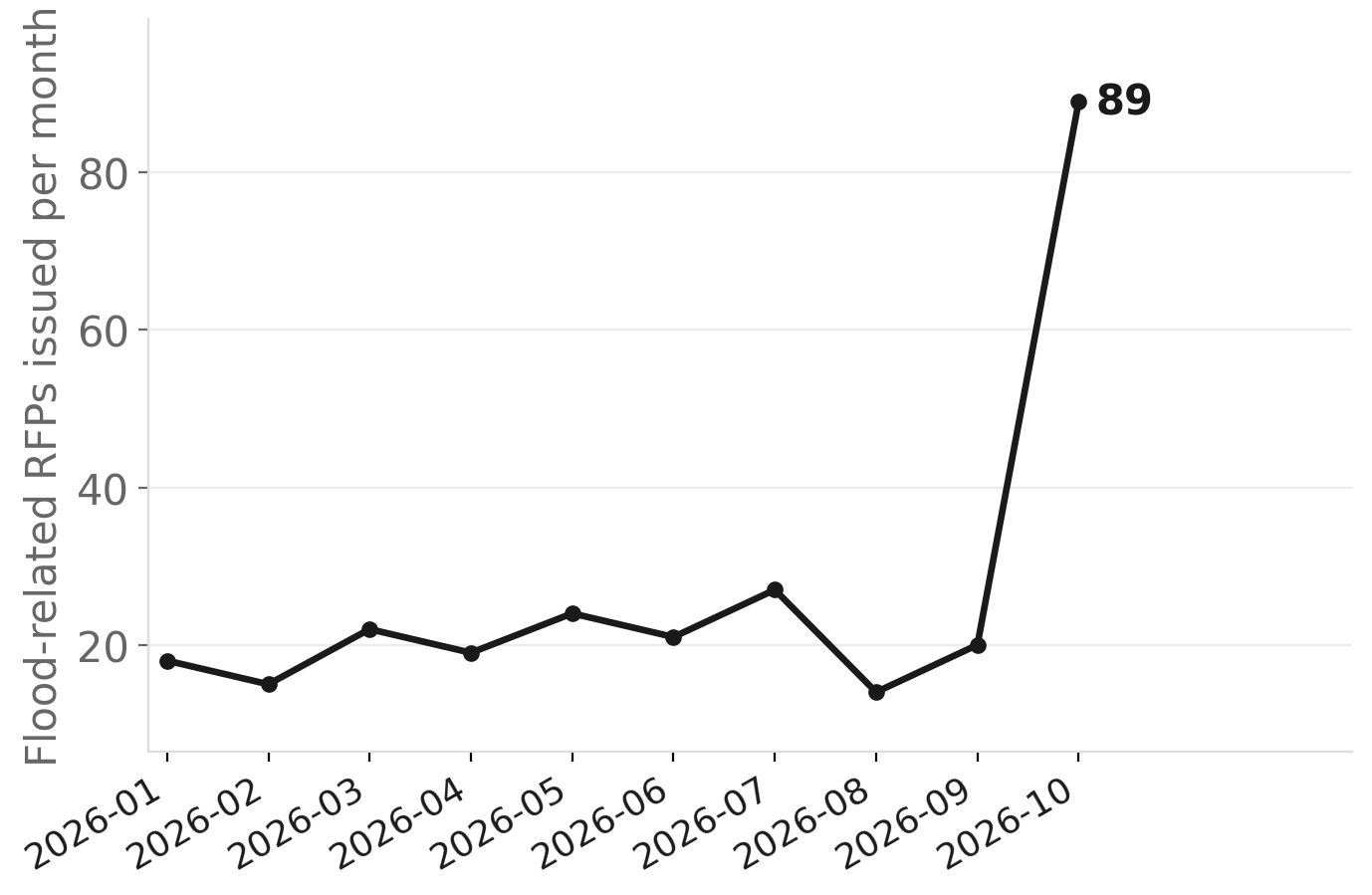
California agencies issued 96 flood-control RFPs in the last 30 days, 4.2 times the 12-month monthly average of roughly 23, the highest sustained monthly volume in the state's procurement record. No major storm triggered this. No federal disaster declaration created a sudden infusion of emergency money. The surge is happening because a deadline is approaching, and local flood agencies that haven't commissioned their technical groundwork will be shut out of hundreds of millions in competitive state grants.
The driver is California Proposition 4, the $10 billion climate bond that voters approved in November 2024. The 2026-27 state budget directs $276.8 million of that money specifically to flood control and levee improvements, spread across four distinct programs administered by two different state agencies. Two of those programs are opening competitive solicitations this fall: the State Water Resources Control Board's Stormwater Grant Program, with roughly $101.5 million available (draft guidelines released July 21, 2026, per SWRCB program materials), and DWR's Watershed Resilience Program, with roughly $152 million available across two solicitations, which held public comment workshops in October 2026. DWR's own timeline puts grant awards in 2027-28, meaning the application window agencies are preparing for right now is the decisive one.
To compete, local agencies need something they mostly don't have yet: completed flood risk studies, hydrology analyses, channel and levee engineering designs, and stormwater modeling documentation. Those are exactly the services being procured. The RFPs pouring out of California right now are for flood risk reduction studies, on-call hydrology and stormwater consulting, channel redesign, and levee and debris-basin engineering, not for construction. Agencies are buying the paperwork that lets them apply.
Source: NationGraph.
The procurement is notably concentrated in a handful of jurisdictions. The City and County of San Rafael leads all issuers with 12 RFPs in the period, anchored by a major San Rafael Canal watershed flood-risk-reduction study. Santa Clara Valley Water District follows with 9, covering the Sunnyvale East and West Channels flood protection project and Coyote Creek flood protection work. Orange County Public Works has issued 5. A cluster of Bay Area flood districts in Marin, Alameda, and San Mateo counties account for 3 each. The geographic concentration in the Bay Area is not coincidental: communities from San Rafael to the South Bay have absorbed repeated atmospheric river flooding in recent years, and they sit within striking distance of the SWRCB's Stormwater Grant Program, which targets urban multibenefit flood-and-water-quality projects.
The Prop 4 programs are distinct enough that agencies need to track each separately. The Stormwater Grant Program (SWRCB) and the Watershed Resilience Program (DWR) serve different scopes, eligible applicants, and project types, even though both draw from the same bond bill. DWR also administers the Flood Control Subventions Program ($148.9 million total bond allocation), which targets local agencies partnering with the Army Corps of Engineers on federally authorized projects, and the State Plan of Flood Control Projects ($250 million total), which covers levee repair, bypass rehabilitation, and small-communities flood risk reduction in the Central Valley. An agency in Sacramento County preparing a levee rehabilitation application and a city engineer in San Rafael preparing an urban stormwater study are both responding to Prop 4, but they are navigating separate programs, separate guidelines, and separate agency review processes. The LAO's February 2026 Prop 4 spending plan analysis describes each program's structure and the administration challenges that come with running multiple competitive solicitations simultaneously.
The scale of the procurement surge carries a structural explanation beyond any single agency's urgency. California's flood control system is not a single bureaucracy. The Sacramento-San Joaquin Delta alone involves dozens of reclamation districts, county agencies, and special flood-control districts, each with independent procurement authority. When a competitive grant program opens, dozens of agencies file RFPs simultaneously rather than one consolidated procurement flowing through a state office. That multiplication effect is why California, not Florida or Texas, leads all states in flood-control RFP volume right now despite having no hurricane season exposure: California has 96 RFPs to Texas's 93 and Florida's 86, an inversion of the historical baseline.
For the engineers, hydrologists, and consultants who service this market, the capacity question is the one to watch. A 4x surge in procurement volume concentrated in a 30-to-60-day window means firms are being solicited simultaneously by multiple agencies with overlapping scopes. Agencies that move slowly on selection risk losing qualified consultants to competitors before their own contracts are executed.
The next signal is the SWRCB's formal solicitation release for the Stormwater Grant Program, expected before year-end 2026. When that document drops with final scoring criteria and eligibility rules, the agencies that have completed studies in hand will be positioned to apply immediately. Those still awaiting consultant deliverables will be filing for extensions or sitting out the first round entirely.