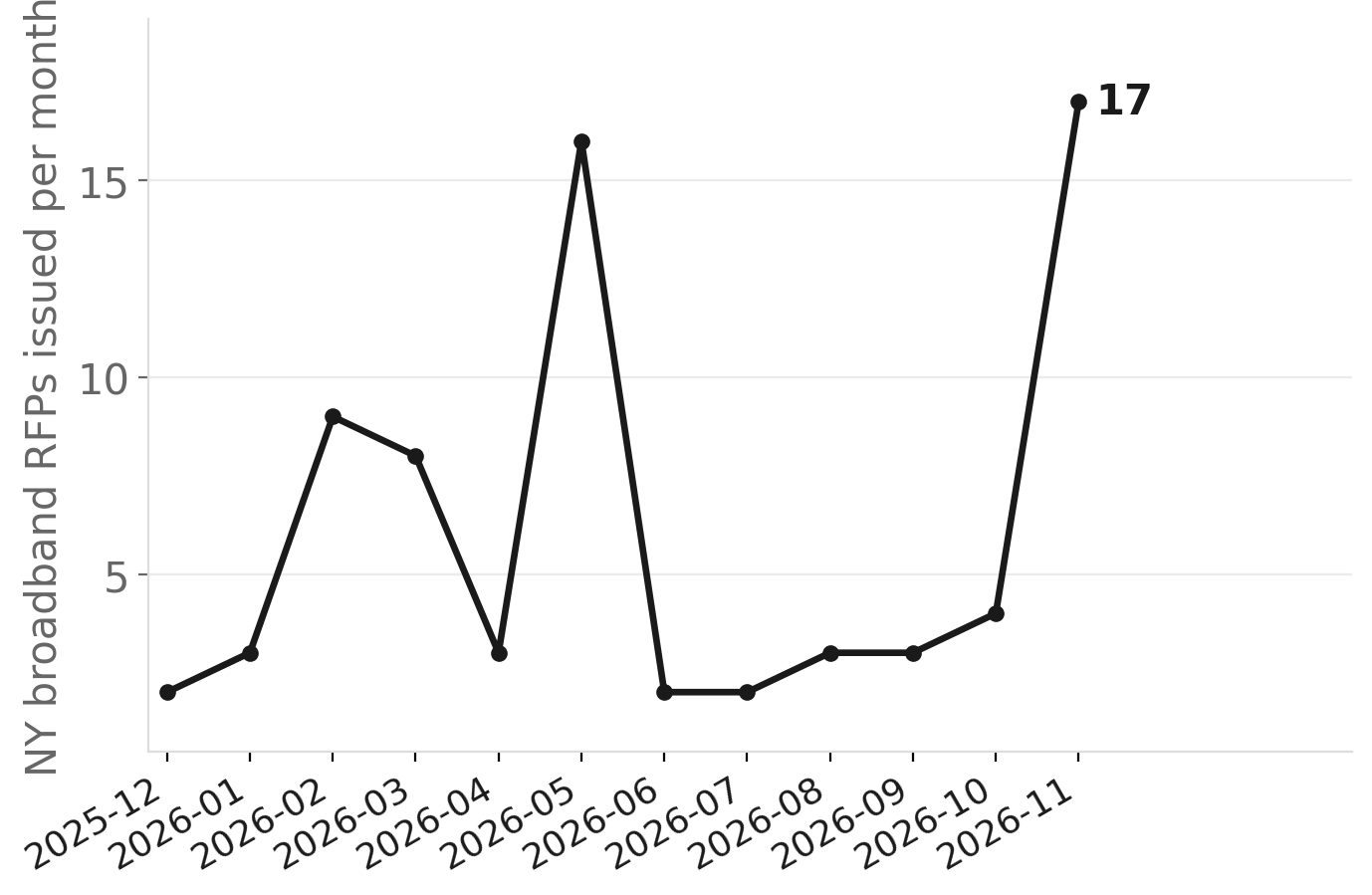
New York issued 17 broadband construction RFPs in the trailing 30 days through mid-November 2026, against a 12-month monthly average of roughly 3.4, a fivefold surge that puts the state in the same procurement tier as Texas and behind only California among large states in the same window.
The number is not the product of a single announcement. It reflects two structurally distinct programs reaching their mandatory construction-execution phases at the same time, producing a combined wave of procurement activity that is showing up as a leading indicator before it shows up in fiber miles or connected households.
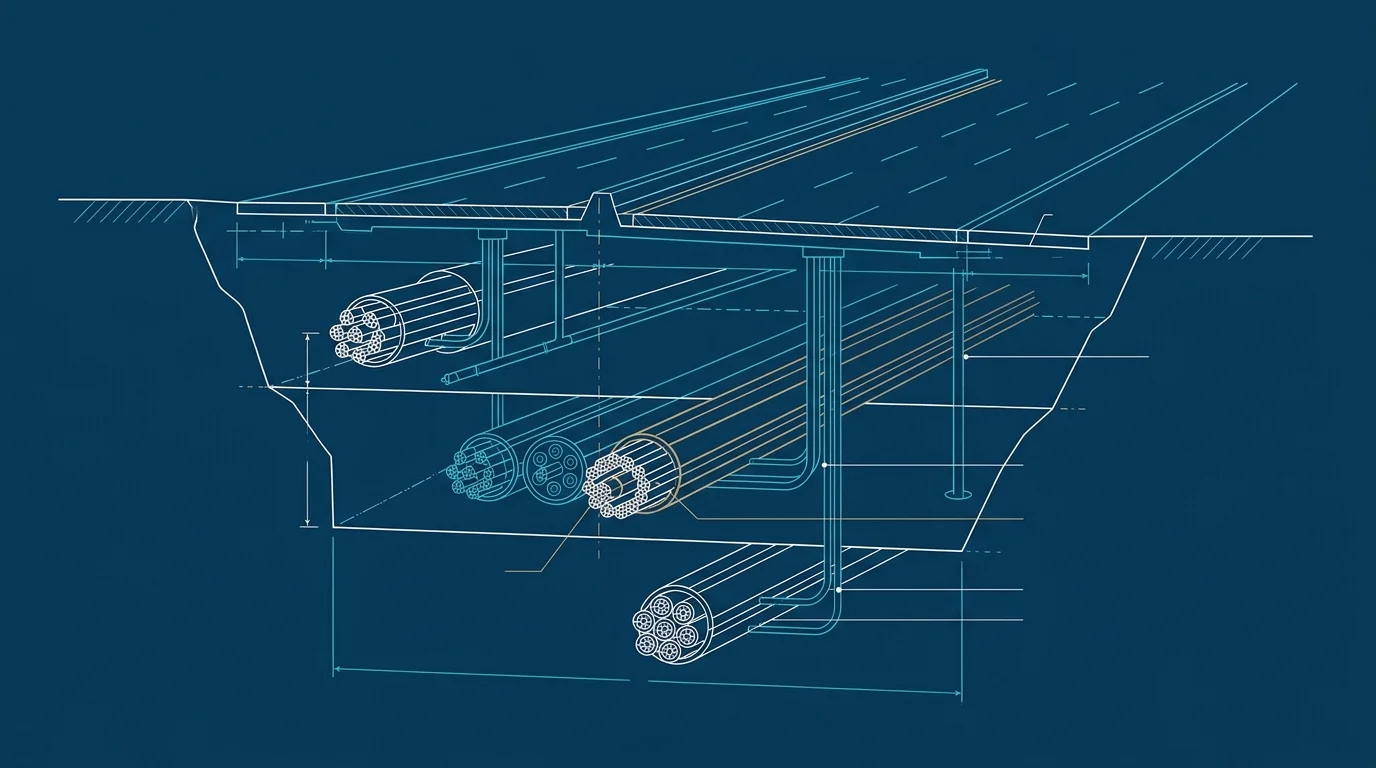
The first program is the state-owned Excelsior Broadband Network, Governor Hochul's 2025 State of the State initiative, which Empire State Development is now translating into active construction bids. EBN is a 426-mile public fiber backbone that will run along the New York Thruway from New York City to Buffalo, serving as middle-mile infrastructure for the upstate communities along its path. Empire State Development accounted for six of the 17 RFPs in the window, soliciting fiber construction services segment by segment through Montgomery County and westward. EBN is funded as a separate state appropriation, not federal money, and Empire State Development administers it independently.
Source: NationGraph.
The second program runs on a different mechanism and a different funding source. ConnectALL, the state's broadband office, received NTIA approval of New York's BEAD Final Proposal in early 2026, unlocking $287.2 million in federal Broadband Equity, Access, and Deployment grants. Those grants flow as subgrants to nine private internet service providers, with $248 million in private matching funds, for a $542 million total plan covering 58,617 unserved and underserved locations. BEAD program rules require projects to commence in 2026, and that deadline is now live.
Running alongside BEAD is the ConnectALL Municipal Infrastructure Program, a separate instrument funded through US Treasury Capital Projects Fund dollars. MIP is not the same as BEAD: where BEAD money goes to private ISP subgrantees, MIP funds county and municipal governments directly to build open-access, publicly controlled broadband networks. A new $36 million MIP round opened in January 2026 with applications closing April 30 and a December 31, 2026 completion requirement. That hard year-end deadline is bearing down, and it explains the county-level procurement surge visible in the RFP data. Cumulatively, MIP has already disbursed more than $268 million to 24 counties, with more than 2,300 miles of new fiber and 68 wireless hubs already underway.
The rural upstate counties appearing most frequently in the recent RFP filings, Schoharie, Livingston, Madison, Cortland, Saratoga, are precisely the communities the EBN Thruway backbone is designed to reach. That geography is not a coincidence. The architecture being built here is layered: state-owned middle-mile fiber on the Thruway corridor, feeding into open-access county networks built with MIP dollars, which then connect end users who would be served by BEAD-funded ISPs. All three programs are operationally complementary, administered through ConnectALL, but funded and governed by entirely different authorities.
This dual-track public architecture, a state backbone paired with decentralized county networks, is relatively uncommon nationally and is being watched as a potential model by other states navigating the same tension between BEAD's ISP-subgrant structure and the appetite for public infrastructure ownership at the local level, a model that community broadband advocates have highlighted as New York expands its municipal investment.
The procurement cadence itself is worth noting. November is not the first spike. The time series shows prior surges in May 2026 (16 RFPs) and February and March 2026 (9 and 8, respectively), suggesting a rolling bid cadence tied to program milestones rather than a single construction season. That pattern implies the pipeline will stay elevated: EBN still has remaining Thruway segments to bid out, BEAD subgrantees face active commencement requirements, and counties with MIP awards must move from procurement to construction before December 31.
For residents in Schoharie County or along the Livingston County fiber corridors, the RFP filings represent the last administrative step before construction crews arrive. For state officials, the procurement surge is the clearest signal yet that New York's broadband investment, years in the planning, has cleared the threshold from commitment to execution.
The next signal to watch is whether the December 31 MIP completion deadline holds. If late-cycle counties request extensions, the Q1 2027 RFP volume will tell the story.