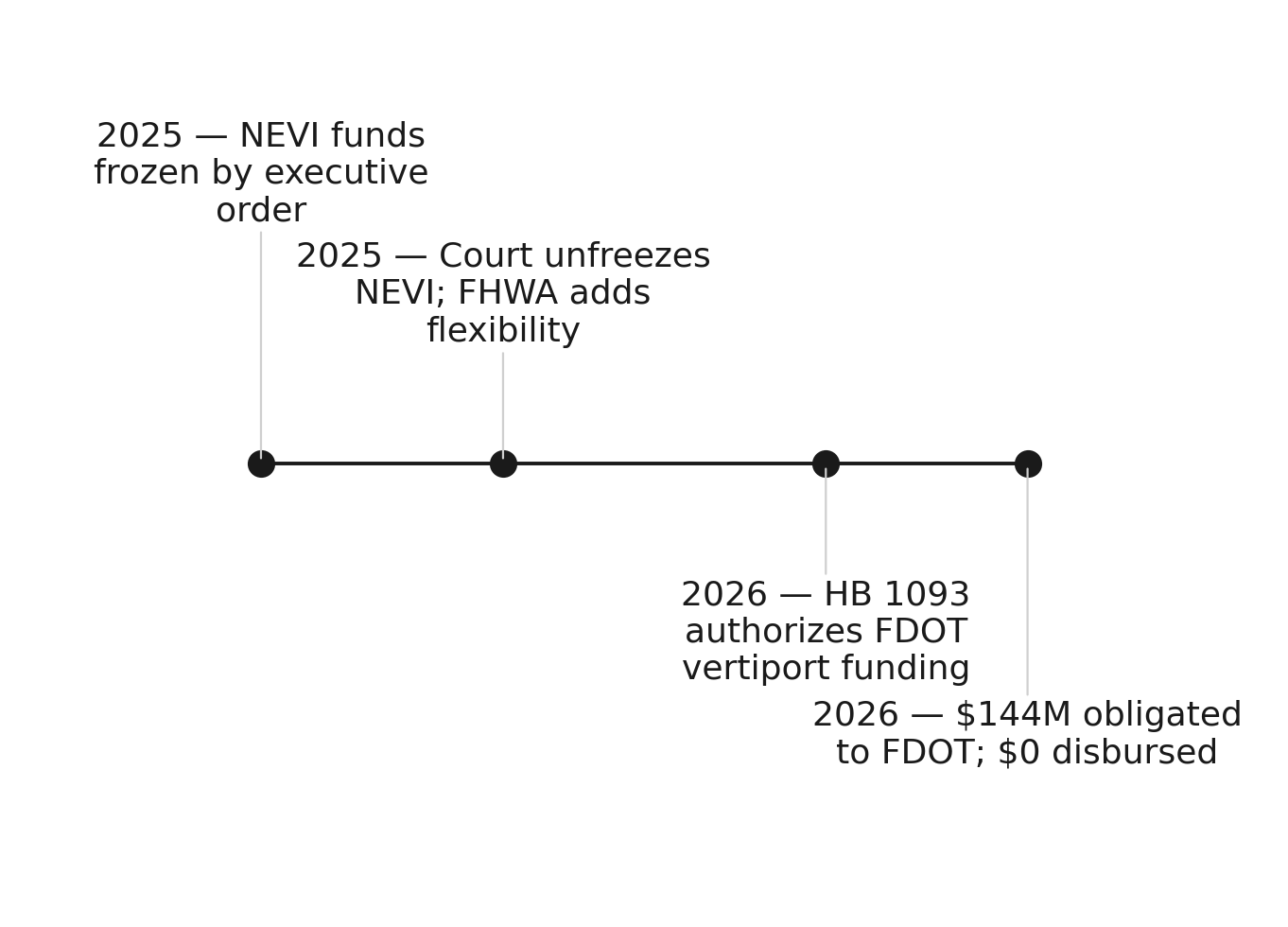
The federal government obligated $144 million in EV charging grants to the Florida Department of Transportation in a single day, September 23, 2026, the largest single-batch EV infrastructure award Florida has ever received. Not one dollar has been spent. FDOT is waiting for permission to use it on something else entirely: landing pads for flying taxis.
That collision is the story behind Florida's 90-day EV grant total of $145.4 million, the highest of any state in the country right now, ahead of New York's $106 million and California's $81 million. The surge is almost entirely one transaction: ten grants from the NEVI Formula Program, all obligated on the same day, all listed with zero outlays. The federal pipeline filled Florida's account; the state hasn't touched the faucet.
The reason traces back to a sequence of federal and state moves over the past eighteen months. NEVI funds were frozen in February 2025 under an executive order review, then unfrozen after a federal court order. FHWA issued revised NEVI guidance in August 2025 that gave states greater flexibility in how they deploy formula funds, particularly in states where major interstate EV corridors are already fully built out. FHWA has confirmed that Florida's primary interstate charging corridors meet that threshold. That confirmation is the legal opening FDOT has been working with.
Source: NationGraph.
On April 20, 2026, Governor DeSantis signed HB 1093, the Advanced Air Mobility Competitiveness and Infrastructure Act, which authorized FDOT to fund up to 100 percent of vertiport construction costs using state or available federal dollars. The law names Joby Aviation and Archer Aviation as state partners and targets a December 2026 commercial air-taxi launch. HB 1093 does not redirect NEVI funds on its own. It creates the state legal framework FDOT is now using to argue that eVTOL charging infrastructure qualifies under NEVI's expanded flexibility provisions for fully-built-out corridor states. The two laws do not share an automatic mechanism; FHWA approval is the missing piece, and it has not arrived.
What FDOT is actually proposing came into public view on July 29, 2026, when the Miami Herald published the results of a FOIA request revealing an updated FDOT plan to redirect Florida's entire remaining NEVI allocation, roughly $153.4 million after a $44.6 million congressional rescission reduced the original $198 million figure, toward 32 eVTOL vertiports. The TechCrunch writeup of that investigation noted proposed vertiport sites that include golf courses, luxury apartment complexes, and military bases. The Southern Alliance for Clean Energy has called on FHWA to deny the redirect, arguing NEVI funds are legally obligated for on-road EV charging and that repurposing them sets a damaging national precedent.
The tension is sharper given where Florida sits in the EV market. The state has the second-highest EV registration count in the nation, and nearly one in ten new cars sold there is electric, well above the national average. Yet Florida has deployed almost none of its NEVI funds to date and has fewer public chargers per registered EV than the national average, according to data tracked by the Electrification Coalition. The state is simultaneously one of the country's largest EV markets and one of its least-served by the federal program designed to build out charging access.
For Florida EV drivers, what's next depends entirely on FHWA's decision. If the agency approves the redirect, the $144 million obligated in September goes toward vertiport infrastructure serving a commercial air-taxi market that, by FDOT's own timeline, won't be operational until late 2026 at the earliest and may serve a very narrow slice of the traveling public for years after that. If FHWA denies the redirect, FDOT would need to submit a revised deployment plan and begin moving money toward the on-road charging network the program was designed to fund, in a state that demonstrably needs it.
The federal agency has not set a public deadline for its ruling. Planetizen's coverage of the proposal noted that advocates and some transportation researchers view FHWA's response as a test case for how much flexibility states can actually extract from NEVI's revised guidance, and whether eVTOL infrastructure can be made to fit a statute written for cars on highways.
The $144 million is obligated. The clock on the grants runs through 2032. What that money builds, and for whom, is an open question sitting in a federal inbox.