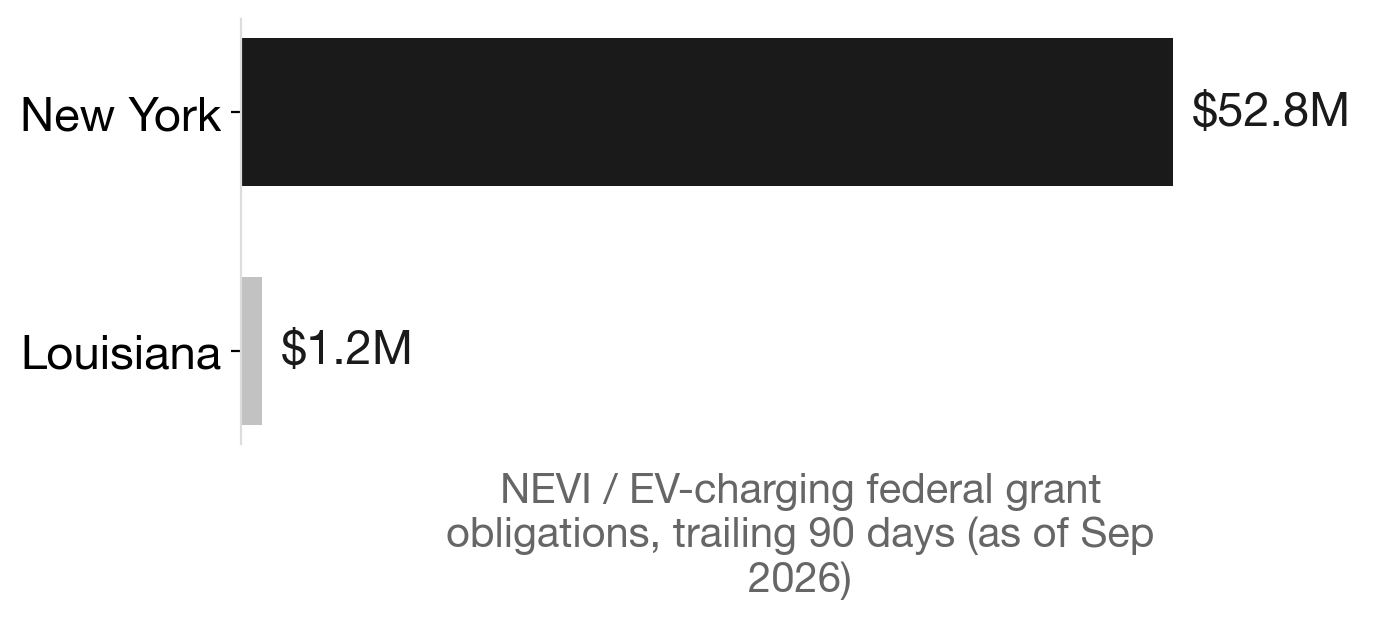
On August 24, 2026, the New York State Department of Transportation obligated $52.8 million in federal EV charging funds in a single batch, eight identical $6.6 million NEVI formula grants, all on the same date, all running through 2036. In the trailing 90-day national window, that one-day burst accounts for roughly 94 percent of all federal EV-charging obligations in the country. The next closest state, Louisiana, logged $1.2 million.
The number is striking. The story behind it is more so.
New York did not accelerate because its EV ambitions suddenly intensified. It moved because two clocks ran out at roughly the same time. FY2026 is the final year of NEVI's five-year authorization under the 2021 Infrastructure Investment and Jobs Act, and FHWA has apportioned $885 million nationally for this last round. Simultaneously, a pending congressional appropriations bill would rescind $879 million in unspent NEVI balances nationally, meaning any state that does not obligate its allocation before the fiscal year closes risks losing it permanently. For New York, with a total five-year NEVI allocation of roughly $175 million, the math on delay was straightforward.
Source: NationGraph.
The more complicated piece is why there was so much to obligate at once. The Trump administration's February 2025 executive order froze NEVI formula funds across all states, halting obligations that had been moving steadily since 2022. Seventeen states, led by Washington Attorney General Bob Ferguson, sued to restore the funds. A preliminary injunction followed in June 2025. Then, on January 23, 2026, Judge Tana Lin of the Western District of Washington issued a final summary judgment, ruling that the administration had acted outside the law. FHWA followed with new interim guidance in August 2025 that also relaxed the program's 50-mile spacing rule and expanded eligible site types. NYSDOT's updated EV Infrastructure Deployment Plan received FHWA approval in September 2025. By the time the procedural runway was fully clear, an 18-month backlog of obligations was waiting to move.
The August 24 batch processed all of it at once.
Within New York, the NEVI formula operates through two complementary channels drawing from the same federal pot. NYSDOT receives formula obligations directly from FHWA, the source of the $52.8 million finding. NYSERDA runs a parallel competitive solicitation, the AFC and Community NEVI DCFC Program (PON 6150), which launched in April 2026 with $45 million in NEVI dollars and sub-awards them to private infrastructure developers for fast-charging stations along Alternative Fuel Corridors and in underserved communities. Proposals closed June 23, 2026. These are not independent programs; NYSERDA is administering a portion of the same federal allocation that NYSDOT is obligating directly. Together they represent New York's full-stack approach to deploying the formula funds: state agency obligations for corridor buildout, competitive awards for community access.
New York has been among the more aggressive NEVI implementers from the start. It opened one of the first NEVI-funded charging stations in the nation in December 2023, through a partnership with the New York Power Authority. The state also has statutory pressure that most others lack: the Climate Leadership and Community Protection Act mandates an 85 percent greenhouse gas reduction by 2050 and requires all new passenger vehicles sold to be zero-emission by 2035. EV infrastructure is not optional policy for Albany, it is a legal obligation.
What the August 24 batch means in practice is a decade of federally backed fast-charging deployment locked in before either the program expires or Congress can claw the money back. The grants run through 2036, insulating them from near-term appropriations pressure once obligated. For drivers, that means the physical infrastructure, Level 3 DC fast chargers along designated corridors and, increasingly, at community sites, should continue expanding regardless of what happens to NEVI's successor programs at the federal level.
The remaining open question is whether the congressional rescission threat materializes. The $879 million figure targets unobligated balances nationally; New York's August 24 move, if it cleared obligation before any rescission takes effect, would put those dollars beyond reach of a clawback. Other states that moved more slowly, or that remain caught in their own procedural backlogs, may not be as protected. According to FHWA's interim guidance issued last August, states have latitude on site selection that they lacked under the original program rules, but latitude does not help if the funds are rescinded before the plans are filed.
The final NEVI apportionments are already made. The court judgment is final. What happens to the $879 million in unobligated funds elsewhere in the country depends on whether Congress acts before states can follow New York's example.