Homeless teenagers and young adults have been a visible presence in Seattle's University District for decades, and Washington State is now putting up to $400,000 toward a center designed to connect them to housing, services and support before they become permanently entangled in the adult homelessness system.
The Washington Department of Commerce is seeking an organization to develop and run the University District Doorway Project, a navigation and resource center for young people ages 13 to 26 who are experiencing or have experienced homelessness. A required partnership with the University of Washington is central to the plan, with the goal of building something sustainable rather than a stopgap.
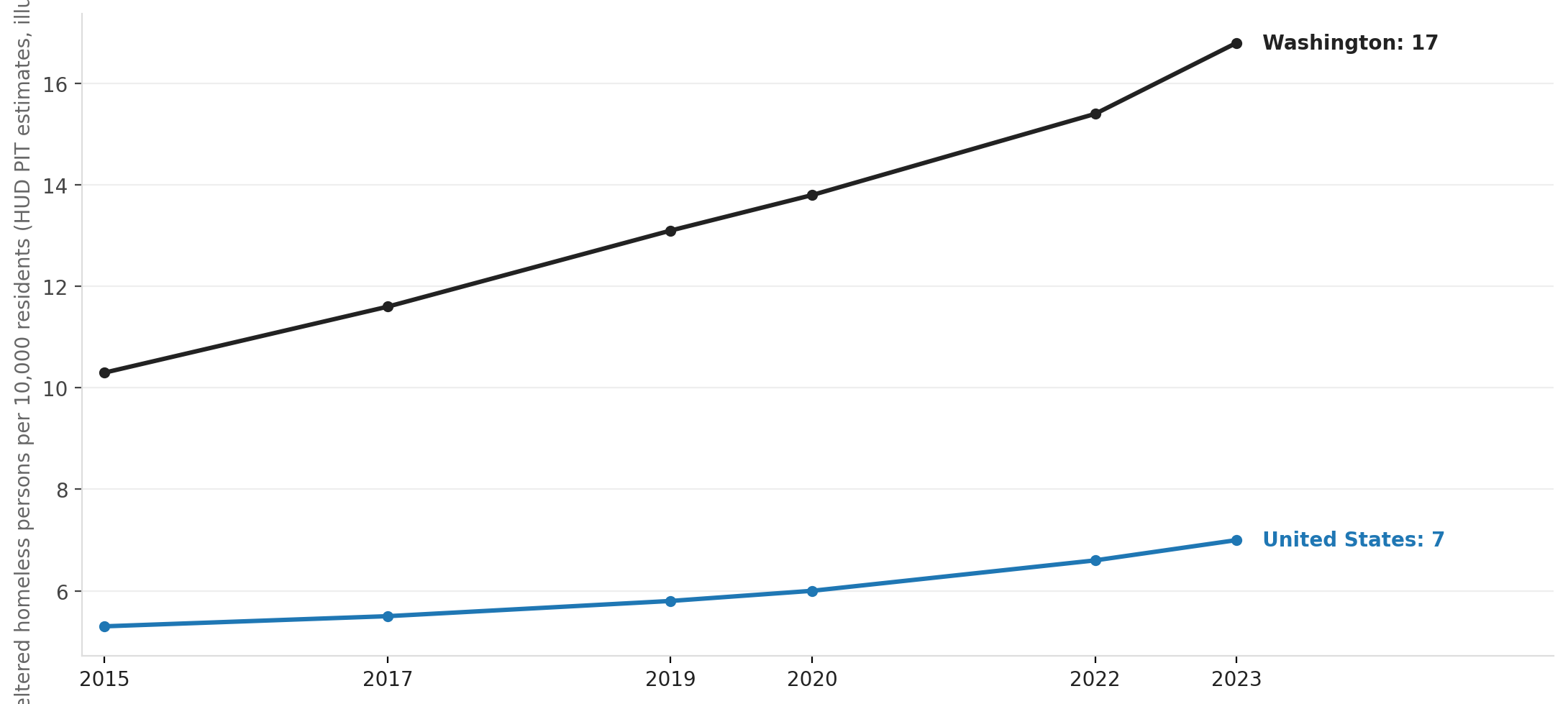
The stakes behind that modest dollar figure are significant. Washington ranks among the top five states for unsheltered homelessness, and the University District has drawn street-involved youth since the 1990s, pulled by the student population, proximity to existing services like ROOTS Young Adult Shelter and the transient energy of the neighborhood. On any given night, King County counts several hundred unaccompanied young people without stable housing, with many concentrated in the U District.
Source: NationGraph.
Research has long shown that youth homelessness is not just a present crisis but a predictor of adult homelessness: roughly 40% of homeless adults report their first experience of homelessness happened before age 25. Washington recognized this in 2015 when it created the Office of Homeless Youth within Commerce, and in 2018 set a goal that no young person leaving a public system would exit into homelessness. The state has consistently missed that goal.
The "Doorway" framing reflects a broader shift away from traditional shelters toward coordinated entry points where young people can get assessed and routed to whatever mix of services they need, whether that's housing placement, mental health care or job training. The project requires meaningful involvement from people with lived experience of homelessness in its design and operation.
The UW partnership adds an unusual dimension. The university is the neighborhood's dominant institution and largest landowner, and its rapid expansion amid the 2021 opening of the U District light rail station has intensified long-running tensions over who the neighborhood is for. Anchoring a youth services center to UW could bring resources like social work students and research capacity, while also putting the university's name and stake directly into the problem.
Commerce has not announced a timeline for selecting an operator, but once a contract is in place, the work of standing up a center in one of Seattle's most rapidly changing neighborhoods will begin.