
Idaho's Legislature voted in April to spend $30.95 million rebuilding a Medicaid mental health system it had finished dismantling four months earlier, and providers say the money may not be enough to undo the damage, because the workers who left are not coming back for a program that expires in 13 months.
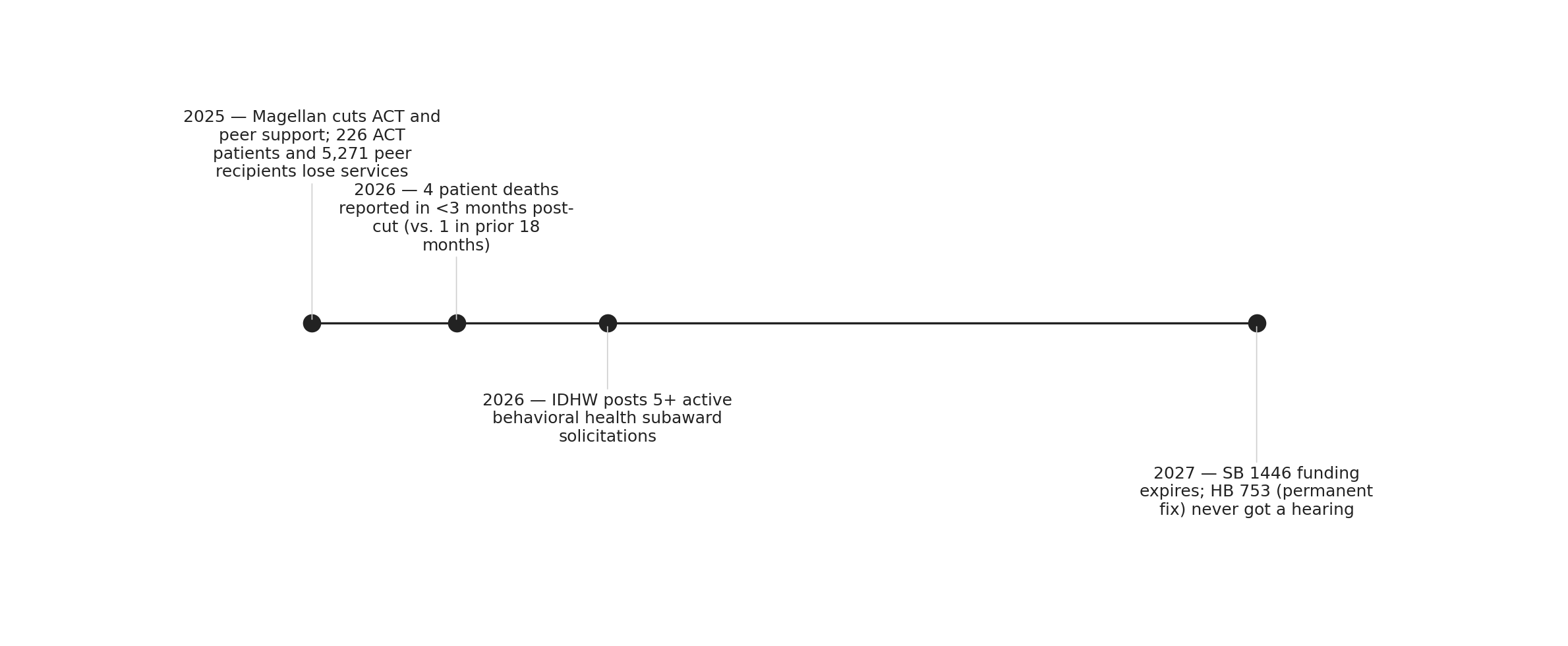
The arc of this crisis is unusually compressed. In late 2025, Governor Brad Little's budget-cut order directed Idaho's Medicaid contractor, Magellan, to slash reimbursement rates for community behavioral health services. The cuts took effect December 1, 2025, eliminating Assertive Community Treatment (ACT) mobile services and reducing peer support programs statewide. ACT teams, which deliver intensive wraparound care to people with serious mental illness in their homes and communities, serve some of the state's highest-acuity patients. When Magellan cut the rates, the small number of clinic operators running those teams, Mental Health Specialists in Chubbuck, Riverside Recovery in Lewiston, Access Behavioral Health Services, had to immediately lay off mobile treatment staff. There was no soft landing.
What followed was a mortality signal stark enough to force a legislative reversal. Providers counted four patient deaths in fewer than three months after the December cuts, compared to one death in the prior 18 months. Senator Kevin Cook (R-Idaho Falls) cited those figures on the Senate floor during debate on Senate Bill 1446. The bill passed with bipartisan support, and Governor Little signed it on April 2, 2026. The funding package draws from three sources: $4.6 million in tobacco settlement funds, $5.8 million from the opioid settlement fund, and $20.5 million in federal Medicaid match. The Idaho Department of Health and Welfare announced it would resume provider reimbursements the next day.
Source: NationGraph.
The problem is what SB 1446 does not do. It funds ACT and peer support only through the end of FY2027, June 30, 2027. A companion bill, House Bill 753, would have made the statutory reinstatement permanent, removing the annual appropriations gamble from the equation. HB 753 never received a committee hearing. What passed instead is a one-year bridge built from settlement windfalls and federal match, with no structural guarantee of what comes after.
For providers trying to rebuild ACT teams, that distinction is decisive. Sara Bennett of Riverside Recovery said staff are cautious about returning to a program that has no guarantee of existing past June of next year. Clinic owners estimated that even with reimbursements restored, onboarding and re-staffing would take roughly a month, and that assumed workers were still available and willing. Mobile mental health work requires specialized training, and many of the staff who were laid off in December have since found other positions or left the field.
The workforce problem is compounded by Idaho's baseline position. The entire land area of the state carries a federal Mental Health Health Professional Shortage Area designation from HRSA, every county, every rural corridor, every city. Idaho was never flush with behavioral health providers. The ACT system that existed before December 2025 was thin by design, relying on a handful of community operators spread across a large, rural state. Rebuilding it quickly was always going to be structurally difficult; rebuilding it when potential hires have reason to doubt the program's durability is harder still.
The state does have other funding streams running in parallel. Idaho currently holds 43 active federal grants with a mental health mandate totaling $62.7 million in obligated funds, including a $5.88 million SAMHSA Community Mental Health Block Grant running through September 2026 and a $3.75 million SAMHSA grant to the State Office of Drug Policy extending through 2028. A separate $930 million CMS Rural Health Transformation Program award, announced December 30, 2025, is directed by IDHW and includes explicit mental health crisis team funding, with contracts beginning to execute in the first half of 2026. The IDHW behavioral health funding opportunities page listed five or more active subaward solicitations as of late May, covering Recovery Support, Maternal Wraparound, and Traveling OBOT programs, a sign that the system is actively re-soliciting providers across multiple program lines.
Those parallel investments matter, but they do not solve the ACT workforce clock. The 226 patients who were receiving ACT services at the time of the December cuts and the 5,271 peer support recipients who lost access need consistent, relationship-based care, the kind that erodes when staff turn over or programs dissolve. A one-year funding window is precisely the kind of uncertainty that drives turnover.
The signal to watch is the 2027 legislative session. If IDHW and providers can demonstrate measurable re-enrollment and stable staffing by late 2026, there is a political case for converting SB 1446's bridge into something permanent. If the workforce does not reconstitute, or if another budget pressure triggers a second round of Magellan rate reductions, the $31 million will have bought Idaho less than a year of the system it already had.