New York public agencies have issued 11 EV charging RFPs in the last 30 days, more than three times the trailing monthly average of 3.2, and the force compressing that timeline into a single sprint is not ambition but arithmetic: a $45 million NYSERDA solicitation closes June 23, and the federal program that backstops much of the state's broader charging buildout may not survive the summer intact.
The agencies signing those RFPs span nearly every level of government. NYSERDA and the Office of General Services are moving at the state level, alongside the Department of Agriculture and Markets and the NYS Insurance Fund. At the municipal level, Kingston, New Rochelle, and Yonkers Public Schools have all entered the market within the same 30-day window. That breadth matters: this is not one agency responding to a single grant announcement. It is a cascade, triggered from the top but landing across the system simultaneously.
The proximate trigger is NYSERDA's April 2026 launch of PON 6150, the AFC and Community NEVI DC Fast Charging Program, which put $45 million on the table for public DC fast chargers with a hard proposal deadline of June 23. Local agencies that want a piece of that funding have roughly six weeks from the announcement to complete site assessments, draft specifications, select vendors, and submit. That sequence is exactly what the RFP volume reflects. A second accelerant arrived earlier: NYSERDA expanded its Charge Ready NY 2.0 rebate program to $28 million in February 2026, up from its original $13 million base, refreshing a pool of Level 2 incentive dollars that municipal fleets and school districts can draw on without competing in a formal solicitation. Taken together, the two programs put roughly $73 million in new state EV incentive capacity into play in a single quarter.
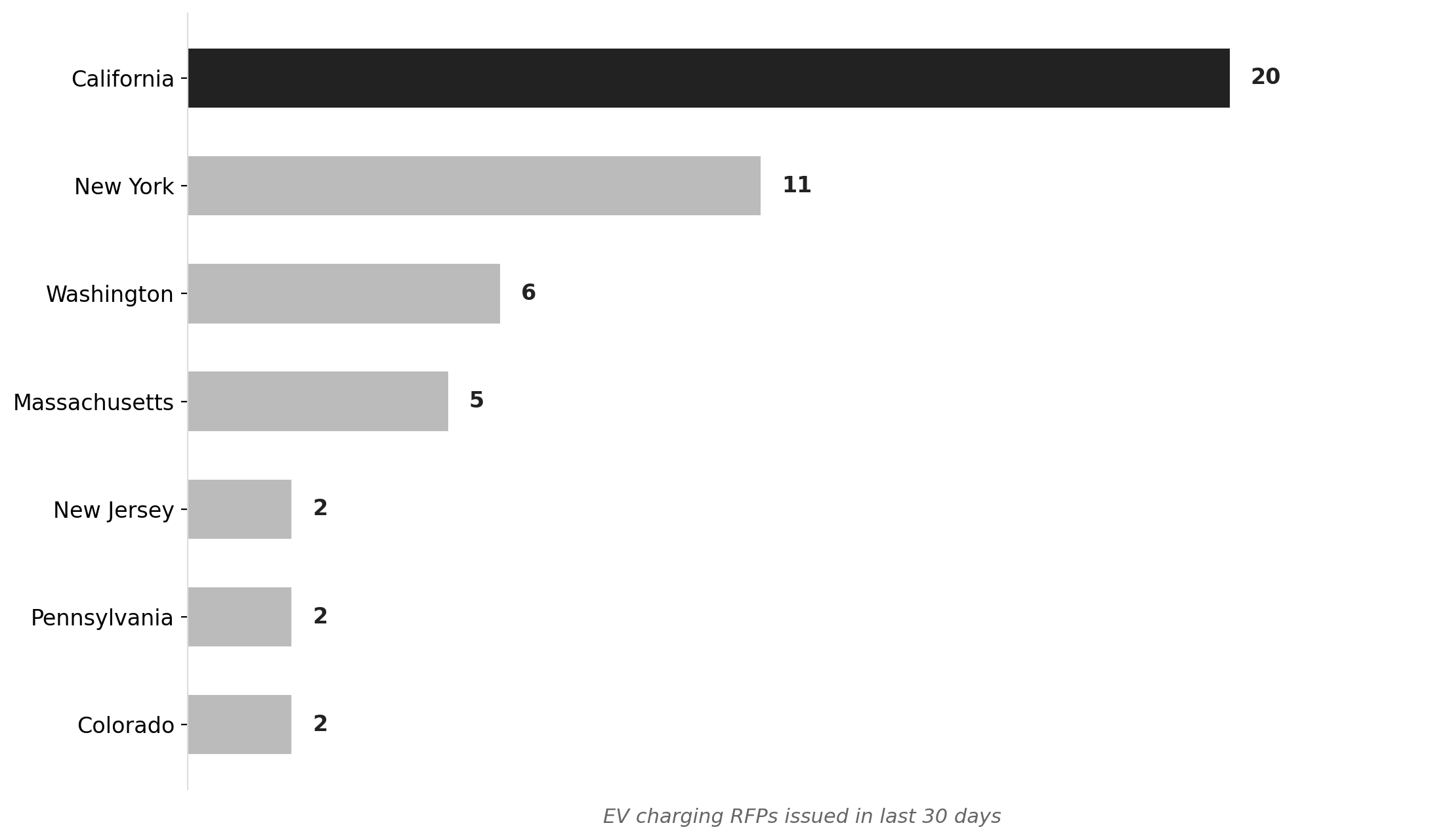
Source: NationGraph.
The urgency sharpens when you look at what is happening to federal dollars. New York's five-year NEVI formula allocation totals $175 million. The Trump administration froze NEVI disbursements in February 2025, and while a federal district court ruled that freeze unlawful in January 2026 in Washington v. U.S. DOT, the FY2026 appropriations deal subsequently cut $503.8 million from NEVI nationally, as Inside Climate News reported. The court ruling restored spending authority on paper; the budget legislation threatened to negate it in practice. For New York, which had more to protect than almost any other state, the calculation is straightforward: lock in procurement now, while both state and federal windows are technically open.
New York's exposure is unusually large because its early implementation lead made it unusually dependent on NEVI continuity. Alongside Ohio, it accounted for more than half of all NEVI-funded stations open in the country by early 2025. The Port Authority is currently executing a $451.6 million EPA Clean Ports grant through 2028. The Niagara Frontier Transportation Authority holds $102.7 million in federal transit EV grants running through 2030. NYC's Department of Citywide Administrative Services is deploying a $17.3 million EPA Clean Heavy-Duty Vehicles award. These are long-horizon commitments now playing out against a short-horizon federal funding environment, and the state's procurement machine is responding accordingly.
That machine has a governance architecture capable of translating federal signals into contracts at scale. NYSERDA, NYSDOT, the New York Power Authority, and the Joint Utilities of New York have operated as a coordinated system since the original NEVI implementation push. A 2025 peer-reviewed analysis in ScienceDirect specifically noted New York's cross-agency coordination model as a structural advantage in EV deployment. What the current RFP data show is that model activating under pressure.
For residents, the practical outcome is that charging infrastructure decisions being made this month will shape which corridors and communities get fast-charging access for the next several years. NYSERDA's Charge Ready 2.0 program includes a $1,000-per-port bonus for sites in designated Disadvantaged Communities, meaning the procurement wave extends beyond highway corridors into urban neighborhoods that have historically been last in line. Whether those equity provisions survive the contracting sprint intact will depend on how many of the 11 pending RFPs ultimately result in DAC-sited installations.
The number to watch next is June 23. That is the PON 6150 proposal deadline, and the volume of submissions NYSERDA receives will determine how quickly the $45 million is committed. If federal NEVI authority narrows again after that date, the agencies that moved in May and June will have captured the window. The ones that waited will be negotiating with whatever remains.