Virginia has received $9.34 million in new federal flood-control grants over the past 90 days, a 75 percent drop from the $37.6 million the commonwealth pulled in during the same window a year ago. One county, Stafford, is the only locality that saw a new federal flood dollar arrive in that entire period: a DOT PROTECT grant awarded September 9, 2026, running through November 2030. The rest of the state is waiting.
The cause is not a drop in need. It is a federally manufactured gap. On April 4, 2025, FEMA terminated its Building Resilient Infrastructure and Communities program, known as BRIC, cancelling every unobligated application from fiscal years 2020 through 2023 and directing roughly $882 million in Infrastructure Investment and Jobs Act funds back to the Treasury. For Virginia, that meant two pending grants, for infrastructure projects in Richmond and Portsmouth, were erased before a single award letter went out. The Virginia Department of Emergency Management confirmed that neither city received an obligation. FEMA's announcement of the termination described the cancellation as a programmatic reset, but for localities that had spent years preparing applications, the effect was an abrupt shutdown.
BRIC was the federal government's primary competitive pre-disaster mitigation program for public infrastructure: flood barriers, resilient community lifelines, hardened public buildings. It was not a small supplemental pot. In its FY2020-through-FY2023 cycle it had selected roughly $4.6 billion in projects nationally before cancellation. For Hampton Roads, a coastal region that sits atop some of the fastest land subsidence rates on the Atlantic seaboard, BRIC was the central funding vehicle for the kind of capital-intensive coastal hardening that smaller locality budgets cannot sustain alone.
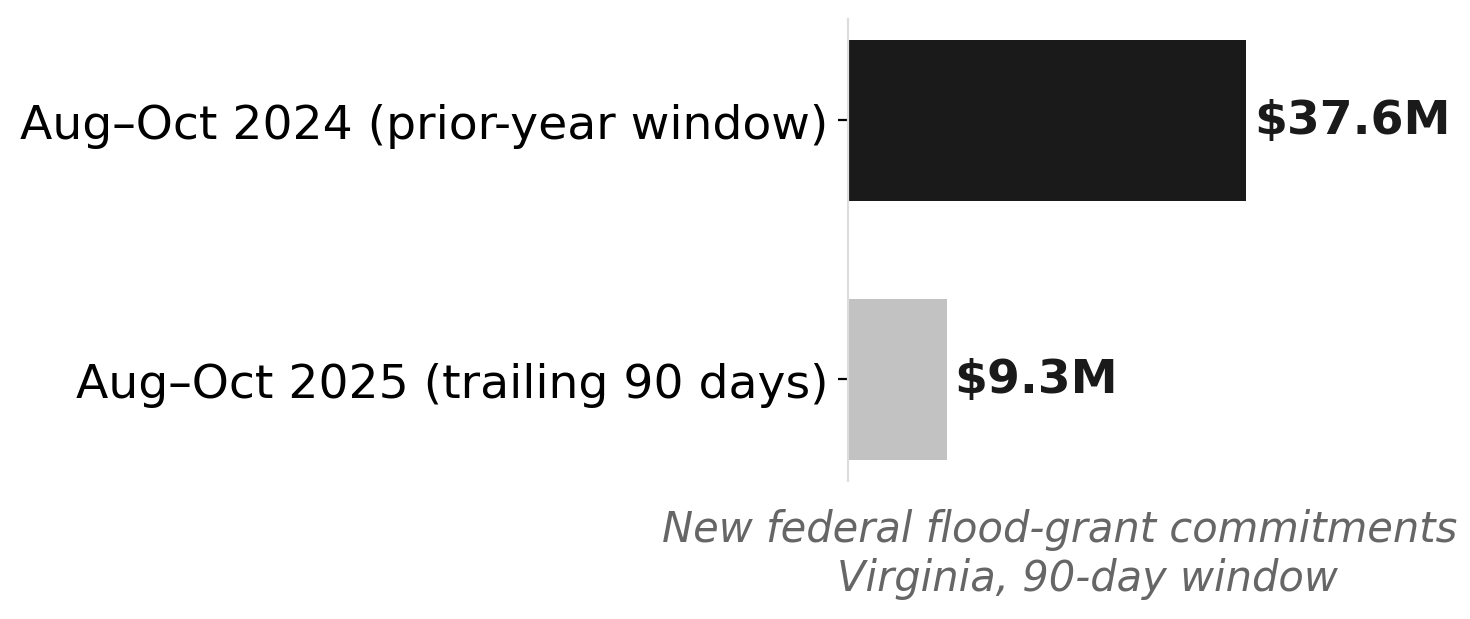
Source: NationGraph.
A coalition of twenty states sued to restore the program. On March 6, 2026, U.S. District Judge Richard G. Stearns issued an enforcement order compelling FEMA to relaunch it. FEMA published a combined FY2024-FY2025 Notice of Funding Opportunity on March 25, 2026, making $1 billion available. The application window closed July 23, 2026. Awards have not been announced. Virginia is, at this moment, in the space between those two timelines: the old pipeline cancelled, the new one not yet open.
FEMA's separate Flood Mitigation Assistance program, which targets repetitive-loss properties insured under the National Flood Insurance Program, is a different instrument with a different purpose, and it has not been cancelled. But no FY2025 or FY2026 FMA Notice of Funding Opportunity has been issued as of mid-2026. The most directly mitigation-focused federal grant currently active in Virginia is a $4.46 million FMA award to Virginia Emergency Management running through July 2027. That is the full federal pre-disaster mitigation toolkit currently in force for the commonwealth.
Virginia has partially filled the gap with state dollars, but the math is tight. On January 15, 2026, Governor Youngkin announced $99 million in Round 6 awards from Virginia's Community Flood Preparedness Fund, a state program funded by budget appropriation rather than federal grants. As the CFPF Round 6 awards page shows, 78 applications requested $129 million total, meaning demand exceeded available supply by about 30 percent before a single award was made. The Georgetown Climate Center has described Virginia's CFPF as a national model for state-level flood resilience finance, in part because it operates independently of the federal competitive grant calendar. But the CFPF and BRIC are not interchangeable: the CFPF funds a planning-to-capital continuum for localities, while BRIC was designed to fund larger-scale public infrastructure at a competitive national level. They serve different actors through different mechanisms, and the CFPF's Round 6 oversubscription illustrates the pressure a program of its size faces when the federal layer disappears.
The CFPF's own revenue picture is also in transition. Governor Youngkin withdrew Virginia from the Regional Greenhouse Gas Initiative in 2023, cutting off the RGGI-proceeds stream that had originally funded the CFPF and replacing it with a one-time budget appropriation. Virginia rejoined RGGI on July 1, 2026, which will restore a recurring revenue source to the fund going forward, independent of any federal decision.
For Virginians outside Stafford County, the practical question is what comes next in the federal pipeline. The BRIC relaunch NOFO is under review at FEMA now, and the $1 billion available is real, but the award timeline is uncertain. Richmond and Portsmouth, whose prior applications were cancelled without obligation, are eligible to reapply under the new NOFO. Whether their projects score competitively in a revised review process, and when awards will be announced, is the signal worth watching. Until those awards arrive, Virginia's federal flood-control intake will remain a fraction of what it was a year ago, sustained by a single transportation resilience grant to one Piedmont county and an active mitigation grant that predates the current funding drought by two years.