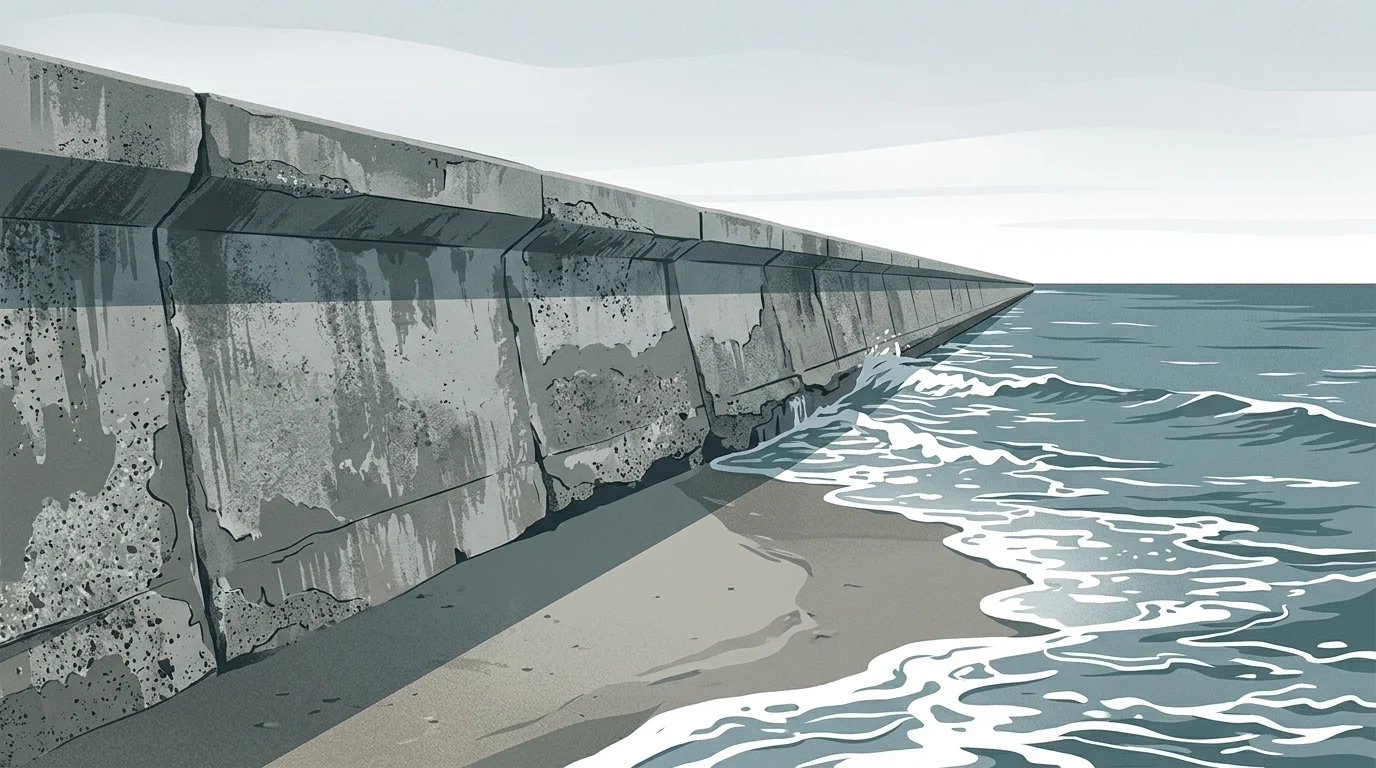
South Carolina completed a $71 million seawall repair on February 18, 2026, and within weeks a judge let an illegal one stand. Both moments point to the same structural reality: the state's 38-year ban on coastal armoring is straining against the physics of sea level rise in ways its drafters never anticipated.
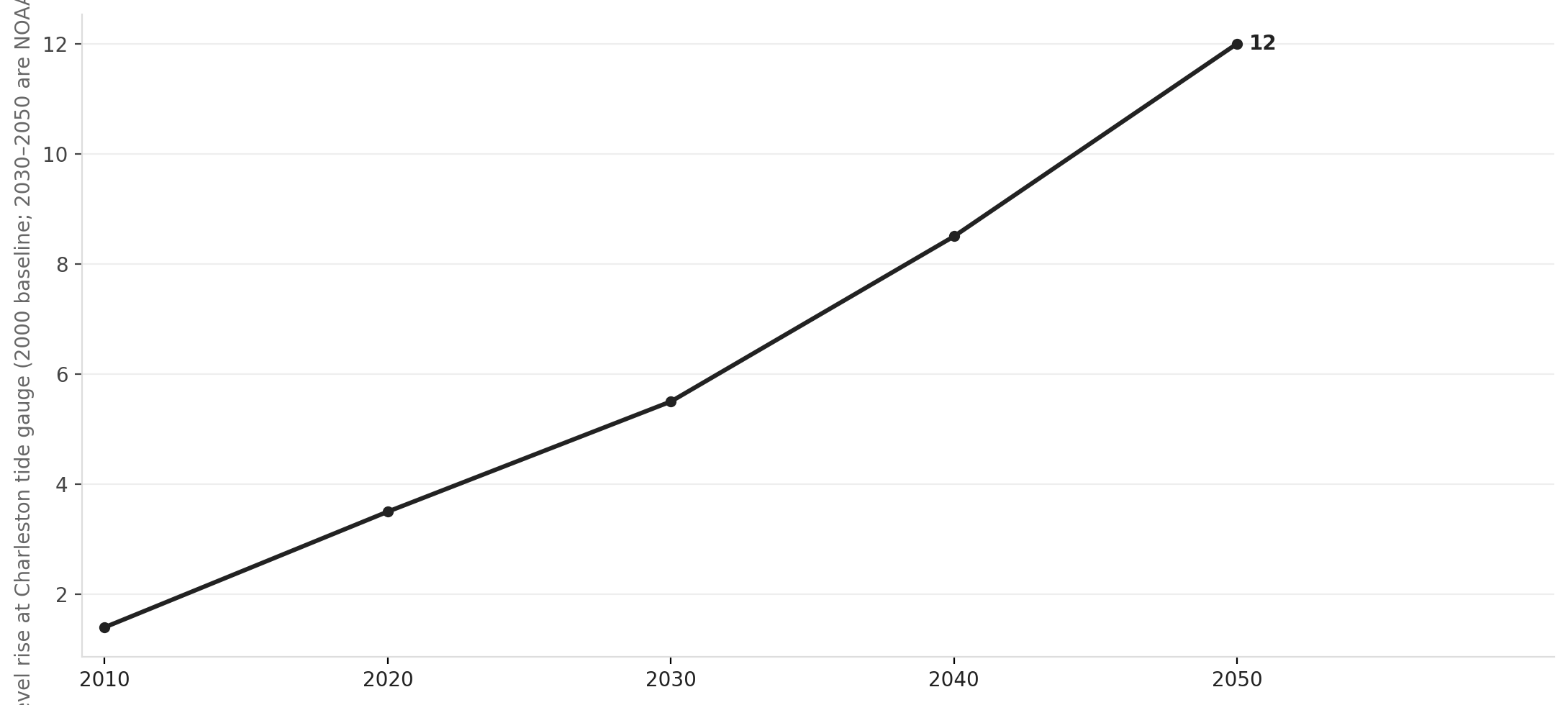
Charleston's Low Battery Seawall took nine years and 387,000 man-hours to finish, funded almost entirely by the city's tourism accommodation tax. It raised the historic wall 1.8 feet, driven 30 miles of piles into the Harbor, and, as Live 5 News reported at the ribbon-cutting, was received as a civic milestone. The celebration lasted about as long as the news cycle. The very same week, city officials were already discussing the Battery Extension: a $1.3 billion Army Corps project that would continue hardening southward. Charleston City Council approved $2.5 million in design funding in September 2025, and a voter sales-tax referendum is targeted for later this year to cover the city's roughly $455 million local share. NOAA projects approximately one foot of sea level rise at the Charleston tide gauge by 2050, and the city is already designing new projects to a 2.5-foot standard for infrastructure with a 50-year life. The $71 million project, in that light, was not a finish line. It was a proof of concept for something much larger.
While Charleston was celebrating, a parallel argument was playing out 15 miles up the coast at Isle of Palms. On December 30, 2025, an Administrative Law Court judge ordered homeowner Rom Reddy to tear down an unpermitted seawall he had built on his beachfront property. All parties, including Reddy, the SC Department of Environmental Services, the Coastal Conservation League, and the SC Environmental Law Project, immediately appealed. On March 11, 2026, Chief ALJ Ralph Anderson granted a temporary stay, letting the wall remain while the case proceeds. As the Post and Courier reported, the Reddy case has become the most closely watched test of the 1988 Beachfront Management Act in a generation, because the legal question is not really about one homeowner. It is about whether the armoring prohibition can hold when erosion is accelerating and enforcement triggers an immediate political backlash.
Source: NationGraph.
The pressure is not hypothetical. Sullivan's Island spent $646,000 on renourishment in February 2025, only to lose roughly half of it to a mid-October nor'easter. Isle of Palms issued its own beach renourishment solicitation, RFB 2026.01, on February 20, 2026. Beaufort County posted an on-call marine and coastal engineering services RFP due April 7, 2026. The procurement activity across the coast this winter reflects a calculation that renourishment, however temporary, is the only legal tool most jurisdictions have while the Reddy appeal works its way to the SC Court of Appeals.
The 1988 Act was, in its moment, nationally significant: South Carolina became one of the first states to prohibit new hard armoring along its ocean shoreline, a policy designed to let beaches migrate landward rather than sacrifice them to protect private property. Governor McMaster reinforced that intent as recently as July 2024, vetoing a budget proviso that would have weakened SCDES enforcement authority over seawall violations, calling it "not good policy." SCDES also updated its coastal zone regulations effective May 23, 2025 under 2023 Act No. 60, the first substantive rewrite of the rules in years, signaling that the agency intends to defend and modernize the framework rather than retreat from it.
But the framework was written when a foot of sea level rise by 2050 was a distant projection, not a planning standard. It was written before cities like Charleston were financing $71 million walls from hotel taxes because federal infrastructure dollars were not available for hard coastal armoring. South Carolina's active federal coastal grants portfolio totals roughly $24 million across NOAA and Commerce programs, support that flows to research and coastal management administration, not to seawalls or revetments. The cost of hardening the Lowcountry falls almost entirely on local governments and, in the Reddy case, on individual property owners willing to build and litigate.
The question the state has not answered is what comes after the Battery Extension vote. If Charleston's $455 million local share passes at referendum, the city will have committed more than half a billion dollars in a decade to a single mile of historic waterfront. The communities with smaller tax bases and no accommodation tax revenue will be watching to see whether the legal and financing architecture that made Charleston's wall possible can be replicated, or whether the 1988 ban will continue to channel that pressure into the courts one unpermitted revetment at a time.
The Reddy appeal is now at the SC Court of Appeals with no ruling date set. The Battery Extension sales-tax referendum has no confirmed ballot date. Both will move this year, and whichever moves first will set the terms for the other.