Flood control procurement across the United States has hit a level with no recent parallel: 647 institutions across 45 states issued flood-related RFPs in the last 60 days, roughly 4.2 times the prior 12-month bimonthly average of 154. The timing is not a coincidence. Three separate federal grant programs, each with its own funding source, eligibility rules, and application deadline, are simultaneously open for the first time in a single fiscal year, and localities have responded by going to market for design, engineering, and construction services all at once.
The programs are distinct, and the brief requires treating them that way. FEMA's FY2026 Flood Mitigation Assistance grant provides up to $400 million for community-led projects to reduce repetitive flood damage to NFIP-insured structures: acquisitions, elevations, floodproofing, and localized drainage improvements. FEMA announced that funding on October 22, 2026, with applications due February 26, 2027. The FY2026 Swift Current program, announced July 14, 2026, provides $600 million specifically for states with Presidential flood disaster declarations issued between June 1, 2025 and May 31, 2027, a faster-moving track for places already inside a declared emergency. And FEMA's FY2026 Pre-Disaster Mitigation program, funded by congressional-directed appropriations under the FY2026 Homeland Security Appropriations Act, distributed roughly $180 million across 39 states in regional tranches throughout September 2026. That last program is not NFIP-linked and operates under entirely different eligibility rules than the FMA family.
Layered beneath all three sits the post-disaster recovery machine. FEMA's Public Assistance and Hazard Mitigation Grant Program funds, which reimburse disaster-declared jurisdictions for debris removal, infrastructure repair, and property buyouts, are flowing to the Southeast on a near-weekly schedule. Florida currently holds $1.83 billion in active federal flood grants across 78 awards; North Carolina holds $1.11 billion across 44; New York holds $860 million across 81. These aren't future promises. They are contracted obligations that have to move through procurement to become completed projects.
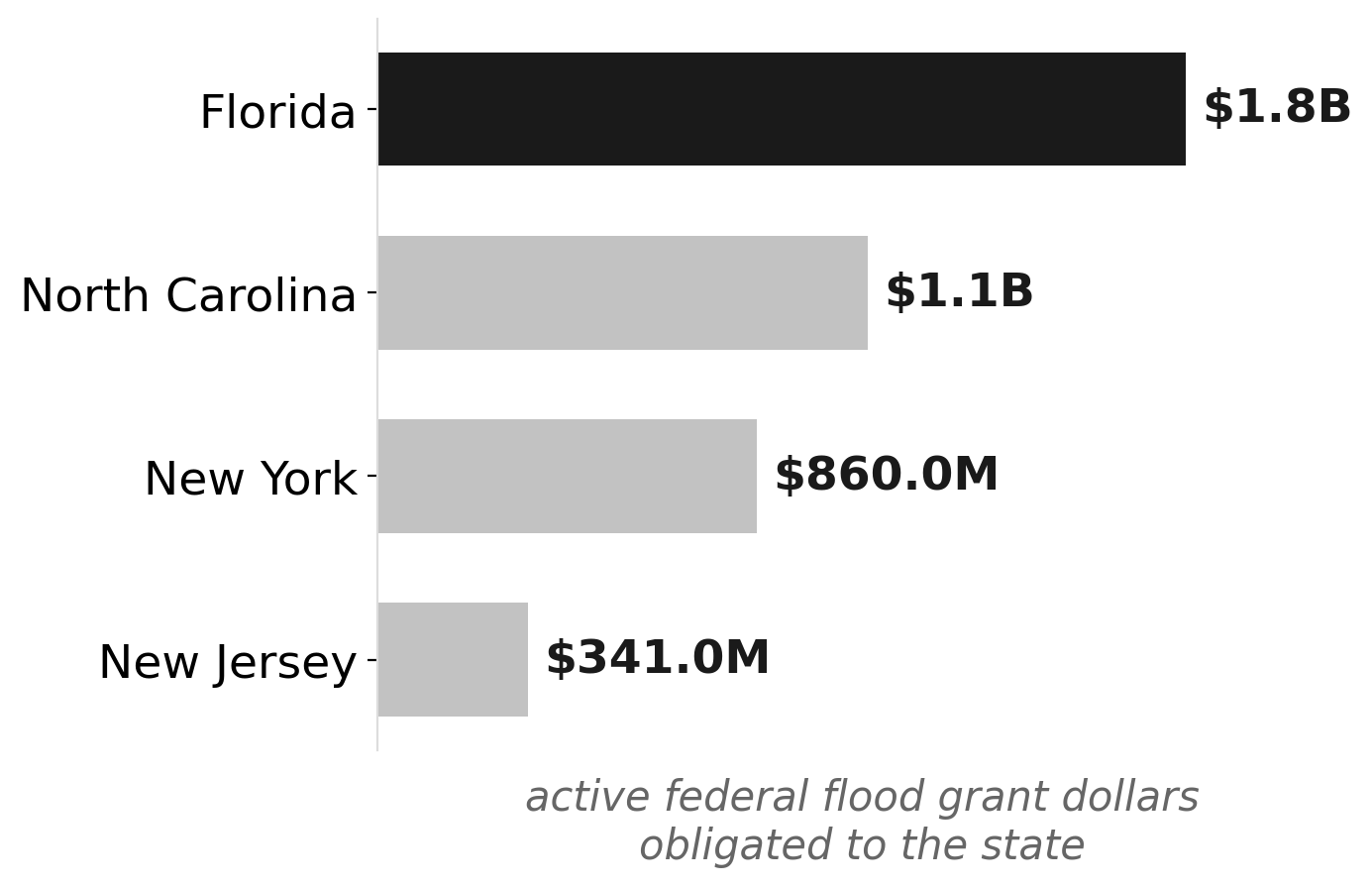
Source: NationGraph.
The October 22 FMA announcement appears to have triggered the sharpest procurement spike. Within 72 hours, the RFP signal across 45 states spiked to its highest recorded level. That proximity is probably not causal in a simple sense, engineering firms and municipal governments don't issue RFPs in three days, but it reflects something real: localities that had been tracking the FMA announcement for months, and had already hired grant writers and scoped projects under Swift Current or the September PDM tranches, used the final FMA announcement as the trigger to move procurement they'd been preparing in parallel.
North Carolina is the clearest illustration of how these programs pile up in a single jurisdiction. The state has received more than five separate FEMA award announcements since July 2026, including a $101 million tranche on October 22 covering 52 projects tied to Hurricane Helene. NC's active RFPs include a natural infrastructure flood mitigation study from the state Department of Environmental Quality, a Swannanoa River resilience corridor in Black Mountain, and a full flood mitigation redesign at Appalachian State University, each traceable to Helene damage in the western part of the state, each drawing on a different funding stream. Vermont and Kentucky show similar stacking: Vermont is drawing on both the Helene declaration and a separate Tropical Storm Chantal declaration; Kentucky is simultaneously spending funds tied to its catastrophic July 2022 eastern flood and to severe storms from early 2025.
The states leading in raw RFP volume, California (61 institutions), Texas (57), Florida (55), New Jersey (34), and Washington (33), are in a different mode than the disaster-recovery cluster. These are resilience-investment procurements: jurisdictions that qualified for Swift Current or PDM funds through recent disaster declarations are moving to harden infrastructure before the next event, not repair it afterward. New Jersey's $341 million active grant portfolio and Washington's position in FEMA Region 10's PDM tranche reflect that forward-looking demand.
For residents in any of these 45 states, the immediate consequence is a surge in active bidding for flood-related engineering and construction services, which tends to compress contractor availability and extend project timelines. The more consequential signal is the deadline structure: the FMA application window closes February 26, 2027, and the amended FY2024 Swift Current cycle, a separate $500 million tranche republished April 30, 2026, has a rolling deadline of October 30 to November 30, 2026 depending on state activation. That means some localities are bidding out preliminary engineering work now specifically to have deliverables in hand before a deadline that is weeks away.
The open question is whether the procurement capacity exists to absorb this. Three simultaneous grant cycles with overlapping but non-identical eligibility rules, deadlines, and funding mechanisms mean that local governments are competing not just for dollars but for the same engineering consultants, environmental reviewers, and grant administrators. Which jurisdictions successfully close contracts before their application windows expire will determine who captures this funding, and which communities wait for the next cycle.