Seven hundred eighty-seven institutions across 46 states issued water infrastructure RFPs in the trailing 60 days ending October 2026, roughly 4.5 times the prior 12-month bimonthly average of 176. October alone produced 776 institutions and 975 individual solicitations, the single largest monthly spike in the dataset. That number is not a coincidence of the calendar. It is the shape of what happens when three separate federal clocks run out at nearly the same moment.
The most immediate trigger is the expiration of the Infrastructure Investment and Jobs Act's $50 billion water authorization, which lapsed on September 30, 2026 without a reauthorization bill enacted. As water finance outlets noted at the time, the expiration did not immediately zero out existing allotments, states retain access to funds already appropriated, but it eliminated the forward authorization that had anchored utility capital plans for five years. For a local water director deciding whether to issue a procurement vehicle this quarter or next year, September 30th was the line. Municipalities that had been planning projects now needed to lock in contracts against money that exists today but may not be reprogrammed if Congress fails to act.
The second clock is regulatory. EPA's Lead and Copper Rule Improvements, finalized October 30, 2024 and currently in effect despite an industry court challenge (American Water Works Association v. EPA, D.C. Circuit, no stay issued), require every water system to have a complete lead service line inventory and a replacement plan in place by November 1, 2027. That deadline is now less than 13 months away. The FY2026 IIJA DWSRF Lead Service Line Replacement allotment stands at $2.875 billion nationally, with a state application deadline of September 30, 2027, meaning utilities that have not yet issued design and construction RFPs are already running behind the funding cycle. Ohio illustrates the density this creates: Akron, Cincinnati, Columbus, Newark, Elyria, Lockland, Niles, North Baltimore, Perrysburg, and Wadsworth each issued discrete lead service line replacement RFPs in the trailing 60 days. The state's aging Rust Belt distribution systems, combined with acute LCRI exposure, produced a concentration of lead-pipe solicitations unmatched anywhere else in the dataset.
Source: NationGraph.
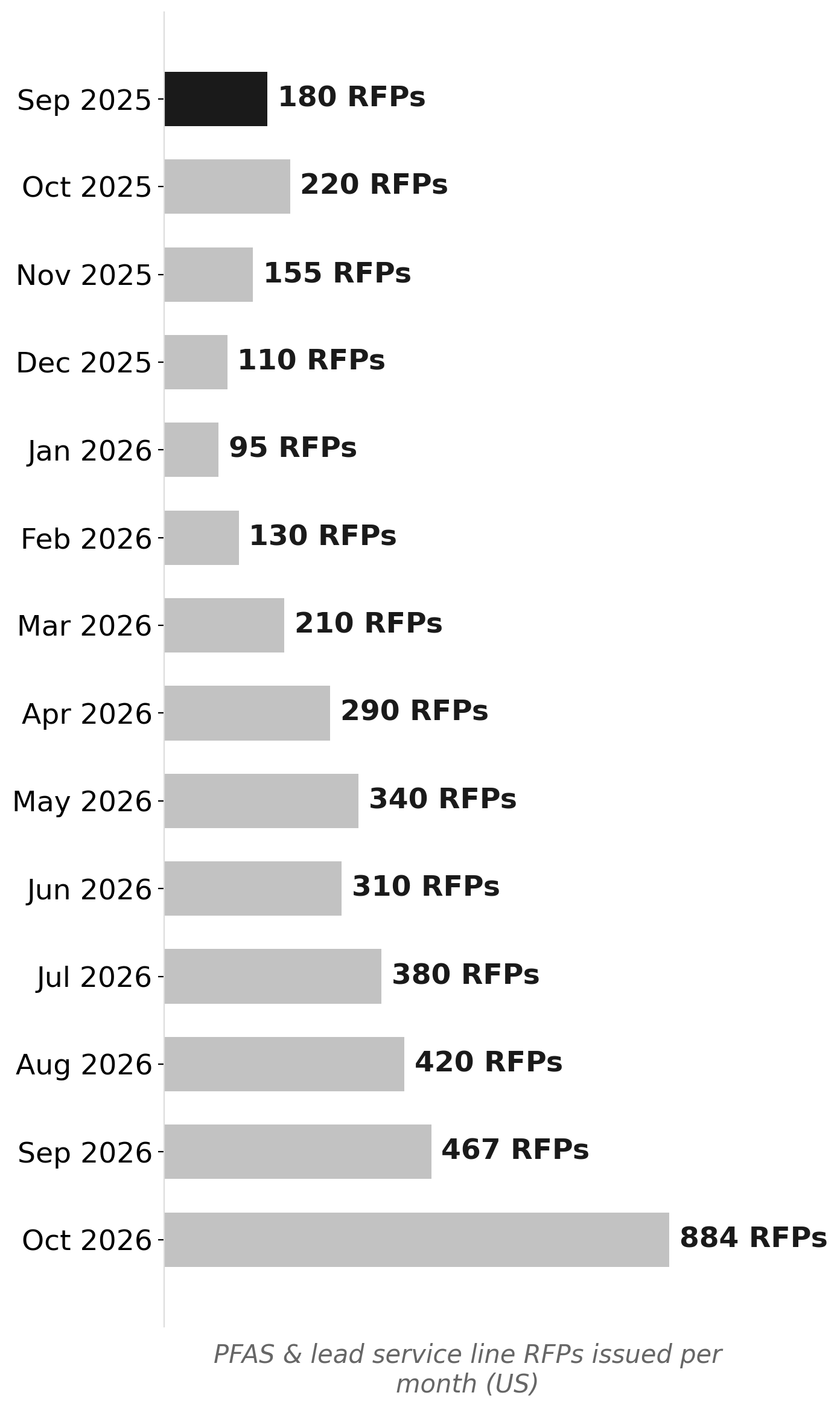
The third driver is money that will not come back. EPA's Emerging Contaminants in Small or Disadvantaged Communities grant program, funded at $5 billion over five years under IIJA, announced its final $1 billion tranche in May 2026. No successor program has been confirmed by Congress. For small and rural utilities facing PFAS contamination from industrial sites, this is the last competitive grant cycle under a known appropriation. The PFAS dimension of the RFP spike is concentrated in the Northeast and industrial Midwest, where per- and polyfluoroalkyl substance contamination from manufacturing is most severe, but it shows up in the national numbers clearly: PFAS and lead-pipe RFPs combined hit 884 solicitations in October 2026 alone, against a monthly range of 48 to 467 in the prior 13 months.
The National League of Cities has urged Congress to reauthorize at IIJA-level funding, roughly $5.85 billion annually split between the Clean Water and Drinking Water State Revolving Funds, but no bill has advanced. EPA has obligated $9.26 billion in water infrastructure grants over the past 18 months, led by $1.26 billion to Florida, $886 million to California, $703 million to North Carolina, and $350 million to Texas through the DWSRF and WIIN Act programs. Those obligations explain part of the geographic concentration in the RFP data: California (72 institutions), Florida (50), Georgia (46), and Texas (43) are both large states and large grant recipients with projects that need to move to procurement.
The three funding streams driving this sprint are legally and programmatically distinct. The IIJA DWSRF base capitalization grants finance broad drinking and clean water infrastructure through state revolving loan funds. The LSLR set-aside is a targeted federal grant specifically for lead pipe replacement, allotted by state formula with 49 percent additional subsidy for disadvantaged communities. The EC-SDC PFAS grants are competitive awards flowing through state primacy agencies to small and underserved utilities. They share a disbursement channel but fund different project types under different statutory authorities. The LCRI is a regulatory mandate entirely separate from the funding architecture, it is what makes the LSLR urgency real by setting a hard compliance date utilities cannot negotiate.
For residents in any of the 787 jurisdictions, the near-term signal is a wave of contractor mobilization: lead pipe excavation, PFAS treatment equipment installation, and advanced meter deployments are likely to appear simultaneously across communities that have been deferring these projects for years. The watch item for the next 90 days is whether Congress moves a water reauthorization bill before the end of the fiscal year. If it does not, the procurement vehicles now being issued will execute against existing allotments, but the next generation of water capital plans will have no federal foundation to build on.