Hawaii's transit agencies are managing more than $760 million in active and newly committed federal grants right now, and the two programs driving that figure have almost nothing in common except geography and a shared deadline pressure.
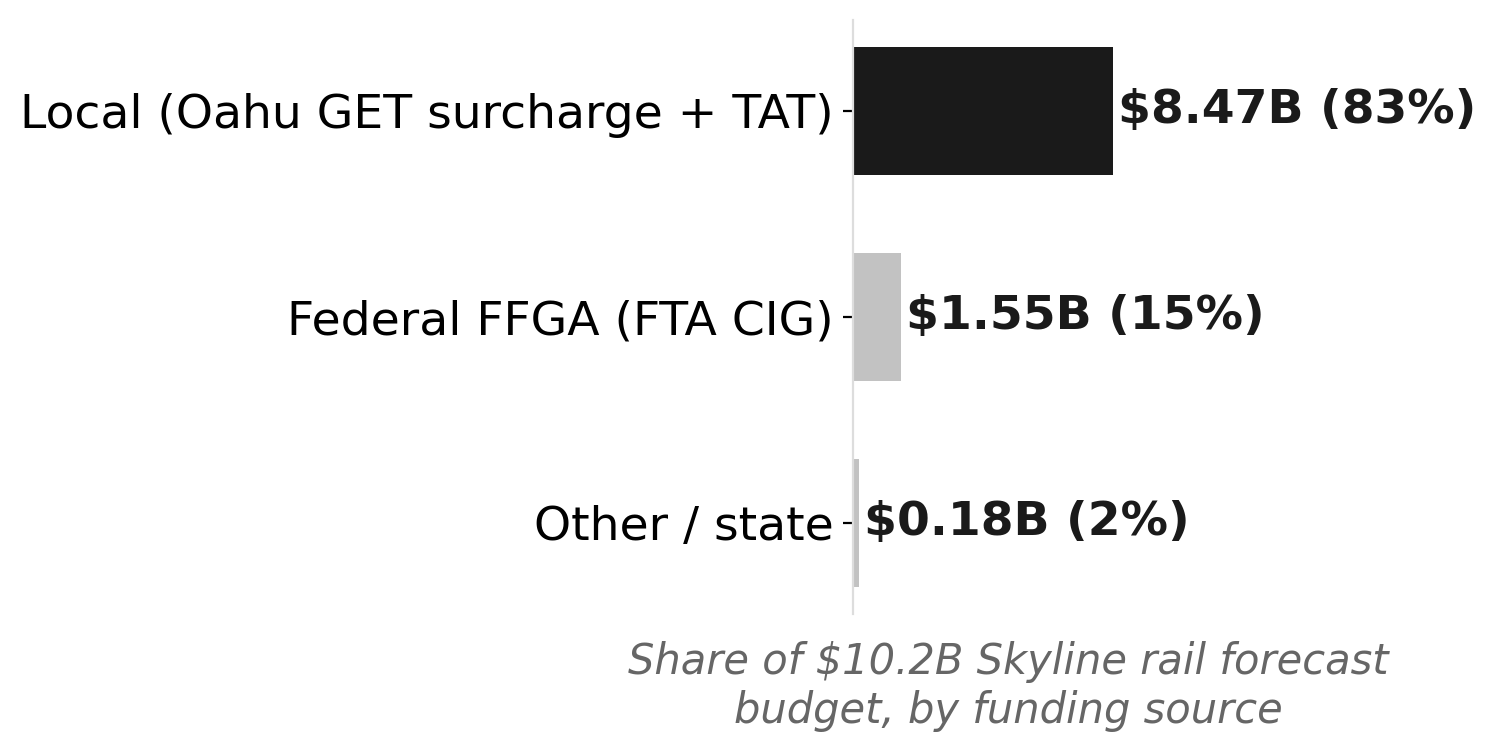
On one track: the Honolulu Skyline rail, a $10.2 billion automated rail system whose third and final construction segment broke ground in August 2025. Tutor Perini holds the City Center Guideway contract through 2031, and the Honolulu Authority for Rapid Transportation (HART) is working through an amended Full Funding Grant Agreement reaffirmed in February 2024 that locks in $744 million in remaining federal Capital Investment Grant money. That federal stake, though large in absolute terms, represents only about 15 percent of the project's total cost. The other 83 percent comes from Oahu's General Excise Tax surcharge and the Transient Accommodations Tax, making Skyline one of the most locally financed rail megaprojects in American history.
On the other track: a fast-moving bus electrification program funded almost entirely by federal Bipartisan Infrastructure Law dollars, flowing through the FTA's Low or No Emissions Grant Program and the Buses and Bus Facilities formula program to all four Hawaii counties. In September 2025 alone, HDOT received $23.2 million and county agencies received $12 million in new BIL-funded awards. New transit grant starts across Honolulu, HDOT, and Maui County in the third quarter of fiscal year 2025 totaled more than $100 million in fresh commitments. These are not the same program, do not share implementing agencies, and carry entirely different risk profiles.
Source: NationGraph.
The bus program is already putting hardware on the ground. Twelve all-electric GILLIG buses, funded by $11.2 million in FTA grants and $3.53 million from Hawaii's Volkswagen Settlement allocation, were delivered to Maui, Kauaʻi, and Hawaiʻi Island in July 2025. Maui County launched service on its four electric buses in January 2026. Honolulu already runs 17 zero-emission buses and has plans to add up to 78 more within three years. Every Hawaii county has committed to 100 percent renewable-fuel public buses by 2035.
Governor Josh Green has framed the bus push around energy security as much as climate. Hawaii imports nearly all of its liquid fuel, and that dependency has no interstate highway workaround. Decarbonizing bus fleets directly reduces fuel import exposure, which gives the program a political rationale that survives shifts in climate policy nationally. That framing also helps explain why the EPA's separate $56.7 million Clean Ports Program grant to HDOT, funding port electrification infrastructure through 2028, has advanced with relatively little friction alongside both transit programs.
The rail story is more complicated. HART's Segment 3, running through Honolulu's City Center, is the most expensive and most politically fraught stretch of the 18.9-mile, 19-station system. The Honolulu City Council passed Bill 60 in March 2026, signed by Mayor Blangiardi, authorizing HART to begin planning extensions to UH Mānoa, Waikīkī, and points west. But authorization is not appropriation. As HART CEO Lori Kahikina told the Star-Advertiser, the current budget is "very, very tight," and no funding for any extension has been secured. The system has to finish before it can grow, and finishing it has already consumed $375 million of the $500 million FTA Capital Investment Grant, with the remainder gated on construction milestones that run to 2031.
What makes the current moment notable is that both programs are peaking at the same time. The rail is entering its most technically demanding construction phase in the densest part of Honolulu, while the bus electrification push is scaling from pilot deliveries to fleet-level procurement. HDOT and county transit agencies are simultaneously managing new grant compliance requirements, procurement cycles, and charging infrastructure buildouts. Hawaii's transit institutions are not large. The state's geographic isolation means there are no neighboring agencies to draw on for staff or equipment when execution strain hits.
For residents, the near-term visible change is more likely to come from the bus program. Electric buses are already in service on three islands and expanding quickly. Rail service on the completed eastern segments is running, but the City Center extension that would make Skyline genuinely useful to most Honolulu commuters is six years away under the current contract.
The signal to watch over the next 18 months is whether HART can stay within its GET and TAT revenue projections as Segment 3 construction costs accumulate. Tourism-driven tax revenues that fund 83 percent of the project are not guaranteed, and any shortfall would put pressure on the federal FFGA milestone schedule before extensions enter serious discussion. The bus program's next procurement wave, expected to add dozens of electric vehicles across Oahu in 2027, runs on a parallel and largely independent clock.