706 public institutions across 46 states issued solar procurement requests in the last 60 days, roughly 3.7 times the prior 12-month bimonthly average of 192. October 2026 alone produced 673 solar RFPs nationally, more than double any single month in the dataset. This is not a gradual build. It is a synchronized sprint by school boards, city halls, sewerage authorities, and public utilities that share one thing in common: a federal tax-credit window that closes in approximately 10 weeks.
The forcing mechanism is the One Big Beautiful Bill Act (OBBBA, H.R. 1), signed July 4, 2025. The law dramatically accelerated the phase-out of the IRA's clean electricity investment tax credit (§48E) and production tax credit (§45Y), replacing the IRA's gradual phasedown with a hard cliff. Solar and wind projects that do not begin construction by July 4, 2026 must be placed in service by December 31, 2027 to claim any credit at all, a timeline that is operationally impossible for most public-sector projects. The vehicle through which tax-exempt agencies actually receive that credit, the IRA's Direct Pay provision, which converts the 30% investment tax credit into a direct IRS cash payment for municipalities, school districts, and public utilities, is subject to the same construction-start deadline. The National League of Cities urged local leaders to accelerate project timelines and make as much progress as possible before the window closes.
The stakes are concrete. A school district installing a 2 MW rooftop array at $4 million in capital cost stands to receive roughly $1.2 million in direct IRS cash under Direct Pay, funds that disappear entirely if the project misses the construction-start bar. For municipalities and utilities running larger projects, the domestic content adder can push the effective credit above 40%, raising the dollar figure further. That math explains why the procurement surge is concentrated in exactly the institutions for which Direct Pay was most economically transformative: municipal and county governments account for 623 of the RFPs in the trailing 60 days, K-12 schools for 179, and public utilities and authorities for 154.
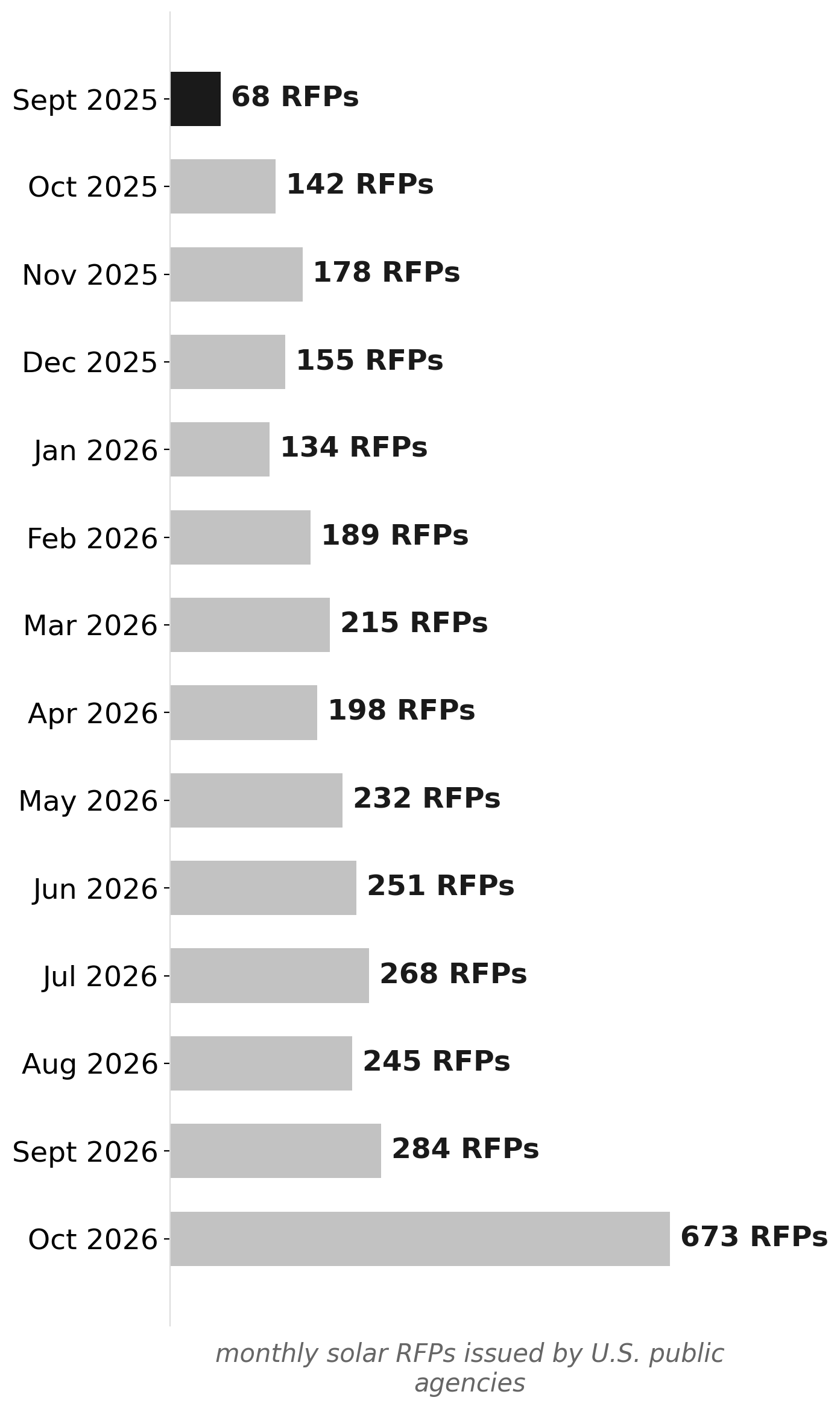
Source: NationGraph.
The state-level numbers underscore how synchronized the surge is. California led with 109 institutions issuing RFPs in October, against a prior monthly average of roughly 25. New York reached 45, up from about 8. New Jersey hit 42, Pennsylvania 39, Massachusetts 31. Every one of those figures represents a 2x to 8x jump from baseline in a single month. The breadth matters as much as the depth: the top 10 states span blue, purple, and red jurisdictions alike, because the OBBBA deadline applies identically regardless of state energy policy.
The complication sharpening the urgency is IRS Notice 2025-42. As the Vermont League of Cities and Towns has warned municipal officials, the notice narrowed the "beginning of construction" safe harbor for larger projects: facilities over 1.5 MW cannot simply demonstrate 5% cost incurrence through procurement contracts or equipment deposits. They must show actual physical construction work before July 4. For projects that clear that bar, a four-year continuity safe harbor generally extends the placed-in-service deadline to December 31, 2030, but reaching that safe harbor requires shovels in the ground, not bids in an inbox.
That constraint means many of the 706 institutions now rushing through procurement will not make it. A public-sector solar project that issues an RFP in late October, evaluates proposals, negotiates a contract, and mobilizes a contractor is running a compressed sequence that typically takes two to four years. Compressing it into weeks is possible for smaller rooftop installations where equipment is pre-purchased and contractor capacity is available, but the window is narrow. A legal analysis by Kutak Rock summarizing the OBBBA's renewable energy provisions noted that the hard cliff structure leaves little room for the kind of administrative flexibility that allowed late movers to qualify under prior IRA phasedown rules.
For residents and ratepayers in these jurisdictions, the outcome of the next 10 weeks will determine whether planned solar projects move forward with a 30% federal subsidy or must be re-evaluated against a full capital cost that in many cases makes the economics marginal. School districts that expected Direct Pay receipts to offset bond payments may find project pro formas underwater. Municipal utilities that embedded the credit in long-term rate assumptions face a similar recalculation.
The next signal to watch is not another RFP count but a construction-start filing count. If federal procurement data and IRS elective pay registrations in early July 2026 show a fraction of today's RFP volume reaching the physical construction threshold, the gap between intent and execution will define how much of this procurement sprint translates into installed capacity, and how many public agencies are left holding plans they can no longer afford to build.