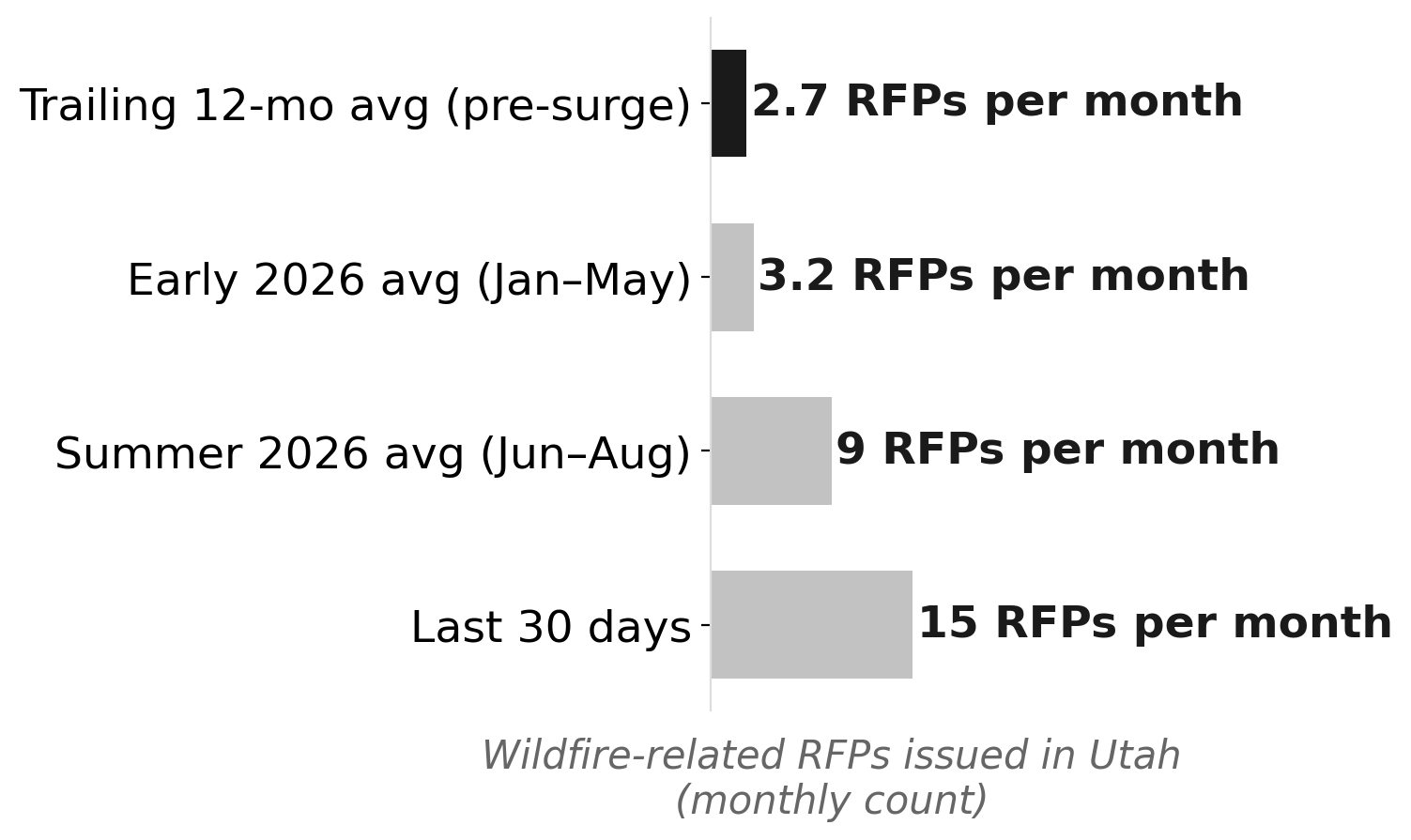
Utah issued 15 wildfire-related RFPs in the last 30 days against a trailing monthly average of roughly 2.7, a 5.6x surge that reflects something more durable than emergency reaction. The state isn't simply buying its way out of a bad fire season. It is executing the first full year of a legislatively mandated procurement engine designed to keep spending whether or not flames are actively burning.
The procurement spike has three distinct engines running in parallel, and understanding why the numbers won't return to baseline requires knowing what each one does.
The first and most structural is HB 307, passed in Utah's 2025 General Session and effective July 1, 2025. The bill created the $150M Utah Wildfire Fund by consolidating three legacy accounts and, critically, mandated a minimum $10 million in annual spending on prevention, preparedness, and mitigation, meaning contracts must go out regardless of fire activity. The Pew Charitable Trusts noted that HB 307 enables "multiyear large landscape-scale projects" and provides "a solid stream of funding" that the state's prior patchwork of supplemental appropriations never could. Legislators who backed the bill were explicit: unpredictable budget hits from bad fire years were unsustainable, and a permanent special revenue fund was the fix. The fund entered the 2026 fire season holding $120 to $130 million.
Source: NationGraph.
The second engine is Governor Spencer Cox's Executive Order 2026-05, issued after more than 590 fires burned approximately 380,000 acres across Utah this summer, with three fires, the Cottonwood, Iron, and Cherry, each drawing simultaneous FEMA Fire Management Assistance Grant declarations. The Cottonwood Fire alone consumed 97,464 acres in Beaver and Piute counties. Utah had spent an estimated $33 million fighting fires through August 2026, with projections that costs could climb by another third, potentially making 2026 the most expensive wildfire season in state history. The emergency declaration unlocked accelerated procurement authority under Utah Code § 63G-6a-803, enabling the Division of Forestry, Fire and State Lands to move on contracts, including CERCLA-related legal services, without standard competitive timelines.
The third engine is narrower but self-contained: HB 41, passed in the 2026 session, mandated updated statewide wildfire hazard mapping data and directly generated a sole-source RFP to Pyrologix, LLC, a firm with an established relationship with Utah DNR dating to 2021. That contract has nothing to do with active suppression, it is a data pipeline requirement that would have produced an RFP regardless of whether a single acre had burned this year.
The footprint of these three mechanisms shows up clearly in who is issuing contracts. The State Division of Purchasing and General Services accounts for 8 of the 15 current RFPs, the clearest signal that state-level emergency authority and the Wildfire Fund's mandatory spend are driving volume. Summit County has issued 3, including planning work for an inaugural Wasatch Back Wildfire Summit scheduled for May 2027. Carbon County, Springville City, and FFSL account for one each. The contract types span the full wildfire lifecycle: fuel reduction and lop-and-scatter vegetation operations in Richfield and Kanab, post-fire rehabilitation chaining on Cherry Fire lands, the Pyrologix hazard data work, and clerical and logistical support for active incident management.
The federal side adds another layer of scale. Utah carries an active federal wildfire grant portfolio of $89.3 million obligated across 53 grants, with $22.8 million already disbursed. The largest single piece is $39.3 million under USDA Good Neighbor Authority, supplemented by $14.6 million combined across three USDA Wildfire Crisis Strategy Landscapes grants running through 2029, and roughly $4.9 million in Infrastructure Investment and Jobs Act-funded Community Wildfire Defense and revegetation grants. Because roughly 63 percent of Utah's land is federally managed, state and federal procurement pipelines are inherently intertwined, a fuels treatment RFP on state land often has a federal cost-share component, and vice versa.
HB 376, also passed in the 2026 session, adds a research coordination layer by establishing the Utah Forest Restoration Institute at Utah State University. The institute is designed to serve as a hub for post-fire science and funding coordination, which will generate its own contracting activity as it stands up.
For residents in wildland-urban interface communities, the practical consequence is that the government entities responsible for fuels management, risk mapping, and post-fire land rehabilitation now have both the legal authority and the dedicated funding to act on longer timelines than a single season's emergency allows. Projects that previously stalled waiting for supplemental appropriations can now be scoped, bid, and contracted as routine annual work.
The next signal to watch is the Wildfire Fund's first full fiscal-year expenditure report, which will show how much of the mandated $10 million minimum flowed to prevention versus suppression reimbursement. If prevention spending reaches or exceeds the floor, it confirms the fund is functioning as designed rather than simply backstopping emergency costs. The May 2027 Wasatch Back Wildfire Summit in Summit County will also offer an early read on whether county-level planning is consolidating around the new state funding structure or developing independently.