New Jersey counties posted 28 opioid-related RFPs in the last 30 days against a 12-month monthly average of roughly 5.8, a 4.9x spike that makes the state's procurement activity more than twice that of New York or Pennsylvania over the same window. The number is not an accident. It is the shape of a fiscal deadline hitting a decentralized spending architecture all at once.
The immediate trigger is the Purdue Pharma and Sackler family settlement. The $7.4 billion national agreement went into effect May 1, 2026, delivering New Jersey $125.4M, with most of that money scheduled to arrive in the first three years. That payment pushed the state's total secured opioid litigation proceeds above $1.3 billion, all of it held in New Jersey's dedicated Opioid Recovery and Remediation Fund, a non-lapsing account administered through county human-services subgrant cycles. This is state-administered money derived from pharmaceutical defendants, not federal appropriations.
Then came the legislative pressure. Assemblyman Cody Miller introduced bill A5588 on October 5, which would impose an 18-month spend-or-return deadline on all settlement tranches. On October 23, the Assembly Human Services Committee held a three-hour public hearing that surfaced exactly why advocates want guardrails: some municipalities had used settlement dollars on concerts, police vehicles, and monogrammed jackets. Oversight advocates called for stricter controls. County purchasing offices heard something else in that hearing, a countdown.
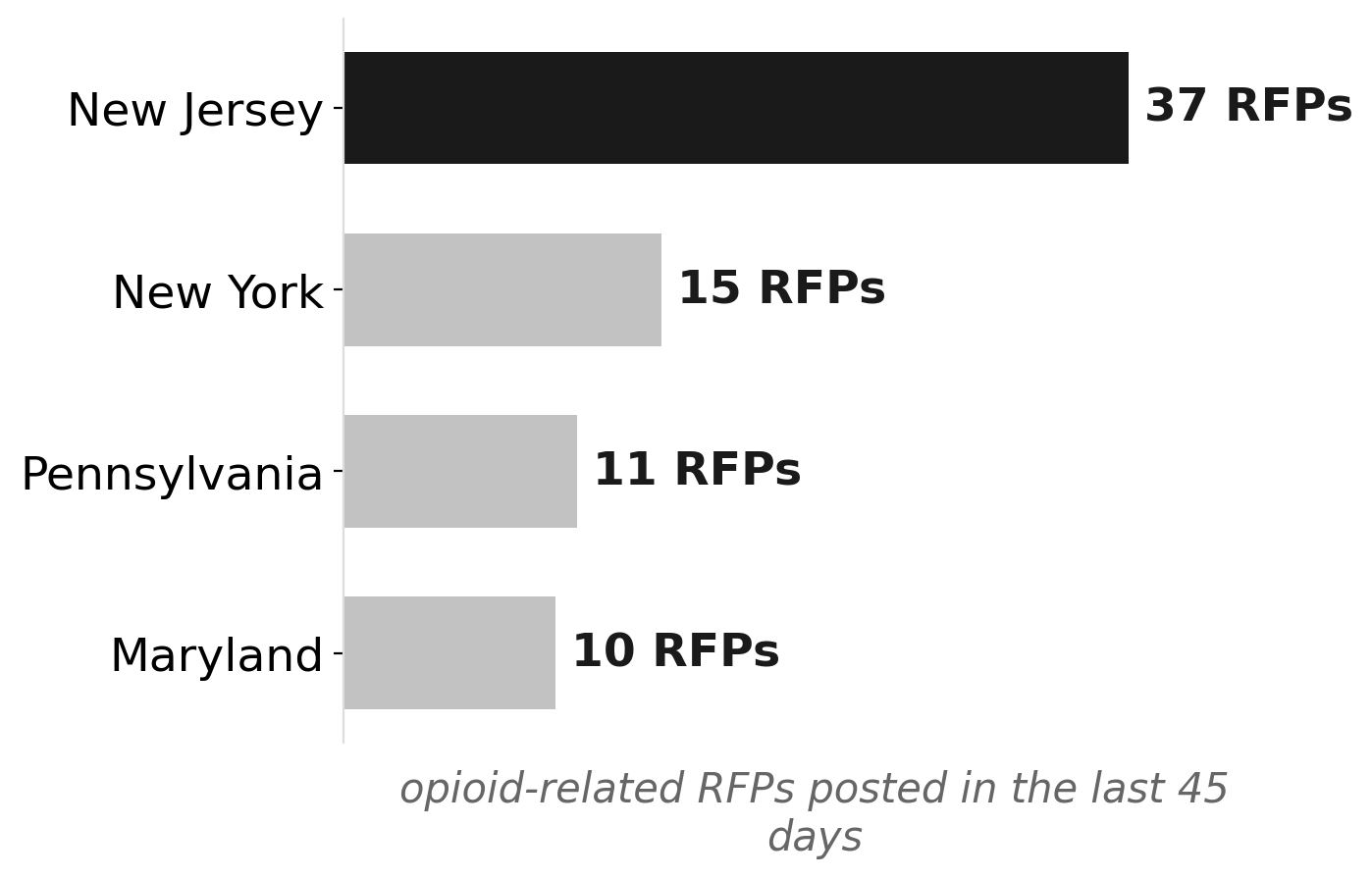
Source: NationGraph.
The result is a simultaneous contracting crunch across at least 15 counties, all trying to obligate funds before December 31, 2026 contract terms expire and before the oversight legislation potentially resets the rules. Atlantic County alone has posted 8 RFPs covering case management, treatment services, and what it calls innovative recovery programs. Sussex, Ocean, Mercer, Hudson, and Camden counties have each posted two or more. The RFPs share a common structure: they cite opioid settlement funds as the source and specify January 1 through December 31, 2027 service periods, meaning counties are contracting next year's programs right now, in October and November, to satisfy the current fiscal calendar.
The paradox the data reveals is that New Jersey built its settlement infrastructure well, it secured deals early, created a dedicated fund, and distributed responsibility to 21 county human-services offices, and that architecture is now the mechanism by which deadline pressure becomes dozens of simultaneous procurements rather than one visible state contract. Each county runs its own competitive cycle. When the pressure is uniform and statewide, every cycle fires at once.
This is not the first sign that the fund has been difficult to govern cleanly. In the FY2025 budget, the Legislature diverted $45 million from the Opioid Recovery and Remediation Fund to four hospital systems, a move that a February 2026 Senate bill sought to reverse by restoring equivalent general-fund dollars. The October hearing made clear that the diversion and the questionable municipal spending are part of the same accountability gap that A5588 is trying to close.
Separate from the settlement money, New Jersey also holds a $140 million SAMHSA State Opioid Response grant running through 2027, part of 79 active federal opioid and substance-abuse awards totaling $340 million obligated statewide. That federal footprint is real and significant, but it is not what is driving the October RFP wave. The settlement funds and the federal grants are distinct streams with different rules, different purposes, and different administrative homes. The procurement surge is settlement money.
For residents in counties where these RFPs are live, the practical effect is that new treatment, case management, and harm-reduction contracts will be in place by January 2027. Whether the programs behind those contracts are strong enough to absorb the money responsibly is the question the Assembly hearing was asking. Advocates have called for independent auditing and clearer eligible-use definitions as minimum conditions before the next tranche arrives.
The next signal to watch is A5588's committee vote. If the bill advances with its 18-month deadline intact, counties will face not just a December 31 crunch but a rolling clock on every future disbursement. That would likely produce a permanent version of the procurement surge now underway, and would put county human-services offices in the position of either building the program capacity to match the money, or returning dollars that were won in a decade of litigation.