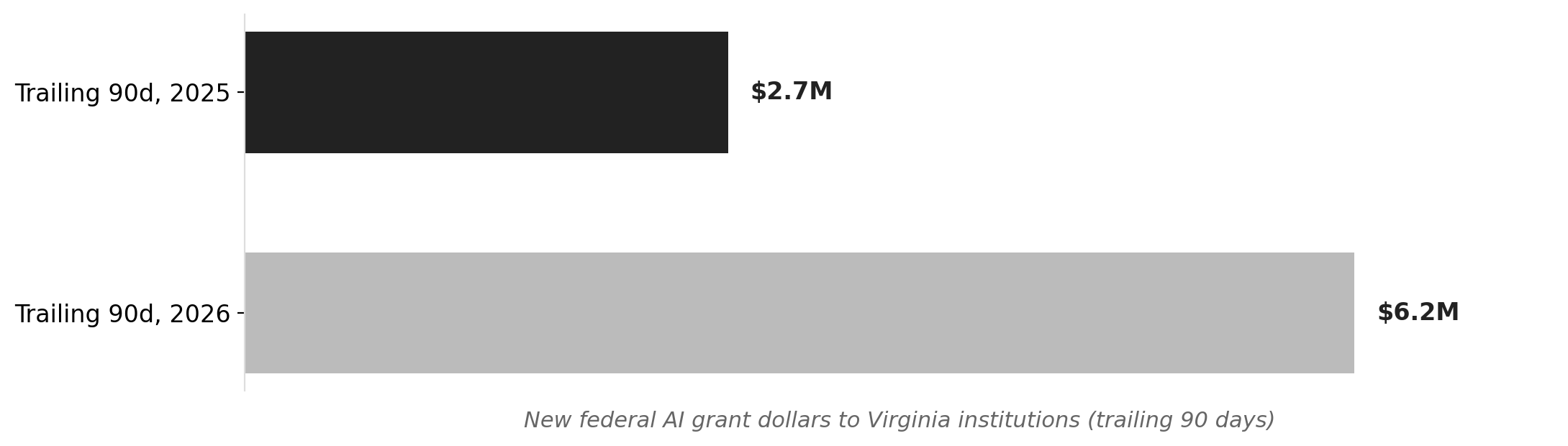
Federal AI grants newly committed to Virginia's public universities have reached $6.2 million in the trailing 90 days, more than double the $2.7 million awarded in the same window a year ago. No single blockbuster contract explains the jump. The money is arriving in dozens of smaller NSF awards, flowing steadily into four campuses, and the pipeline shows no sign of slowing.
The top recipients in the current window are Old Dominion University ($2.5 million, for a STEM education AI program), George Mason University ($1.76 million across four grants in computing and technology), Virginia Tech ($1.45 million across four engineering and CISE grants), and the College of William & Mary ($500,000 in CISE funding). Every dollar in this window comes from NSF. Zero new Defense Department awards have started in the period, though that is about to change.
The primary engine behind the surge is NSF's CISE Future Computing Research program, known as NSF 25-543, the renamed and expanded successor to the legacy CISE Core Programs solicitation. The program runs on a $280 million total anticipated budget, cycles awards twice annually on September and February deadlines, and expects 400 to 600 awards per cycle. Virginia's two biggest recent surges, $12.3 million awarded in October 2025 and $7.6 million in September 2025, track almost perfectly with those deadline windows. The grants are not splashy. They fund foundational machine learning, intelligent systems, and human-computer interaction research at the individual-lab scale, which is exactly what makes them a reliable signal: this is sustained infrastructure investment, not a one-time injection.
Source: NationGraph.
Zoomed out, Virginia's position is stronger than the 90-day number suggests. The state holds roughly $100 million in currently active AI grants across 11 federal agencies. NSF accounts for $45.9 million of that across 84 separate grants. Virginia ranks fourth nationally in 90-day AI grant volume, trailing only California, Massachusetts, and New York, states with research ecosystems two to three times larger by university population.
What makes Virginia structurally distinct from those three peers is where the money goes. In California and Massachusetts, federal AI dollars mix with private-sector R&D at research universities that are themselves deeply embedded in venture-backed tech ecosystems. In Virginia, the recipients are almost entirely public universities, and they are knitted together by a state-funded backbone: the Commonwealth Cyber Initiative, which links Virginia Tech, George Mason, UVA, and others around a shared mission the state describes as building Virginia into a global center of excellence at the intersection of intelligence, autonomy, and security. The CCI has issued 12 or more research awards in its current cycle alone. State investment de-risks federal grant pursuit by building shared infrastructure before the federal dollars arrive.
The geography reinforces the advantage. NSF, DARPA, and much of the defense research establishment are headquartered in or immediately adjacent to Northern Virginia and Arlington. George Mason's main campus sits roughly four miles from the Pentagon. Virginia Tech's Northern Virginia campus in the Innovation Campus corridor opened in 2024 explicitly to deepen that proximity. For program officers and university researchers to be in the same metropolitan area is not incidental; it affects which institutions get early signals about solicitations and which faculty end up on review panels.
The next catalyst is already in motion. DARPA's Decentralized Artificial Intelligence through Controlled Emergence program, known as DICE, held its Proposers Day in Arlington in May 2026 and has full proposals due August 25, 2026. The solicitation seeks to develop AI collectives capable of autonomous, long-horizon missions in contested environments, a research agenda that maps directly onto existing work at George Mason and Virginia Tech. Individual DARPA program awards routinely run $5 million to $20 million, multiples of a typical NSF CISE grant. A single successful DICE proposal could, by itself, exceed Virginia's entire 90-day NSF haul.
A second concurrent opportunity is the AI Forge initiative, jointly launched by DARPA and NSF in June 2026, which funds university-only research in AI interpretability and control at $750,000 to $3 million per project. The program is designed for exactly the kind of foundational-computing departments that George Mason, Virginia Tech, and William & Mary have been building out with NSF CISE support for years.
For Virginians outside the lab, the practical implication is less about any single research result than about workforce and economic geography. Federal AI research dollars fund graduate students and postdocs who, in Virginia's case, are often absorbed by the defense and intelligence contractors concentrated in the Northern Virginia corridor. The public university pipeline and the private-sector demand have been co-evolving for years; the current grant acceleration suggests that relationship is tightening.
The immediate signal to watch is the DARPA DICE deadline on August 25. If Virginia universities land awards in that competition, the state's active AI portfolio will cross into territory that begins to rival the coastal research giants on a per-university basis, not just in raw volume. If they miss this cycle, the February NSF deadline will be the next reset.