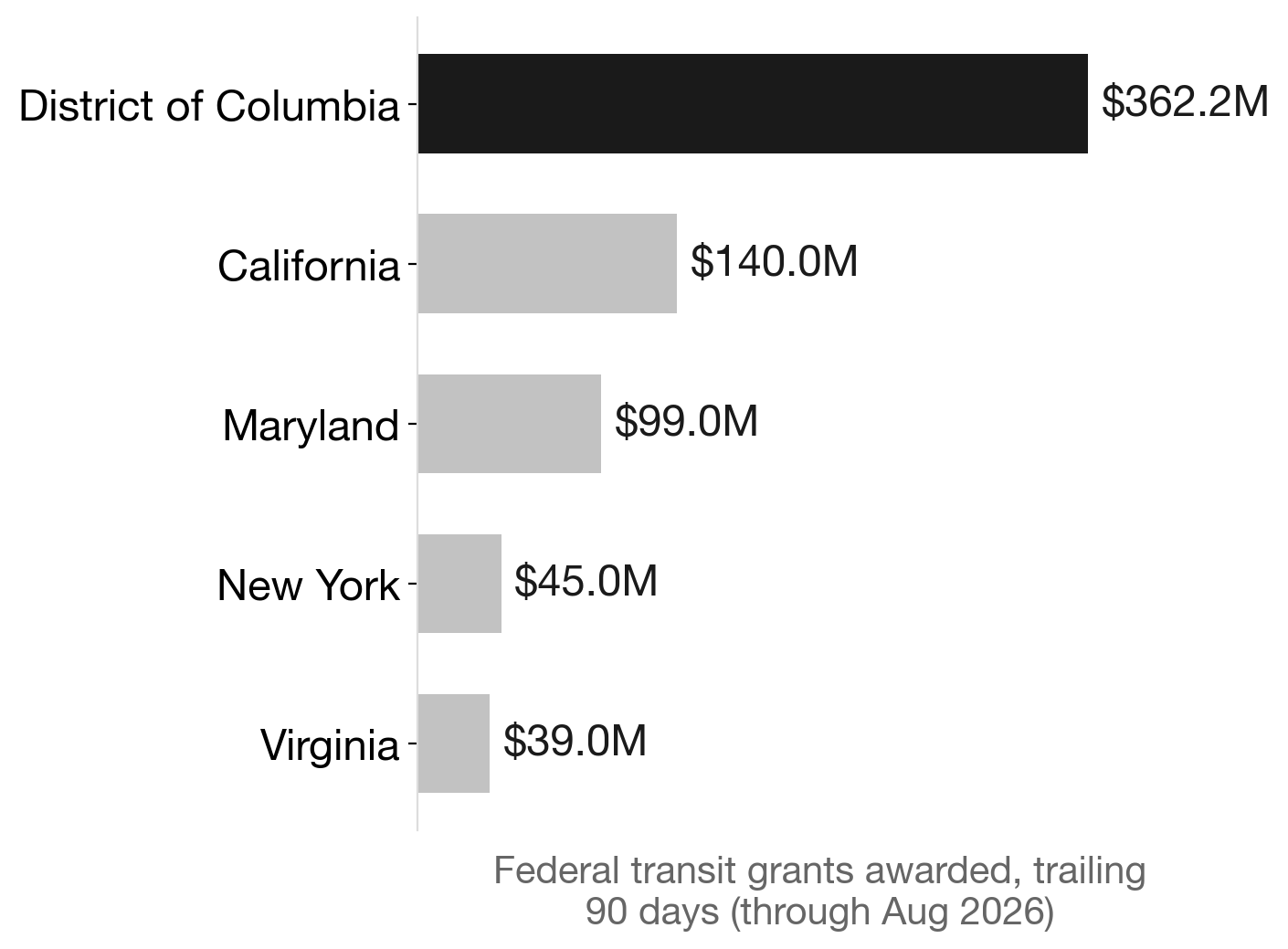
Federal transit grants flowing to Washington's Metro system have hit $362.2 million in the last 90 days, more than double the $170 million the same window delivered a year ago and more than California, Maryland, New York, and Virginia received combined. The surge is not the result of a special appropriation or a political favor. The formula dollars are paying out on autopilot, and WMATA happens to be at the front of the line.
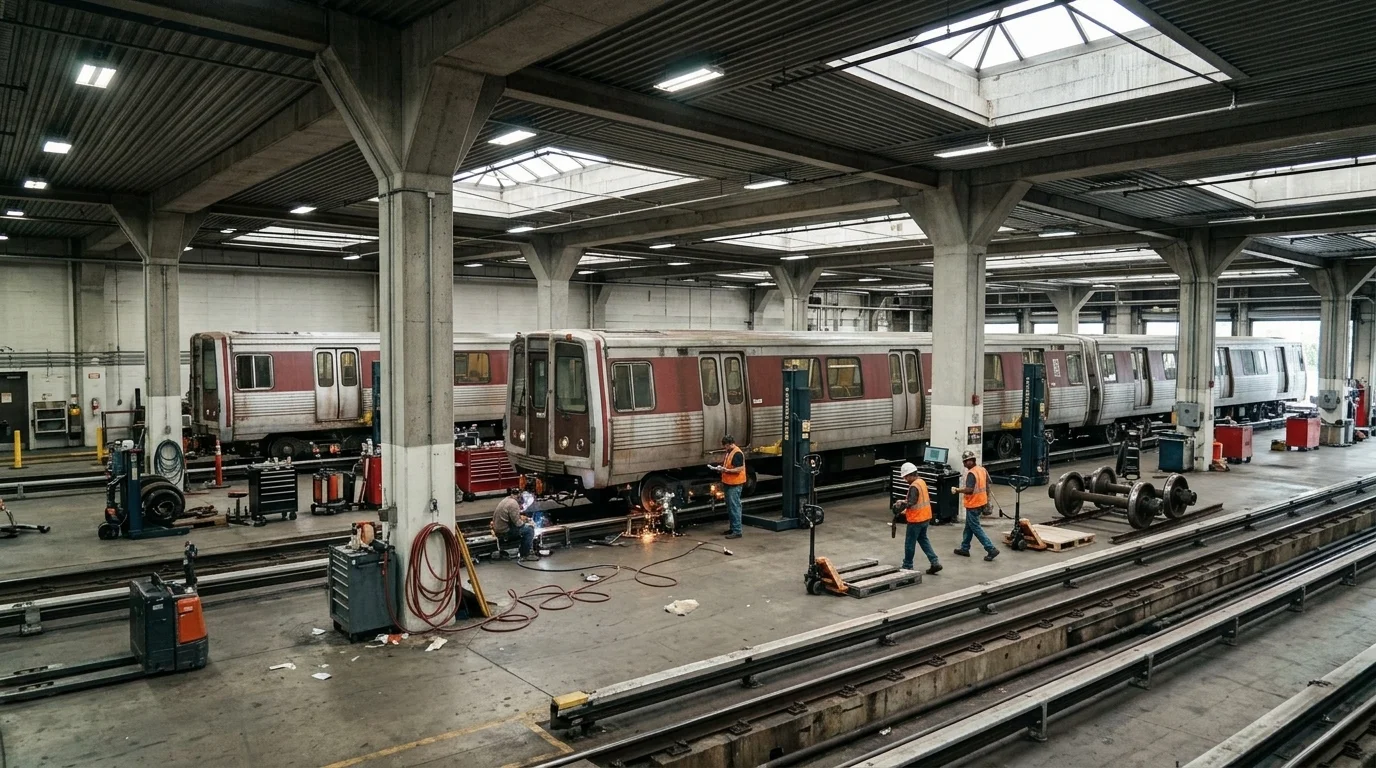
Two awards landed in early and late June 2026, and together they account for nearly the entire increase. On June 9, the Federal Transit Administration disbursed $154.3 million in Low or No Emission Bus grants to WMATA, combining a $50.3 million FY2025 award with a $104 million follow-on tranche, the largest single bus modernization commitment the agency has received. Two weeks later, on June 24, a $191.9 million State of Good Repair grant arrived, running through December 2031 and covering rail car rehabilitation, station infrastructure, and systems-level maintenance that WMATA has long identified as its most urgent capital need.
Both grants draw from the same well: the 2021 Infrastructure Investment and Jobs Act, which authorized more than $108 billion for public transit nationally. The State of Good Repair program (49 U.S.C. §5337) distributes funds through a statutory formula, meaning eligible agencies receive apportionments automatically once the FTA releases them. The June timing reflects the federal government's end-of-fiscal-year grant cycle, not a policy decision about WMATA specifically. What is specific to WMATA is the scale: its active federal grant portfolio from the Department of Transportation now totals $1.18 billion across 22 active grants, with $199.9 million already outlayed and commitments stretching to 2036.
Source: NationGraph.
The concentration looks even starker in cross-state comparison. DC's 90-day total of $362 million exceeds the combined intake of California ($140 million), Maryland ($99 million), New York ($45 million), and Virginia ($39 million) in the same window. That gap is partly structural. Unlike state transportation departments, which spread transit dollars across dozens of local agencies, DC's federal receipts flow almost entirely through a single compact authority serving the District, suburban Maryland, and Northern Virginia. When WMATA's formula apportionment arrives, it shows up in the DC column in full.
The local funding base underneath these grants is substantial in its own right. The DC Dedicated Funding Agreement commits $178.5 million annually from the District for WMATA capital through FY2026. WMATA's Board approved a $2.12 billion Capital Improvement Program for FY2026 in April 2025; through Q3, $1.32 billion of that budget has been invested. The federal surge lands on top of a system already spending at near-record capital rates.
The political backdrop complicates the picture. On March 6, 2025, USDOT Secretary Sean Duffy sent WMATA CEO Randy Clarke a formal oversight letter demanding documentation of steps to reduce crime and fare evasion, signaling that federal-WMATA relations carry real friction even as the checks keep clearing. The letter did not trigger any withholding of formula funds, the statutory structure of §5337 makes that difficult without a formal compliance action, but it introduced a layer of scrutiny that coincides with the largest capital infusion in recent memory. WMATA was named Transit Agency of the Year by the American Public Transportation Association in 2025, citing an eight-year crime low and record ridership growth; the oversight letter and the award arrived within months of each other.
For Metro riders, the practical consequence of this spending moment will take years to materialize. State of Good Repair grants fund the unglamorous infrastructure that keeps rail systems running: rail car overhauls, signal upgrades, tunnel rehabilitation. The bus modernization grants point toward a cleaner, newer fleet on the surface network. Neither produces a ribbon-cutting in the near term, but both address the deferred maintenance backlog that has driven WMATA's reliability problems for a decade.
What riders and regional officials should watch next: the FTA issued a new notice of funding opportunity in late July 2026 for $610 million in additional bus grants nationally, a signal that the bus modernization pipeline is not closing. Whether WMATA competes successfully for another tranche, and whether the oversight letter from Secretary Duffy escalates into a formal compliance review, will determine whether this 90-day surge becomes the floor for a new level of federal investment or a one-quarter anomaly driven by favorable calendar timing.