Federal flood-control grant commitments to Vermont hit $5.37 million in the trailing 90 days ending mid-November 2026, a 1,978% increase over the same window a year earlier, when the state drew just $258,000. The surge puts Vermont second among New England states in new flood-related federal grants over that period, behind only New York's $13.9 million, a striking position for a state of 650,000 people.
The money flows through a layered federal pipeline that two summer 2024 disasters put in motion. When flooding struck Vermont in back-to-back events in July 2024, FEMA issued DR-4810-VT for the July 9–11 floods (declared August 20, 2024) and DR-4826-VT for the July 29–31 floods (declared September 26, 2024). Those declarations did two distinct things at once: they unlocked FEMA's Public Assistance program, which reimburses governments for repairing damaged public infrastructure, and they triggered the Hazard Mitigation Grant Program, which funds measures to reduce future risk. DR-4810-VT alone has since generated $66.7 million in Public Assistance obligations and $9.76 million in hazard mitigation grants statewide.
But the declarations were only the starting gun. On top of the backward-looking disaster response came forward-looking mitigation investment. FEMA's Flood Mitigation Assistance program, administered through the Vermont Department of Public Safety as the state's primary FEMA subgrantee, awarded Vermont $6.4 million in September 2024 and an additional $5.37 million in September 2026, the latter running through September 2029. Combined, the two FMA grants total roughly $11.8 million, with $2.4 million of the earlier award already disbursed. A fourth mechanism arrived in April 2026: the Homeland Security and Further Additional Continuing Appropriations Act, signed April 30, 2026, directed $17 million in pre-disaster mitigation funding to New England with Vermont projects named explicitly: Montpelier's Elm Street Housing Elevation ($1.4 million), Barre's Gunners Brook Floodplain Restoration ($591,000), and Hardwick's Flood Recovery and Resilience Plan ($70,000).
These four programs, Public Assistance, Hazard Mitigation, Flood Mitigation Assistance, and Pre-Disaster Mitigation, are legally and mechanically distinct. PA and HMGP are post-declaration instruments, triggered by catastrophe and aimed at repair and immediate risk reduction. FMA and PDM are proactive, competitive or congressionally directed grants aimed at hardening communities before the next event. What makes Vermont's situation unusual is that all four are running simultaneously, compressing what is normally a years-long sequential recovery into a single overlapping surge. The state's total active flood-tagged federal grant portfolio now exceeds $24 million.
The clearest sign that the money is arriving faster than capacity can absorb it is the procurement record. Active RFPs for flood-mitigation work are flowing from Hardwick, Waterbury, Montpelier, Orange, Woodstock, Plainfield, and Lamoille County, many citing FEMA DR-4810 directly. Montpelier is soliciting architecture and engineering services for flood reconstruction of City Hall, the fire department, and the police station. The Town of Orange is replacing culverts. Waterbury commissioned a Winooski River flood study. And the Town of Wheelock, a community of roughly 600 residents, issued an RFP specifically for a FEMA project manager, a signal that small towns are turning to consultants to do work their staff cannot.
That staffing constraint is the structural risk embedded in this otherwise welcome surge. Vermont's flood geography, a river-dense, mountainous landscape threaded with hundreds of small municipalities, means grants are distributed across dozens of towns that have no dedicated grant administrators, no floodplain managers on payroll, and in some cases no full-time planning staff at all. The Vermont Department of Public Safety serves as the state's primary FEMA subgrantee, concentrating execution responsibility in a single agency already managing overlapping recovery timelines from the historic July 2023 floods (which preceded both 2024 events) and the new 2024 declarations simultaneously.
According to a FEMA press release from September 2026, more than $2.3 million was approved for Vermont specifically through the Community Assistance Program and Pre-Disaster Mitigation programs, underscoring that the pipeline is still opening, not closing. The three-year window on the new $5.37 million FMA grant, running to September 2029, gives Vermont more runway than a typical annual appropriation. But that runway matters only if towns can hire engineers, write environmental reviews, and clear FEMA's project approval process within it. Unspent grant dollars do not roll over indefinitely.
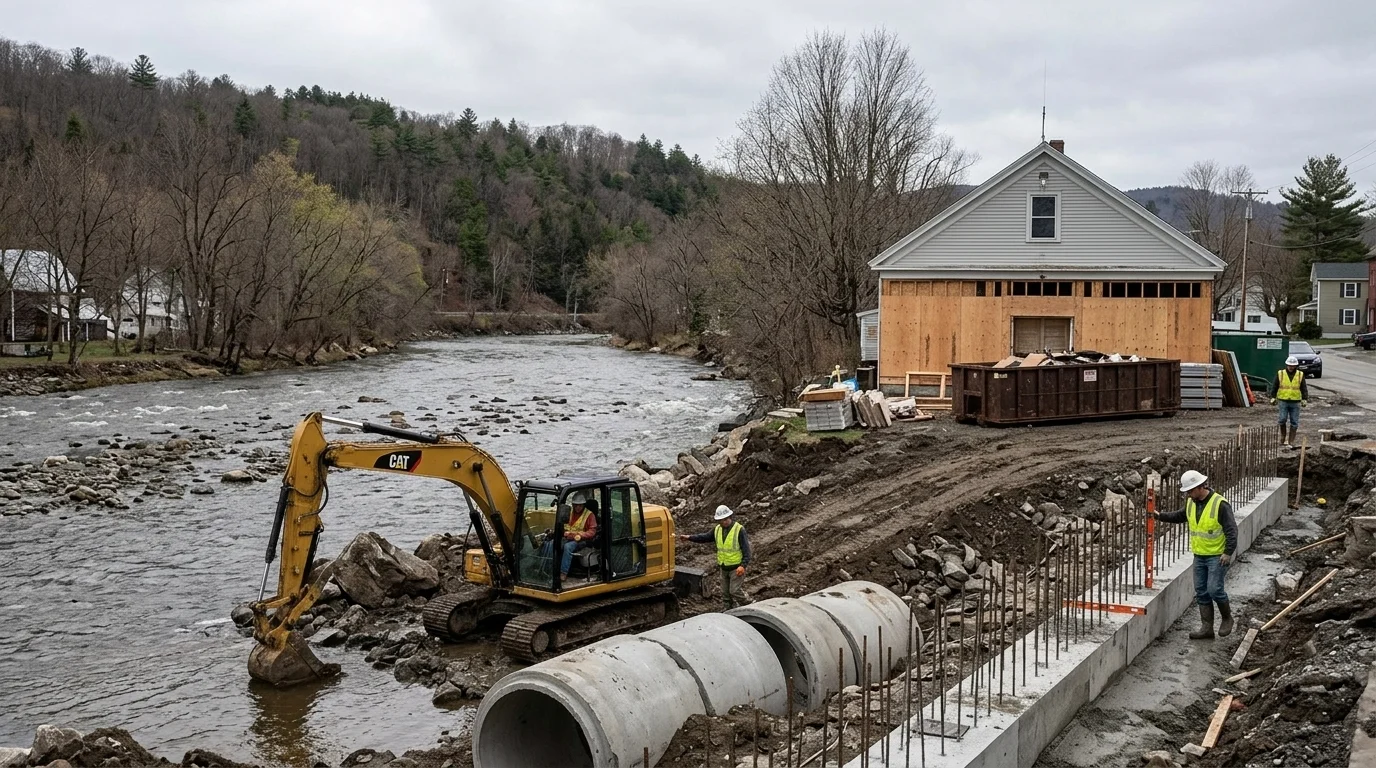
For Vermont residents, the most immediate consequence is a construction and planning boom in river corridors: housing elevations, culvert replacements, floodplain restorations, and updated resilience plans are either underway or in procurement across the state. The projects, if completed on schedule, would materially reduce flood exposure for thousands of households in communities that have flooded twice in two years.
The next signal to watch is how quickly FEMA approves individual subprojects under the September 2026 FMA award. The grant runs to 2029, but FEMA project approvals typically precede spending by 12 to 24 months. If the approval queue stretches, the gap between dollars committed and dollars spent will widen, and the question of whether Vermont has enough planners and engineers to execute will become harder to avoid.