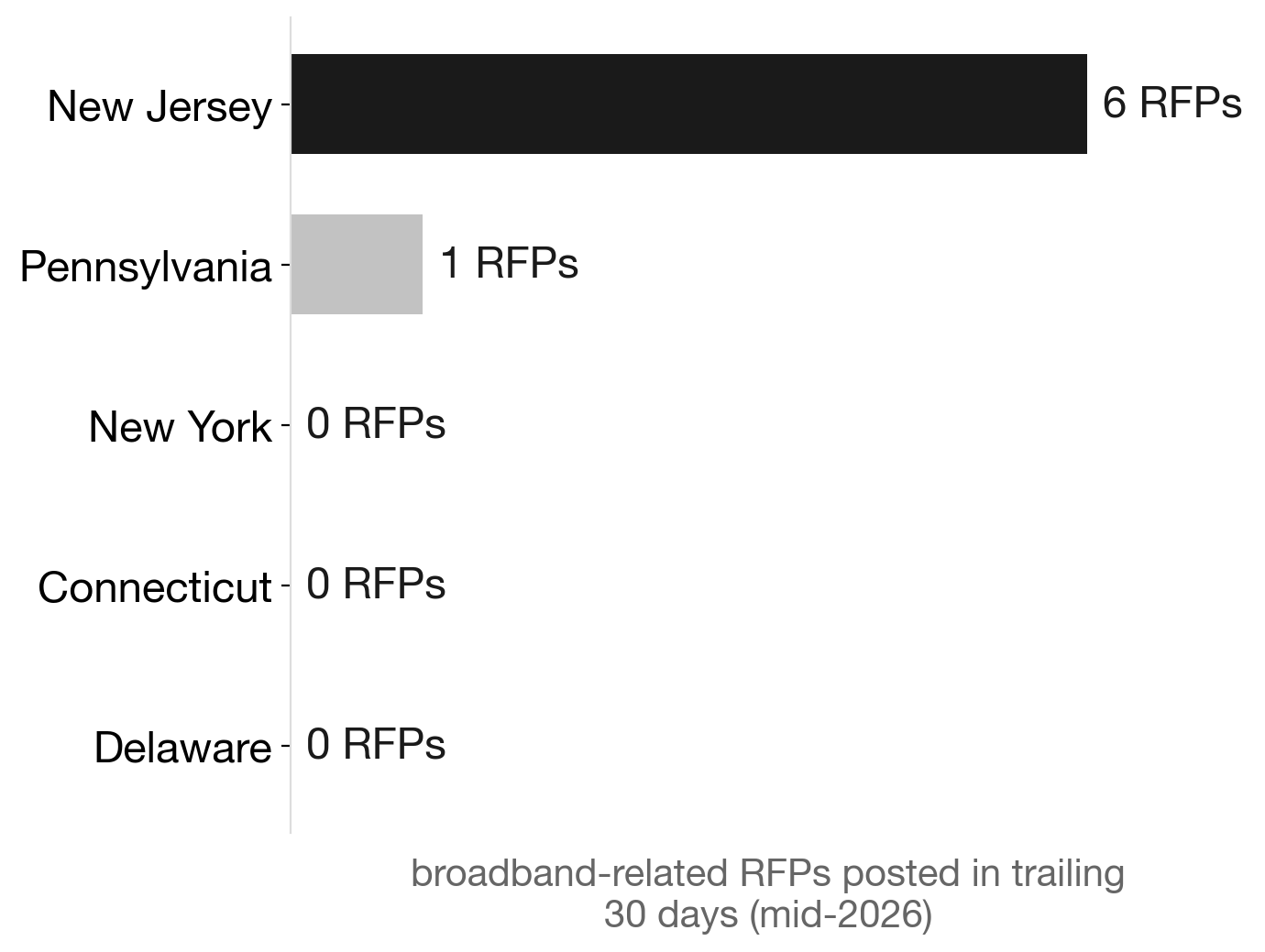
New Jersey posted six broadband-related RFPs in the last 30 days, more than twice the 12-month average of about 2.6 per month, and the two municipalities driving that spike are not suburban tech hubs. They are Vineland and Penns Grove, two economically distressed South Jersey communities that incumbent telecoms spent decades underserving and that are now, with stacked state and federal grants finally clearing construction phase, building their own infrastructure.
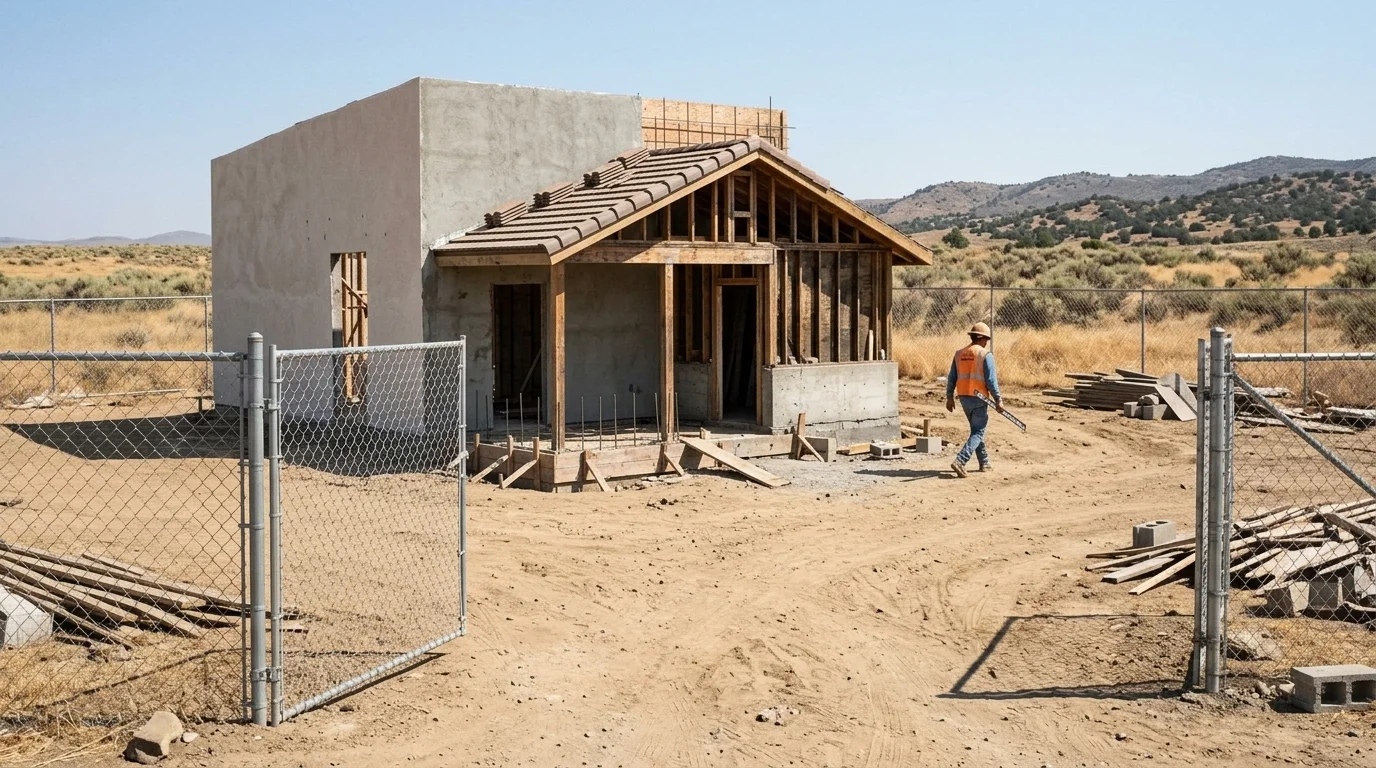
The raw count flatters the trend somewhat: the six filings trace back to two distinct procurement actions, with re-postings and updates inflating the number. But the underlying signal is real. Vineland's newly created Municipal Broadband Utility is soliciting electronic payment processing, the kind of administrative scaffolding you only need once a network is operational. Penns Grove's Borough is soliciting architectural services for a Technology Hub. These are not planning documents. They are construction-phase contracts.
The reason both municipalities are moving at once is that three funding streams are converging on South Jersey simultaneously. The NJBPU's $40M NJBIDE Pilot Program, funded by American Rescue Plan Capital Projects dollars, entered its deployment phase in June 2025, with Vineland and Penns Grove among the awardees. Salem County holds a separate $22.76M NTIA Middle Mile grant active through 2028. And in January 2026, NTIA approved New Jersey's $62M BEAD Final Proposal, authorizing the state to begin drawing funds and initiating construction in early 2026. Grant cycles create procurement cycles, and three programs arriving in the same window are producing a concentrated burst of municipal purchasing activity.
Source: NationGraph.
Vineland's case makes the stakes legible. Cumberland County's largest city has unemployment pockets approaching 9% and poverty rates as high as 19.2% in some neighborhoods. Comcast and Verizon served the profitable parts and let DSL networks decay elsewhere. Rather than wait for a market correction that was not coming, Mayor Anthony Fanucci's administration created a Municipal Broadband Utility from scratch, secured a $3.7M NJBIDE grant, and is now in pilot testing with a Q1 2026 target for initial service. The utility's payment processing RFP is a signal that Vineland expects to have paying customers soon.
Penns Grove, across the Delaware River from Wilmington in Salem County, received a $9.5M NJBIDE award and is building a Technology Hub that will anchor community broadband access in a borough Mayor LaDena Londo has described as having been overlooked and underserved for decades. Salem County's NTIA Middle Mile grant adds backbone infrastructure that makes last-mile investments in places like Penns Grove economically viable, which is precisely the layering logic these federal programs were designed to produce.
The financial picture suggests the procurement surge is early-stage, not a peak. New Jersey's active federal broadband grant portfolio shows roughly $25.7M obligated but only about $578,000 actually disbursed. The gap between commitment and outlay is where construction bids, architectural contracts, and operational service agreements live. As grantees draw down funds over the next two to three years, the volume of procurement activity is likely to grow before it plateaus.
New Jersey's position nationally is also worth noting. The state is among roughly eight jurisdictions, alongside Connecticut, Delaware, Maryland, Massachusetts, Rhode Island, North Dakota, and DC, that have reached active BEAD deployment phase as of mid-2026. That reflects faster planning timelines in smaller-allocation states with existing baseline coverage, but it also reflects genuine administrative execution. New Jersey's total BEAD allocation is $263M, targeting more than 43,000 unserved and 29,000 underserved locations statewide, with South Jersey's seven-county NJBIDE corridor, including Atlantic, Burlington, Cumberland, Essex, Salem, Sussex, and Warren counties, serving as the initial construction front.
For residents of those counties, the immediate signal to watch is service availability timelines. Vineland's pilot is already underway. Penns Grove's Technology Hub will take longer, but the architectural RFP marks the point at which a construction schedule becomes real. For the rest of the state, the South Jersey corridor is a test of whether municipal-built broadband can function as a durable alternative to incumbent providers in communities where the market has clearly failed, a question that $263M in BEAD funds and a parallel state program will now help answer with actual infrastructure rather than projections.
The next milestone is BEAD disbursement. Grants authorized in January 2026 take months to flow into project budgets. When that money starts moving, the procurement numbers will move with it.