Seven New Jersey school districts and municipalities issued solar procurement requests for the first time in more than a year during July 2026, a number that stood at zero for the same window twelve months earlier. The shift is not ideological. It is arithmetic.
The forcing event was a single wholesale electricity auction. In July 2024, PJM's Base Residual Auction cleared at $269.92 per megawatt-day, up from roughly $29 the prior year, an 833% increase in regional capacity prices. That number worked its way through utility rate cases and landed on New Jersey ratepayers starting June 1, 2025, as a 17-20% retail bill increase. By late 2025, the average NJ residential electricity rate had reached 22.55 cents per kilowatt-hour, roughly 25% above the national average, with PSE&G all-in rates approaching 26 cents per kilowatt-hour in 2026. For a school district running a building seven days a week or a borough maintaining a water treatment facility, that is not a rounding error in the operating budget, it is a line item that has started crowding out everything else.
The seven institutions now moving span five counties and three distinct procurement structures, which reflects how many paths the state has opened to local governments. Four school districts, in Morris, Hunterdon, Ocean, and Middlesex counties, are pursuing Power Purchase Agreements, the most straightforward fix: a developer builds and owns the solar installation, the district buys the output at a contracted rate below what the utility charges, and the budget volatility disappears for the contract term. West Windsor-Plainsboro Regional School District in Mercer County is pursuing Solar Renewable Energy Certificate sales, monetizing generation it already controls. Washington Borough in Warren County is offering land for a ground-mounted solar lease. And the City of Camden in Camden County is doing something different from all of them.
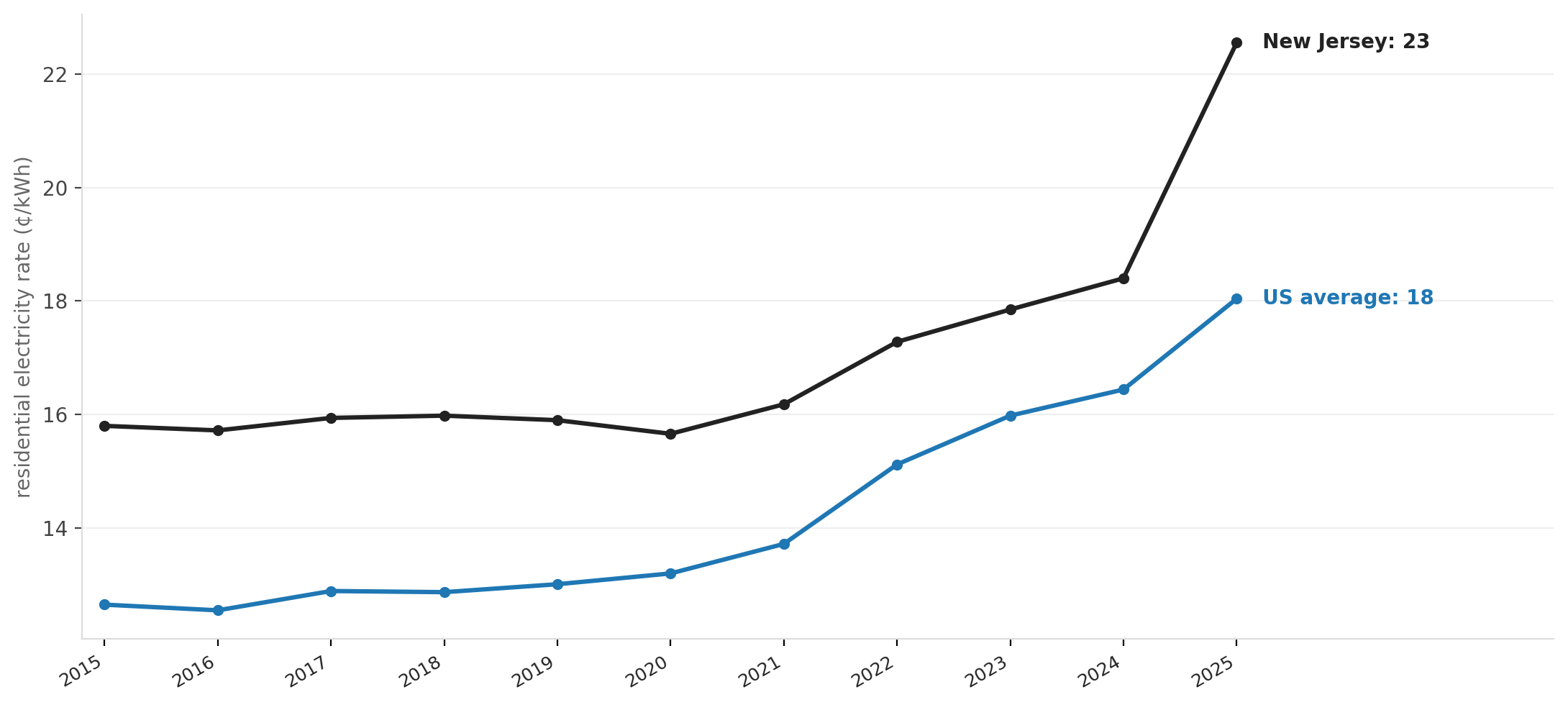
Source: NationGraph.
Camden's RFP 26-04 is the first visible municipal implementation of a procurement mechanism that did not legally exist before April 2025. Under NJBPU regulations that took effect that month, municipalities can now use public procurement to auto-enroll low-and-moderate-income residents in community solar projects, meaning Camden is not just cutting its own electricity costs but building a contract structure that will route bill savings to some of the lowest-income households in the state. Governor Murphy's signing of S4530 on August 22, 2025, enlarged the landscape further: the law opened 3,000 MW of new community solar registration capacity and removed a 150 MW annual cap that had effectively rationed access for years. Local governments now have both the legal authority and the market headroom to act.
The timing also reflects a federal deadline that has already passed. The residential solar investment tax credit under Section 25D expired December 31, 2025. Institutions structuring PPAs and community solar contracts in mid-2026 are locking in terms before the incentive environment deteriorates further, the urgency is not hypothetical.
New Jersey's structural exposure to PJM price swings amplifies all of this. The state generates relatively little in-state capacity and is a net electricity importer in the regional grid. When PJM clears high, NJ customers absorb it more directly than states with larger in-state generation fleets. The state's 2035 100% Clean Energy Standard set a long-horizon target, but the capacity auction compressed that timeline for budget managers who cannot wait for state policy to solve a problem that showed up in this fiscal year's utility invoices. NJ already has more than 5 GW of installed solar capacity and another 1 GW in the interconnection pipeline, the physical infrastructure exists to absorb these procurements.
The regional comparison matters too. New Jersey issued 12 solar RFPs across these 7 institutions in the trailing 30 days, leading Connecticut (9), Maryland (8), New York (8), and Pennsylvania (7). All of those states sit in or adjacent to the PJM footprint and faced the same capacity price shock. The gap in institutional procurement activity suggests New Jersey's combination of higher baseline rates, the new community solar statute, and the NJBPU's April 2025 municipal enrollment regulations is producing faster local-government response than neighboring states have managed so far.
The next signal to watch is whether this July cohort is a one-month spike or the leading edge of sustained volume. The NJBPU was directed under S4530 to open the 3,000 MW community solar registration window by October 1, 2025, that window is now open, and local governments that spent the past year understanding the new rules are now the ones filing RFPs. School boards in districts that have not yet acted face budget cycles where the electricity cost problem does not go away on its own. The question is whether procurement offices can move fast enough to close contracts before the next PJM auction results, due in 2026, reset the calculus again.