New York municipalities issued six pickleball-related RFPs in the 30 days ending September 16, 2026, against an organic baseline of roughly one to two per month over the prior year. That 4x spike is not a coincidence in timing. It is the direct result of a state bond-funded grant program that will cover up to 90 cents of every dollar a town spends on a qualifying court project, provided the town can show a shovel-ready bid when the next award cycle opens.
The grant in question is the Municipal Parks and Recreation (MPR) Grant Program, Round 2, funded by New York's $4.2 billion Environmental Bond Act, which voters approved in 2022. On June 30, 2026, Governor Hochul announced $10 million in awards to 20 projects under the MPR program's second round, with pickleball courts explicitly among the funded uses. The Town of Germantown received $175,181 for four permanent courts at Palatine Park. Auburn received $492,555 for tennis and pickleball court reconstruction at Casey Park. The Town of Gates received $377,000 for new pickleball court additions at Lions Park. The program covers up to 90% of eligible costs, capped at $900,000 per project, with a 10% local match required. For a small municipality, that math is nearly impossible to ignore.
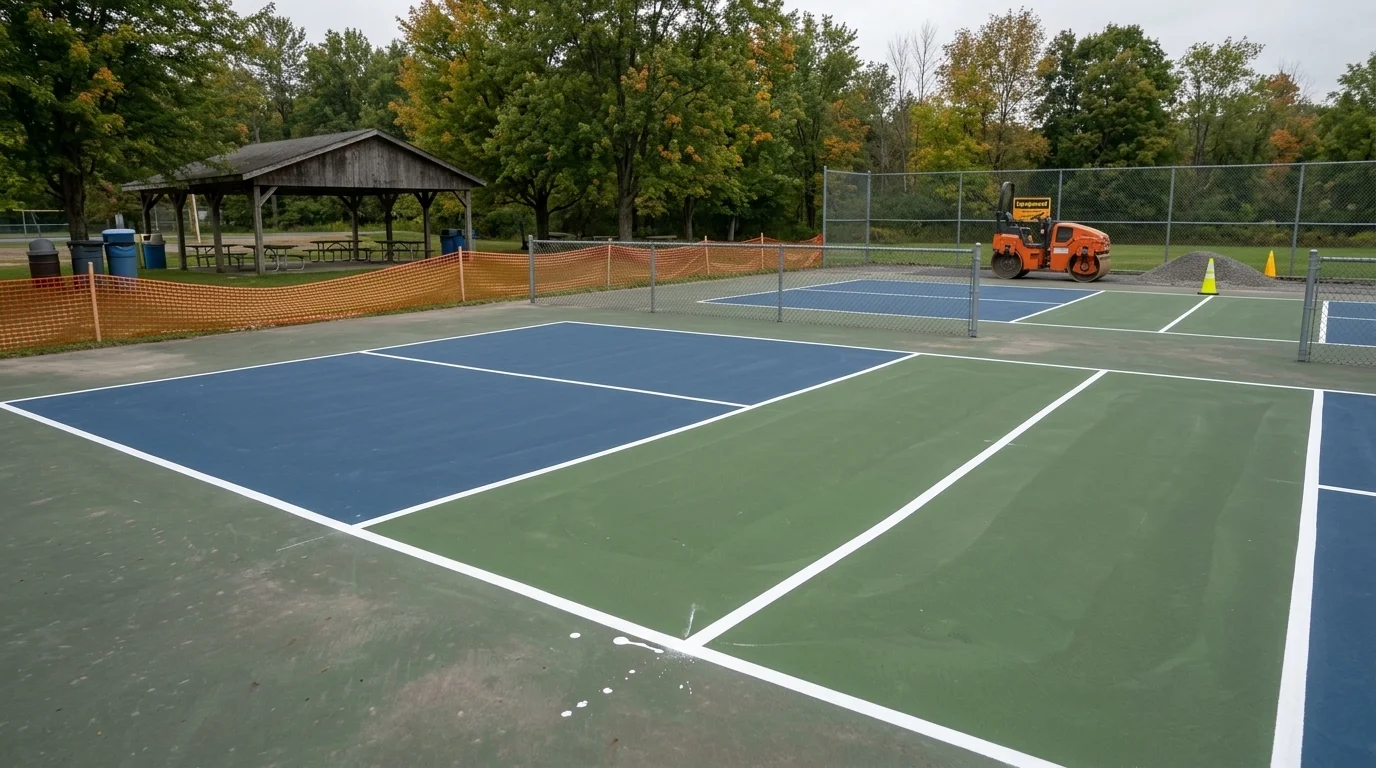
The RFP surge reflects how reimbursement-based grant programs actually work in practice. Towns do not receive money up front; they receive it after documenting what a project will cost. Getting competitive bids out now lets a municipality arrive at the next MPR application window with a real number in hand, rather than an estimate. The six active RFPs span the full lifecycle of court infrastructure: Briarcliff Manor in Westchester County is soliciting bids for new pickleball courts at Chilmark Village Park; the Town of Clarence in Erie County is rehabilitating sport courts at Town Place Park; and Orange County is resurfacing six existing courts, a signal that earlier investment has now entered a maintenance cycle requiring its own round of documented costs.
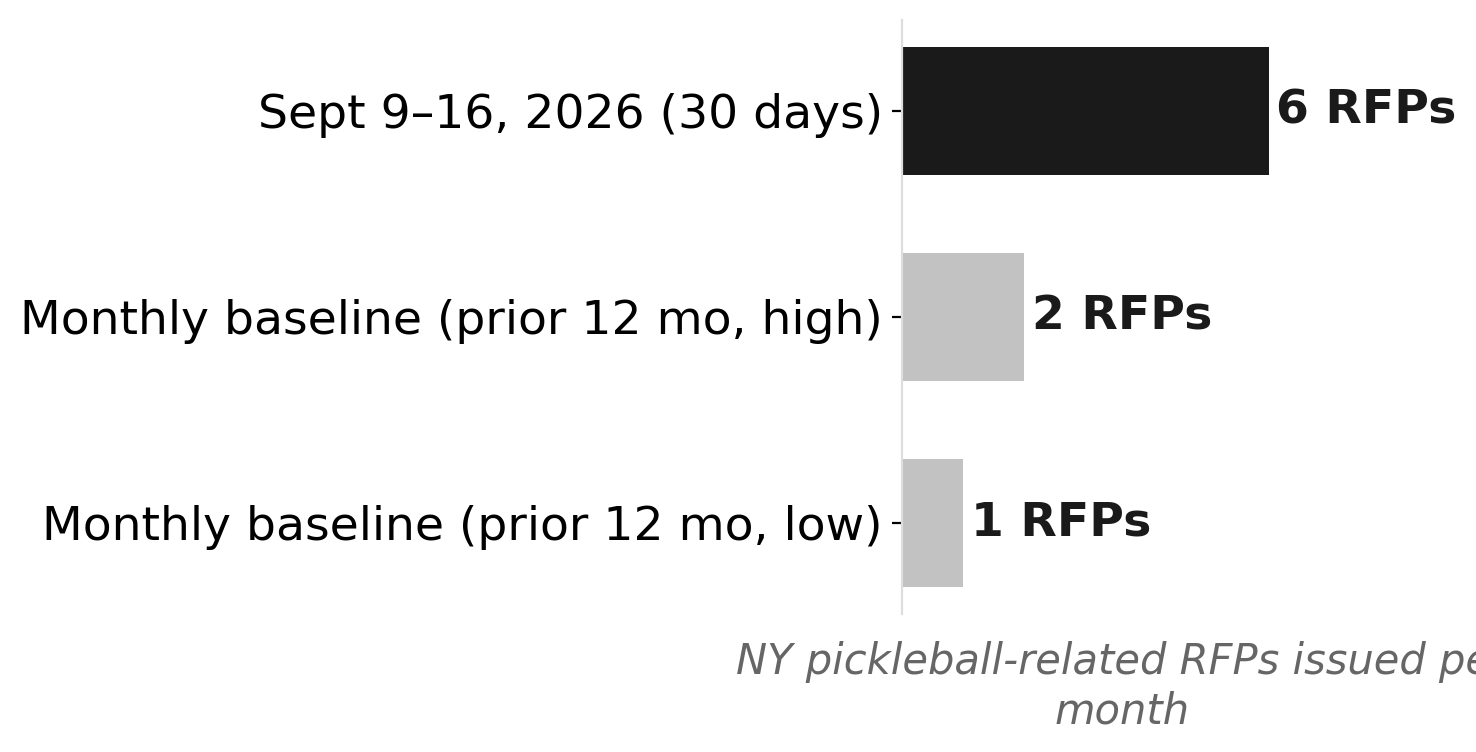
Source: NationGraph.
A second program is adding urgency on a parallel track. On August 31, 2026, Hochul announced $75 million in Round 2 funding for NY BRICKS, Building Recreational Infrastructure for Communities, Kids and Seniors, a separate state appropriation aimed at indoor community centers rather than outdoor parks. NY BRICKS applications open November 2 and are due December 7, 2026. The program funds construction and renovation of municipal and nonprofit community centers, which can include indoor court facilities, with grants ranging from $250,000 to $15 million. BRICKS and MPR share a political umbrella, Hochul brands both under the 'Unplug and Play' initiative, and both are administered by NY State Parks, but they draw on different funding mechanisms and serve different infrastructure types. Towns eyeing an indoor court facility under BRICKS have their own reason to move quickly on documentation before December.
It is worth being precise about the money's origin. The MPR grants are funded by the Environmental Bond Act, a state bond bill, not federal grants, not FEMA dollars, not any federal pass-through. That distinction matters for how towns account for the funds and for understanding why New York's architecture here is relatively unusual. Most states building recreational infrastructure rely on general appropriations or federal Community Development Block Grants, which carry different matching requirements and timelines. New York's dedicated bond act gave Albany a standing pot of outdoor recreation money that municipal parks departments can tap on a rolling basis, making the grant infrastructure more predictable and the procurement incentive more durable.
New York's current pace puts it tied for second nationally in pickleball RFP volume over the past 30 days, behind Massachusetts at eight. Florida, Tennessee, and California are also at six. The national comparison suggests pickleball infrastructure is genuinely booming across the country, but New York's clustering in a tight 30-day window, driven by specific grant deadlines rather than general enthusiasm, is a distinct phenomenon.
For residents in Westchester, Erie, and Orange counties, the practical consequence is new or resurfaced courts arriving within the next one to two construction seasons, largely at state expense. For other municipalities watching from the sideline, the window to move on MPR Round 3 will depend on when NY State Parks announces the next solicitation; the pattern from Rounds 1 and 2 suggests annual cycles. Towns that have not yet bid out a project have less leverage at that window than towns arriving with contractor pricing already in hand.
The next concrete signal to watch is the NY BRICKS application deadline of December 7, 2026. If indoor court facility projects appear in that award announcement, expect another RFP spike to follow in early 2027 as those awardees move toward construction documentation.