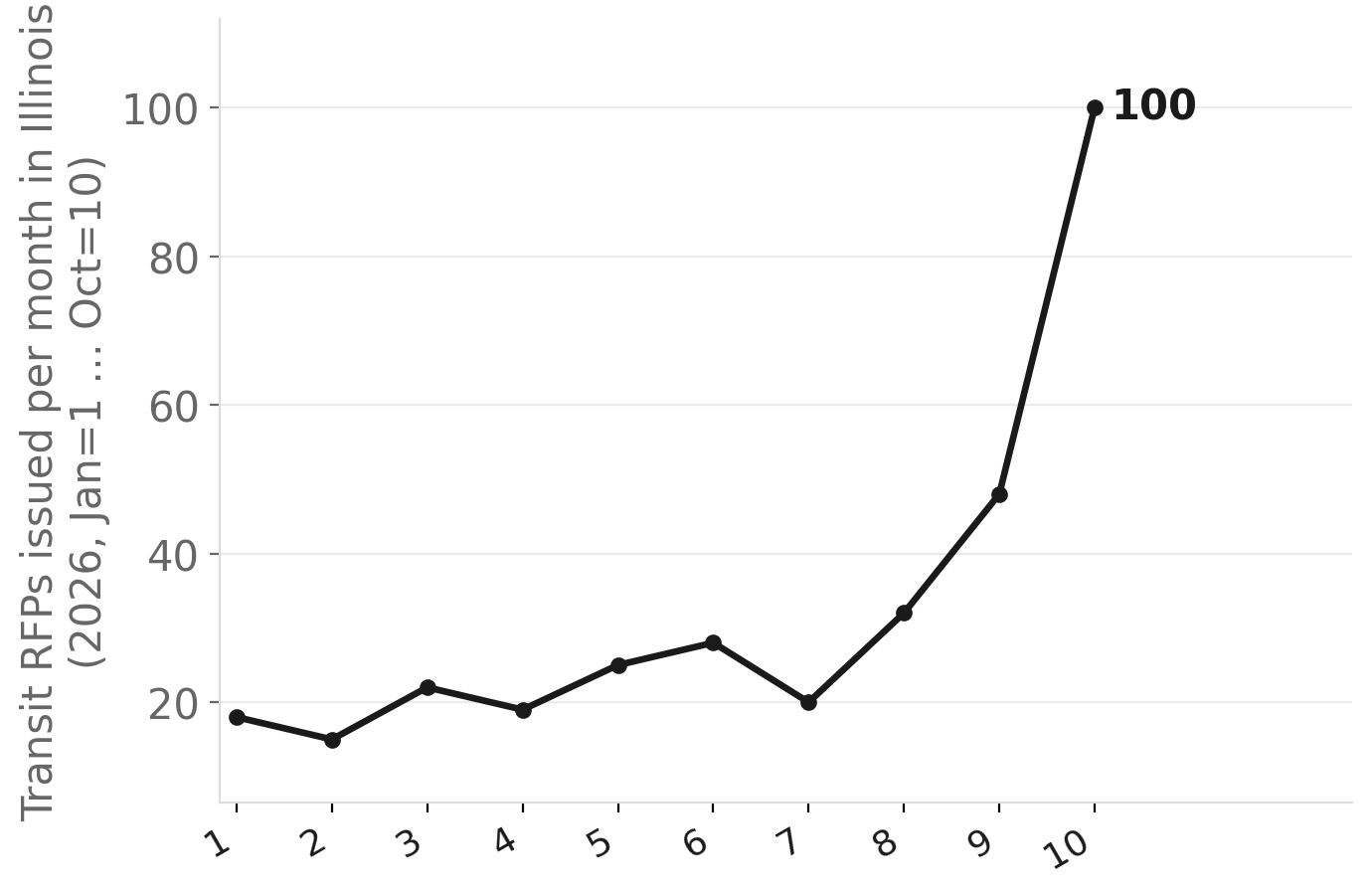
Illinois transit agencies posted 100 RFPs in October 2026, roughly 4.8 times the trailing 12-month average of about 21 per month. At least 71 of those are genuinely new solicitations, not updates or rebids. No prior month in 2026 came close: the previous high was 48.
The timing is not a coincidence. The Northern Illinois Transit Authority, created by Senate Bill 2111 and formally replacing the Regional Transportation Authority on September 1, 2026, seated its 20-member board on that date. October's wave arrived five to six weeks later, the first full procurement cycle in which NITA held independent authority to solicit contracts. The bureaucratic machinery of a new superagency turning on looks, in the data, like a starting gun.
Three forces converged to produce the surge simultaneously. First, governance: NITA inherited the RTA's contracting authority and immediately needed its own procurement vehicles, vendor relationships, and institutional infrastructure. Second, mandate: the NITA Act requires that every bus purchased from June 1, 2026 forward be zero-emission, forcing fleet procurement restarts across all service boards regardless of where they were in prior contract cycles. Third, money: new state revenue streams created by SB 2111, a redirection of the motor-fuel sales tax providing roughly $731 million annually for NITA regional operations, and a dedication of Road Fund interest providing roughly $180 million annually for capital projects, began flowing July 1, 2026. Agencies now have funds they are legally required to begin spending down within the current fiscal year.
Source: NationGraph.
The breadth of issuers matters as much as the volume. The Chicago Transit Authority and the Saint Clair County Transit District each filed six new RFPs; RTA/NITA itself filed five; Madison County Mass Transit District filed three; the City of Chicago filed three. Pace Suburban Bus and Springfield Mass Transit were also active. This is not a Chicago phenomenon reshuffled into regional headlines. As the RTA noted when the bill passed, SB 2111 was designed to stabilize the entire regional network, and the procurement footprint reflects that scope.
The fiscal urgency underneath the procurement surge is worth stating plainly. Before SB 2111 passed the General Assembly on October 31, 2025, the CTA was on track to exhaust operating funds by mid-2026, with Metra projected to follow by year-end. The law averted that cliff, but it did so by attaching new money to new obligations. NITA must integrate three separate fare systems by 2030. It must build a new law enforcement structure. And it now carries a 10-year regional capital need identified at $44.6 billion, against which the new funding streams are a start rather than a solution.
Federal dollars are layered on top of the state restructuring, though they are distinct programs with separate purposes. Illinois currently holds $2.84 billion in active federal DOT transit grants across 70 awards. In September 2026 alone, the federal government committed an additional $94.8 million in new formula grants to the state, including $75.5 million for rural and small urban transit through the FTA's Section 5311 program and $12.3 million for bus fleet replacement and low- or zero-emission vehicle transitions through Section 5339. Those federal flows predate NITA and run through IDOT and directly to agencies like the CTA, but they are landing in the same window as the state restructuring, amplifying the pressure to procure.
The NITA Act also opened a category of solicitations that did not previously exist under the RTA structure: transit-oriented development and joint development authority. Some of the October RFPs likely reflect agencies beginning to test that new authority, adding real-estate and land-assembly solicitations to what had historically been a narrower procurement menu.
For riders, the immediate consequence of the RFP surge is not visible, procurement precedes construction and operations by months or years. What the October numbers signal is that the institutional transition is real and moving faster than the public-facing rollout might suggest. NITA's own transition timeline set several year-end 2026 deadlines for contracting and budget obligations, and agencies appear to be meeting them.
The next signal to watch is whether November and December sustain elevated volume or fall back toward the historical average. A sustained plateau would suggest the surge reflects genuine institutional buildout. A sharp drop would suggest October was a one-time catch-up, agencies clearing the backlog of solicitations that had waited for the new board to take authority. Either way, the October number has already established NITA's procurement era as something categorically different from what the RTA left behind.