Maryland has issued five electric vehicle procurement solicitations in the past 30 days, more than three times its trailing monthly average of roughly 1.6, and the burst is concentrated almost entirely at two state agencies racing against two separate clocks at once.
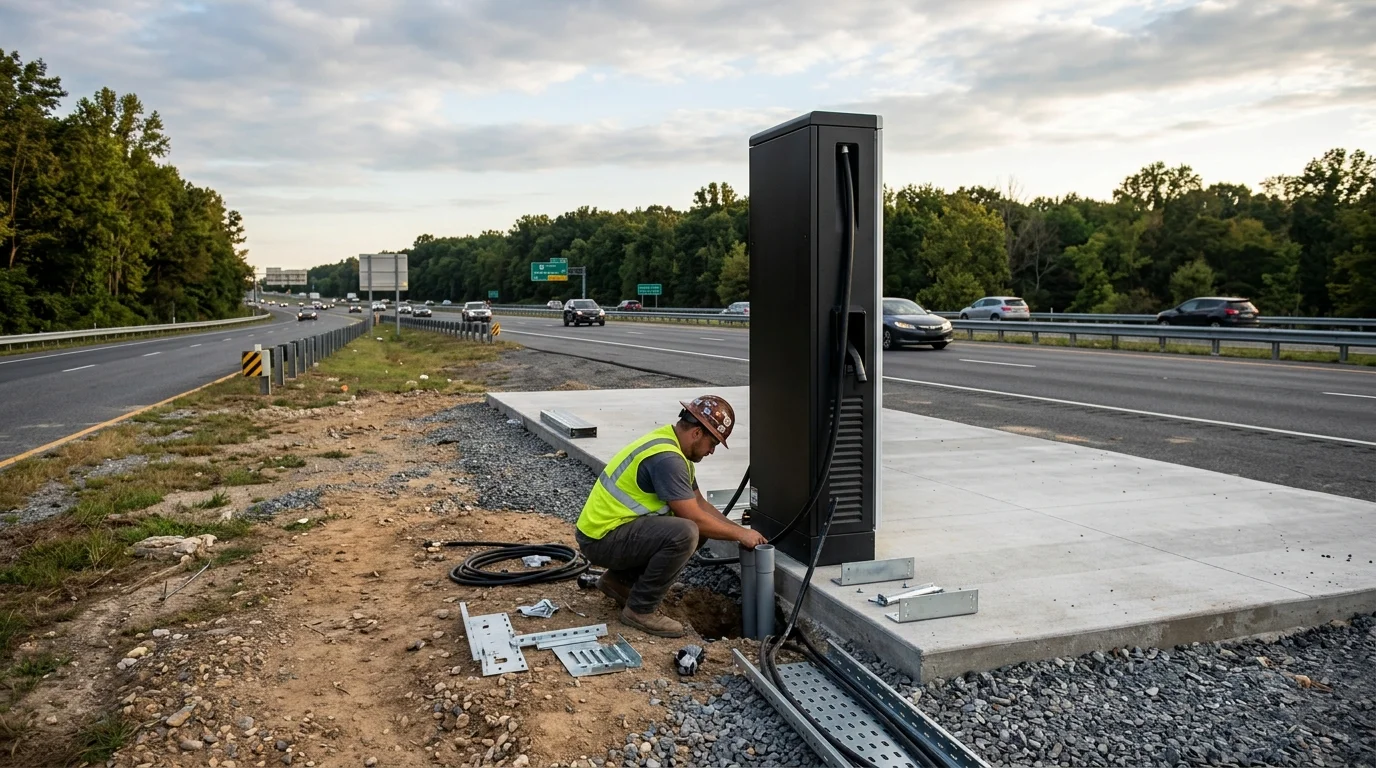
Four of the five RFPs come from the Maryland Department of General Services. Two solicit statewide fleet contracts for electric passenger vehicles and Type 4-9 buses (model year 2026); two more seek statewide contracts for EV charging station equipment and services. A fifth, from the Maryland Transportation Authority, covers comprehensive ITS and electrical engineering services. No neighboring state comes close in the same window: Virginia has two EV-related solicitations, the District has one, and Pennsylvania, Delaware, and North Carolina have none.
This is not the output of a state smoothly executing a long-planned green agenda. It is the sound of a system under simultaneous statutory and fiscal pressure, finally moving.
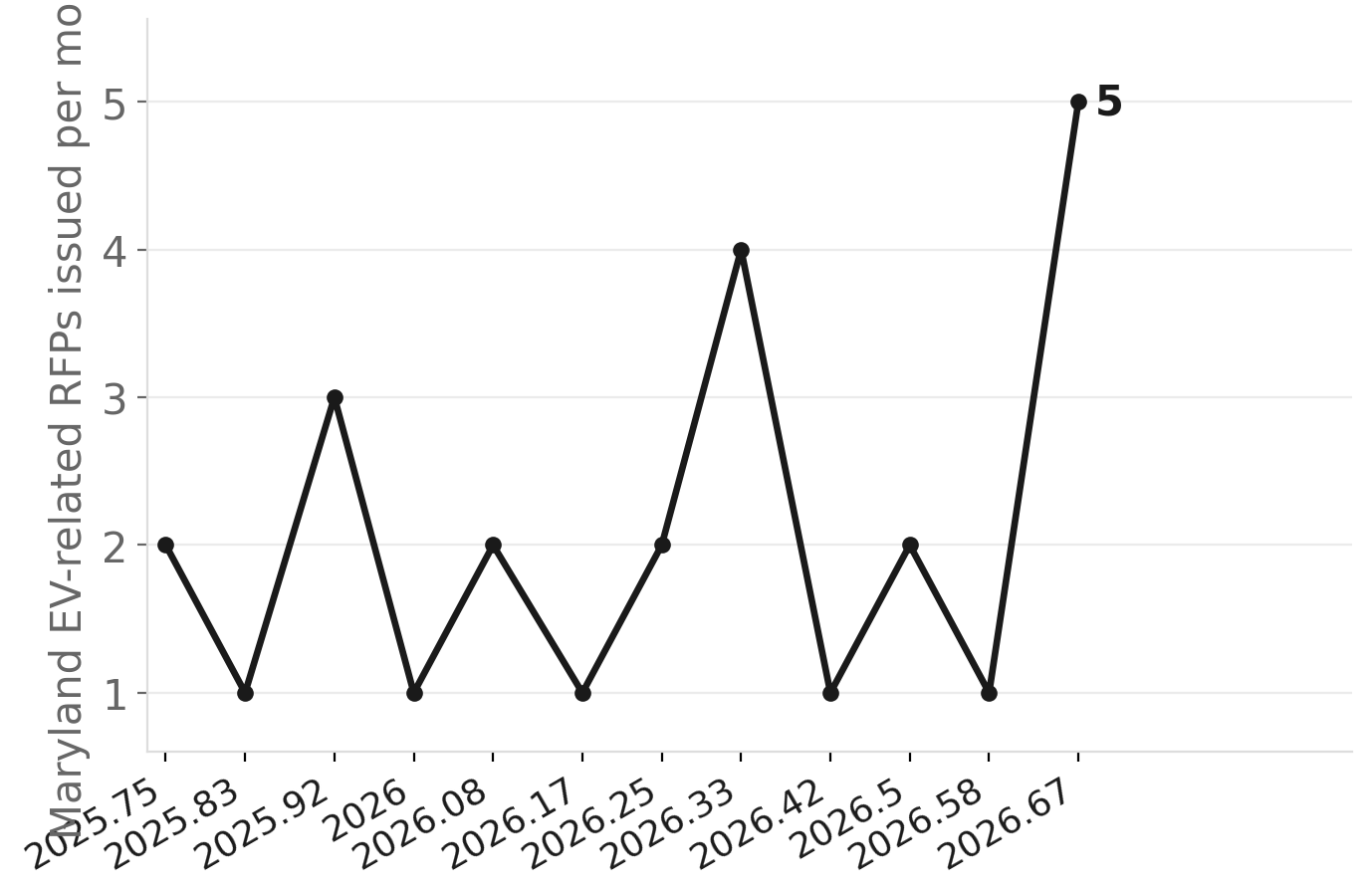
Source: NationGraph.
The first pressure is Maryland's Climate Solutions Now Act of 2022, which requires that 50 percent of new state passenger vehicle purchases be zero-emission vehicles in fiscal years 2026 and 2027, rising to 100 percent in FY2028 and beyond. DGS issues statewide contracts that all state agencies draw on to meet those targets, so if the contracts aren't in place, compliance is structurally impossible. The DGS fleet RFPs are not optional; they are the mechanism the law depends on.
The second pressure is federal money that nearly slipped away and may not survive the next appropriations cycle. Maryland received a $63 million apportionment under the National Electric Vehicle Infrastructure (NEVI) Formula Program, a federal grant administered through FHWA and MDOT to build publicly accessible fast-charging stations along designated highway corridors including Interstates 95, 70, and 495. As of early 2026, Maryland had obligated just $15.6 million of that total, roughly 25 percent, according to a Sierra Club Maryland report from April 2026. Its entire $33 million Charging and Fueling Infrastructure grant allocation, a separate federal program targeting community and corridor charging beyond designated highways, sat at zero percent obligated and spent.
The gap between Maryland's allocation and Maryland's action widened significantly because the Trump administration froze NEVI program funds in February 2025. A court order eventually restored access, with funds fully secured only in January 2026. That freeze cost the state roughly a year of deployment momentum. Then Congress's Consolidated Appropriations Act, 2026 transferred some unobligated NEVI funds for other purposes, a concrete signal that states sitting on unspent allocations face real political risk. The $47 million still on the table in Maryland is not guaranteed to stay there.
MDOT has been moving on its own NEVI pipeline in parallel. Its Round 2 NEVI awards reached 12 sites across 12 counties, totaling $9.5 million. Round 3, launched in March 2026, made up to $10 million available. MDOT published its Zero Emission Vehicle Infrastructure Plan on May 18, 2026, pursuant to Governor Moore's Executive Order 01.01.2024.19. Secretary Katie Thomson has described the program's goal as making EV charging as easy as fueling a gas-powered vehicle, a framing that points toward the 5,302 public charging ports Maryland currently supports against a registered EV population of more than 150,000 vehicles.
The DGS charging-station RFPs and the NEVI and CFI programs are distinct tracks with different mechanisms. NEVI and CFI reimburse private operators at an 80 percent federal share to build and operate public chargers along corridors and in communities. The DGS RFPs procure equipment and services for state-owned infrastructure. The Climate Solutions Now fleet mandate drives the vehicle purchase contracts through an entirely separate statutory channel with no direct federal funding attached. The September 2026 RFP cluster is not one program accelerating; it is three separate policy tracks, federal infrastructure grants, a federal transit bus grant to MTA, and a state fleet compliance mandate, all hitting their activation points in the same month.
For Marylanders, the near-term effects are most visible on the infrastructure side: MDOT's NEVI program page tracks corridor charging buildout as sites come online. For state employees, the DGS fleet contracts determine what vehicles agencies can actually purchase to hit the FY2027 ZEV acquisition threshold. For commuters and freight operators, the Maryland Energy Administration's community EVSE grant program, which opened for applications in September 2026 with $2.5 million in state appropriations, adds a third layer of charging deployment running alongside the federal corridor work.
The next signal to watch is whether the DGS contracts actually close before the FY2027 procurement window opens and whether MDOT's Round 3 NEVI awards can move the obligated-spending needle past 25 percent before Congress revisits infrastructure appropriations again. Maryland has the mandates and, for now, the federal money. What September's RFP surge shows is that the state's procurement machinery is finally treating both as the deadlines they are.