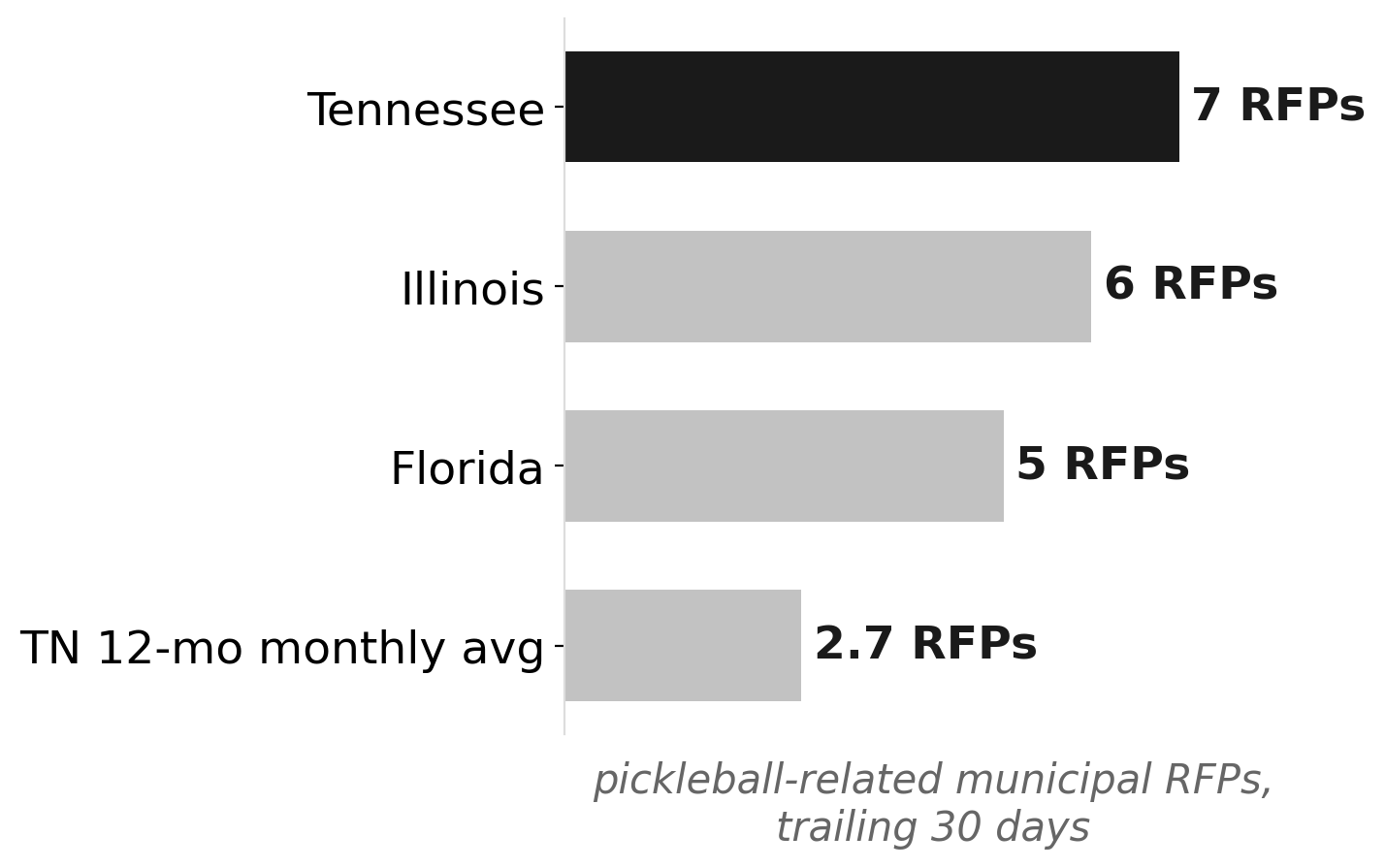
Seven pickleball-related construction bids have hit Tennessee's public procurement market in the last 30 days, more than any other state in the country and 2.6 times the state's own monthly average. Illinois is in second place with six, Florida third with five. The spike is not a coincidence of timing: it lands almost exactly four to eight weeks after TDEC's August 20, 2026 announcement of $18.49 million in Local Parks and Recreation Fund grants for 19 Tennessee communities.
The LPRF is a state appropriation, not a federal program. Under TCA 67-4-409, a dedicated stream of state tax revenue flows annually to TDEC's Office of Outdoor Recreation, which competitively awards capital grants to local governments for park construction, land acquisition, and facility improvements. Communities apply in winter, awards come in summer, and construction bids follow in late summer and early fall. That calendar is visible in the procurement data: the current September surge mirrors a spike that followed the July 2025 LPRF round, which sent $22 million to 31 communities and explicitly named pickleball courts in several project scopes, including Lakeland's six-court complex, Lebanon's Don Fox Park, and White House Municipal Park.
What's new in the 2026 round is who is showing up to bid. TNECD's Grant Opportunity Fund contributed $6.8 million in matching dollars specifically for distressed and at-risk rural communities. That matters because the LPRF requires a one-to-one local match: for every state dollar, the receiving municipality must put up an equal amount of its own funds. For small towns operating on thin budgets, that requirement has historically been the barrier that kept them out of the program. The GO Fund removes it for rural communities by covering the local share on their behalf.
Source: NationGraph.
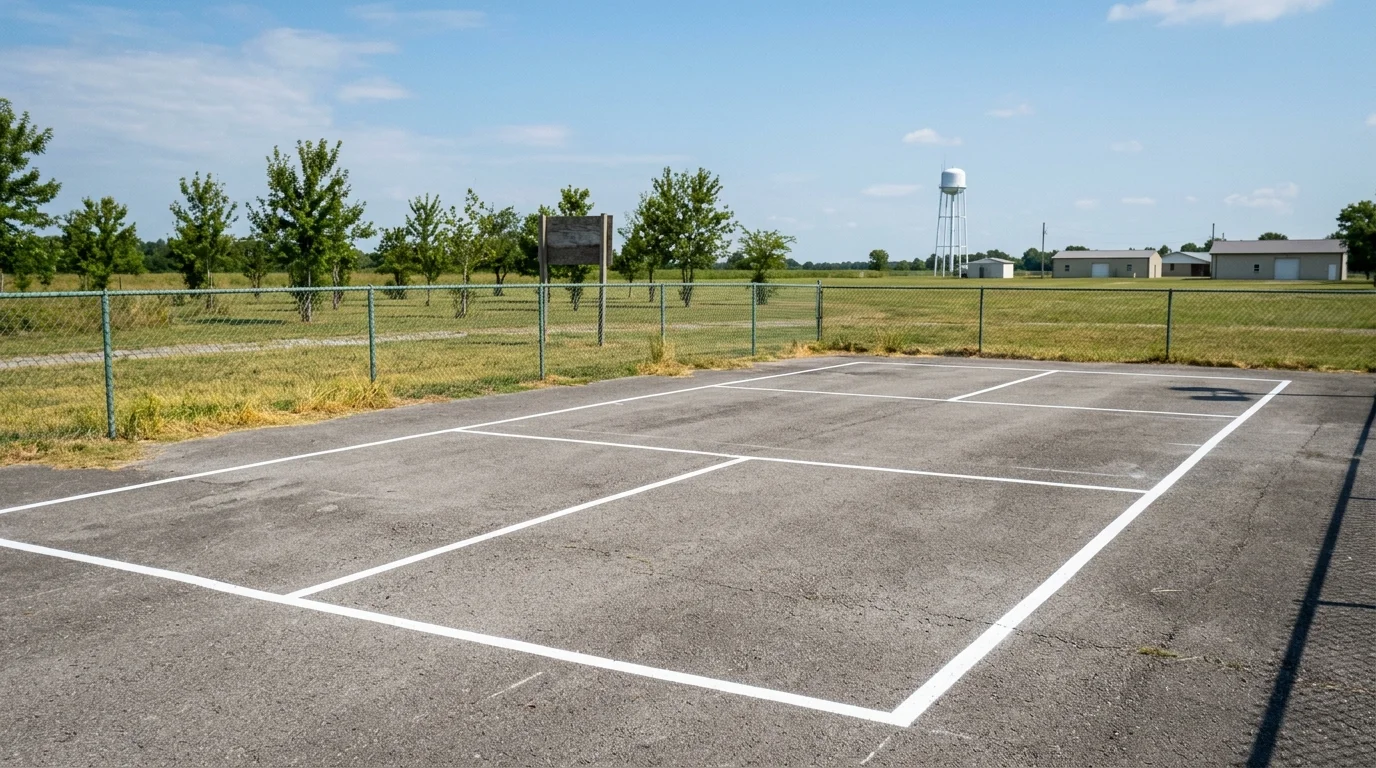
The effect is visible in the current RFP geography. Lewisburg, a Marshall County town of roughly 12,000 people, issued three separate scopes for a new recreation center court complex: asphalt paving, perimeter fencing, and acrylic surfacing with line-striping. Carthage, the Smith County seat with a population around 2,600, bid court resurfacing work for a combined basketball and pickleball facility. Tipton County's bids include pickleball amenity components within a broader farmers market park phase. These are not the mid-sized suburban cities that dominate most state grant programs. They are the rural communities the GO Fund was designed to reach, and they are now going to market.
TDEC Commissioner David Salyers called the 2026 round "a smart investment in Tennessee's communities." The data suggest the investment has a reliable downstream effect. Tennessee has now run LPRF rounds large enough to produce measurable construction procurement spikes in consecutive years, and the 2026 additions to the program's architecture make it likely that the rural tail of that procurement wave will grow, not shrink, in future cycles.
The national context gives the Tennessee numbers additional weight. An estimated 14,000 new pickleball facilities were installed across the United States in 2024 alone, and contractors describe a systematic conversion of underused tennis courts, old splash pads, and roller hockey rinks into pickleball infrastructure. Tennessee is participating in that national shift, but it is doing so through a structured annual grant pipeline rather than through ad hoc municipal decisions. That distinction matters: communities elsewhere are building courts when they can find the budget. Tennessee communities are building courts because a predictable state funding cycle has made the budget question largely answerable.
For residents in LPRF-awarded towns, the practical implication is construction activity at local parks within the next 12 to 18 months. For smaller municipalities that received GO Fund matching assistance, the 2026 award may represent the first capital park investment in years. The open question for the next cycle is whether TNECD extends the GO Fund partnership again and at what scale. The 2025 round had no GO Fund component; the 2026 round added $6.8 million. If that figure grows, the list of small towns issuing pickleball bids next September will almost certainly be longer than the one active right now.