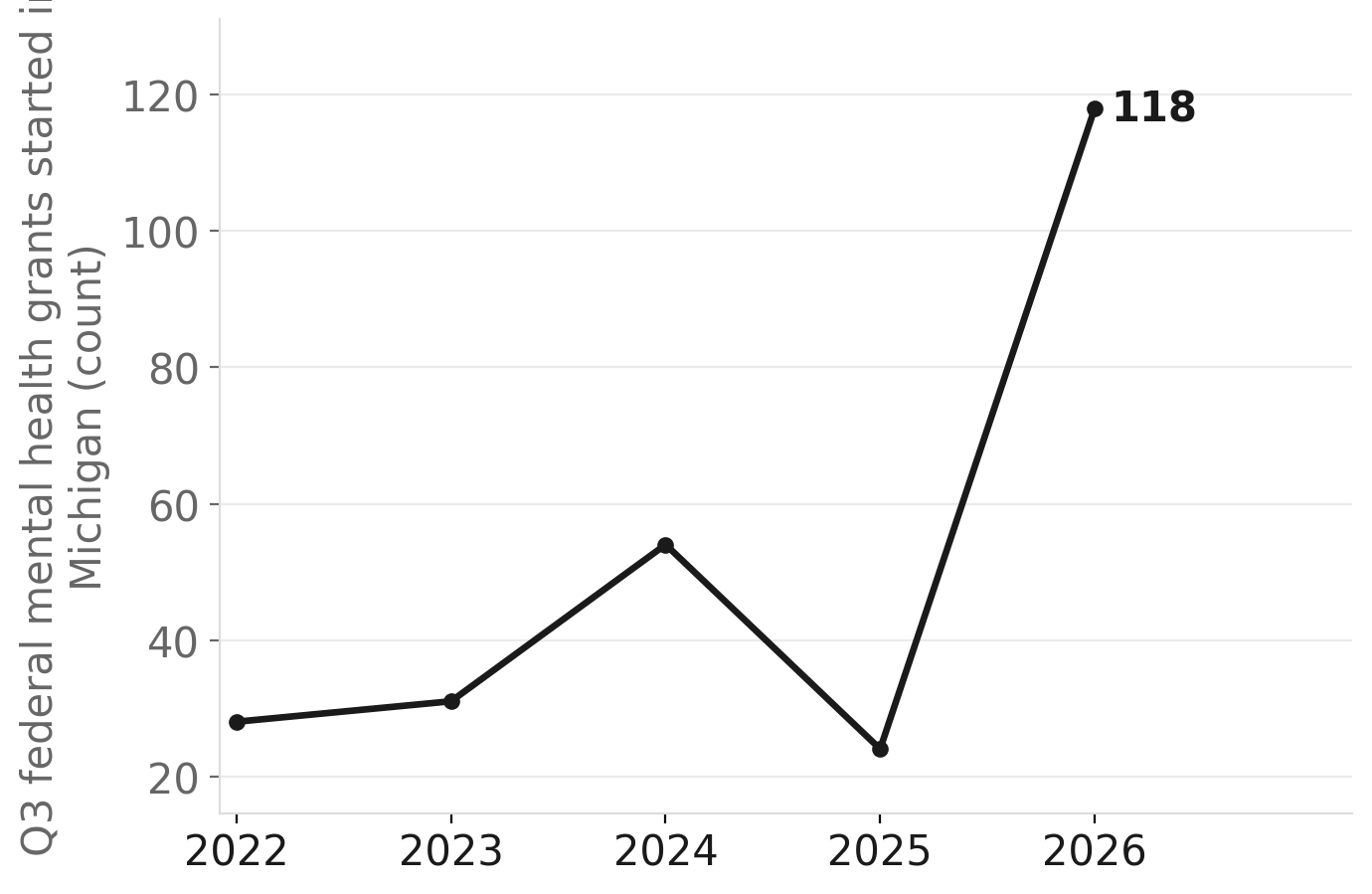
Federal mental health grants newly started in Michigan have reached $75 million in the trailing 90 days, a 224% jump from the $23.1 million awarded in the same window a year ago. The single quarter that produced that surge, Q3 2026, saw 118 grants start in the state, more than double the count of any third quarter in the 2022-through-2025 record, and nearly five times the 24 grants that started in Q3 2025.
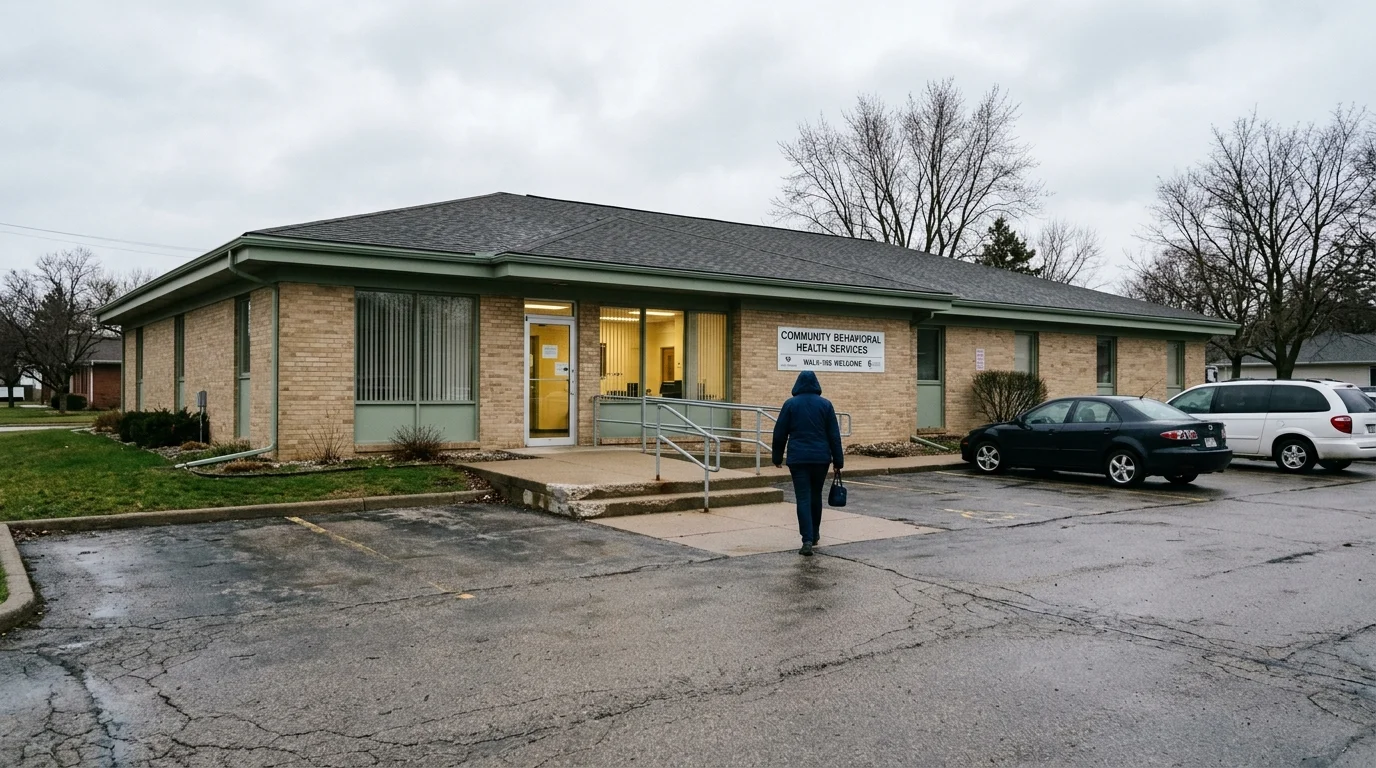
The money followed a specific political moment. On June 17, 2026, HHS Secretary Robert F. Kennedy Jr. stood at Easterseals MORC's certified community behavioral health clinic in Clinton Township and announced more than $700 million in national behavioral health funding opportunities. Michigan was not chosen at random: the administration framed the state's county-level Community Mental Health authority structure as a replicable delivery model, and Kennedy named the Great American Recovery Initiative as the organizing frame. According to an HHS press release, the package included $238.6 million for 988 Suicide and Crisis Lifeline expansion, $96 million for a new program called STREETS (Safety Through Recovery, Engagement, and Evidence-based Treatment and Support), and $223 million for Certified Community Behavioral Health Clinics. Within roughly 100 days, a substantial share of those national dollars had landed in Michigan.
Four distinct funding mechanisms drove the surge, and they work differently enough that collapsing them misrepresents what's actually happening. The Community Mental Health Services Block Grant, a formula-based allocation that flows directly to MDHHS, is not competitive and was already running: Michigan holds an active $27.8 million block grant for FY2026-27 and a $15.3 million 988 infrastructure grant from 2023. What's new in Q3 2026 is a separate competitive layer. MDHHS received a $5 million 988 cooperative agreement on September 30, 2026, running through 2029, to expand in-state crisis call, chat, and text response capacity. Macomb County CMH, whose own service area includes the clinic where Kennedy spoke, received a $213,000 add-on, citing a 10% increase in crisis call volume in 2025.
Source: NationGraph.
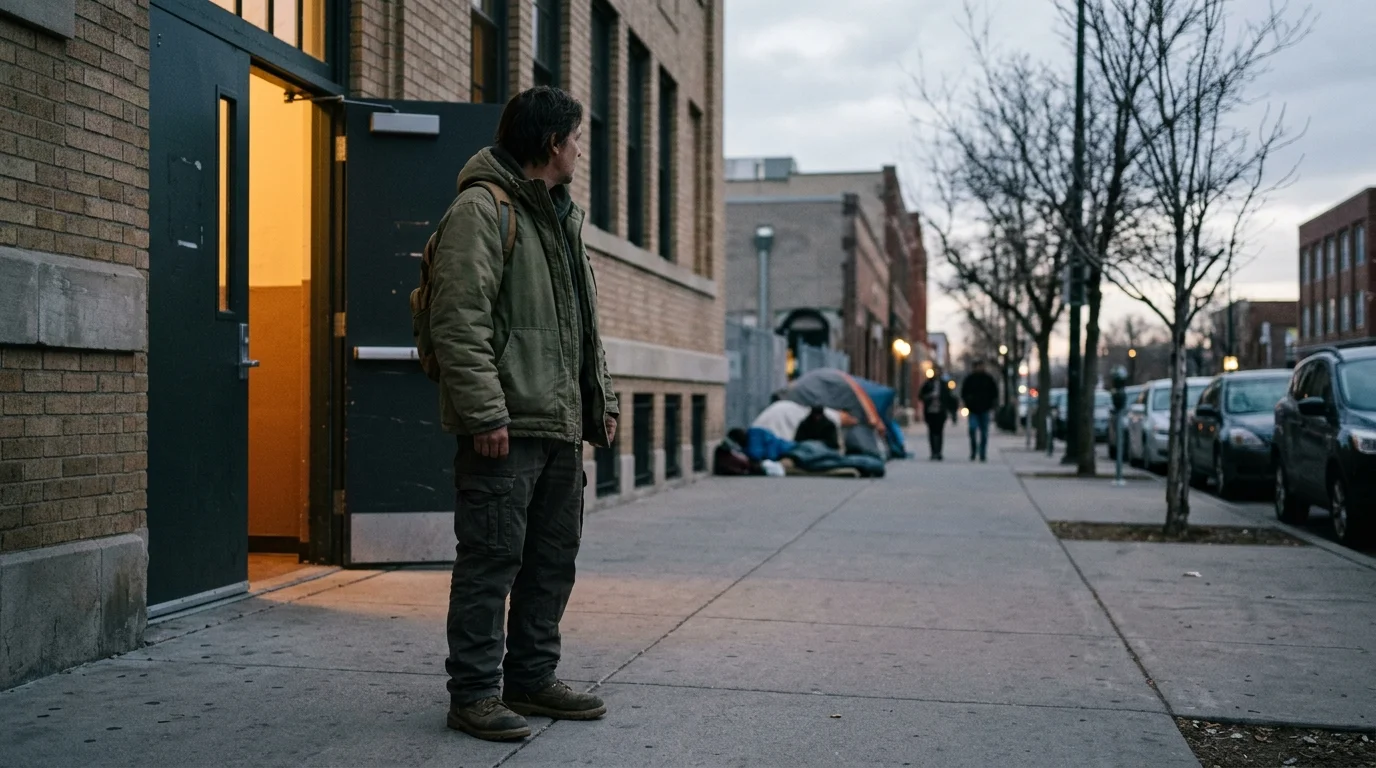
The STREETS program represents the most structurally novel piece. Designed for local government coalitions addressing homelessness alongside serious mental illness and substance use disorders, it explicitly opened eligibility to faith-based recovery organizations, a signature policy choice of the current administration. Michigan counties are in the CCBHC and SAMHSA county grant pipeline for this program, and a cluster of new county-level awards dated September 30, 2026, the last day of the federal fiscal year, signals a delivery-infrastructure tier that was not prominent in prior Michigan rounds. Kent County, Calhoun County CMH, Ottawa County CMH, Van Buren County, Bay Mills Indian Community, and Frederic Township all received awards in that single-day closeout window.
The third and fourth mechanisms are university research grants, which share neither a program office nor a purpose with the SAMHSA service dollars. NIMH, NIDA, and NICHD research awards flowing to the University of Michigan ($41.6 million across 69 grants), Michigan State University ($19 million, 22 grants), and Wayne State University ($2.5 million, 7 grants) account for roughly $63 million of Michigan's 90-day total. These are competitive extramural research grants on neuroscience, substance use, and behavioral disorders. What they share with the SAMHSA awards is the federal fiscal year closeout pressure: agencies obligate unspent appropriations before September 30, and Q3 is historically heavy for grant starts. This year, the volume was exceptional by any recent Michigan benchmark.
The state budget running concurrently adds another layer. Michigan's FY2026 Medicaid and behavioral health appropriations included a $3 million increase in the Mental Health Block Grant line and $11.3 million in new federal behavioral health Medicaid reimbursements tied to the anticipated opening of psychiatric residential treatment facilities in Grand Rapids, Lansing, and Livonia. As the Detroit News reported on the day of Kennedy's announcement, state officials were present and framed the federal dollars as complementary to those state-level moves.
For Michigan residents, the practical effect is a behavioral health system that is being recapitalized at two levels simultaneously. The research dollars at Ann Arbor and East Lansing fund longer-horizon work on treatment and prevention. The SAMHSA dollars fund the call centers, crisis teams, and county CMH clinics that people in Macomb, Kent, and Ottawa counties encounter directly. Whether both streams translate into measurable service capacity depends on how quickly county CMH authorities can staff up against a persistently tight behavioral health workforce.
The next signal to watch is the STREETS award announcement. SAMHSA has indicated eight communities will share the $96 million national pool; which Michigan jurisdictions, if any, land multi-year STREETS agreements will determine whether the county-level infrastructure shift visible in the September 30 data is a one-quarter spike or the start of a sustained delivery expansion.