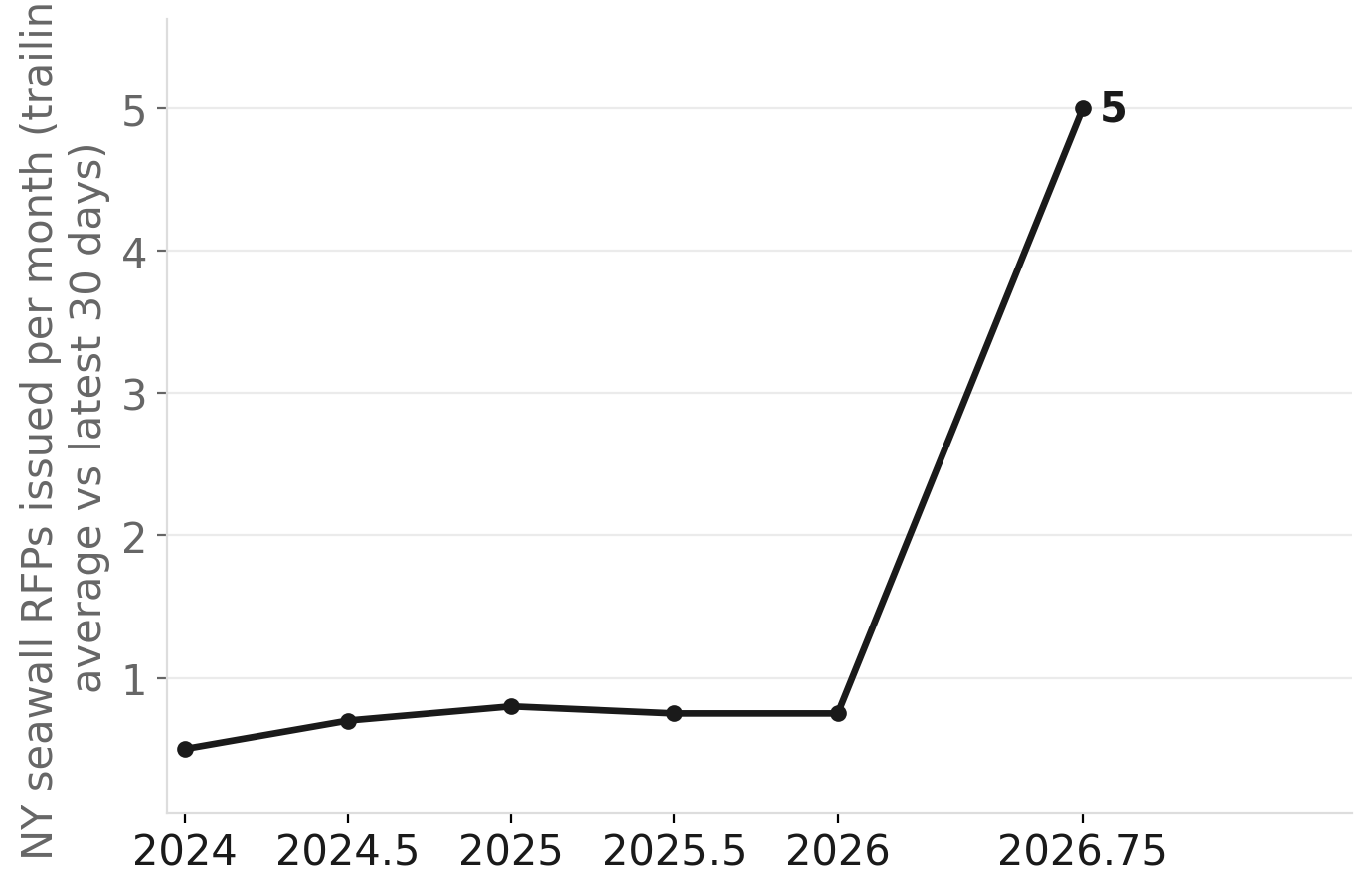
New York City has issued five seawall procurement solicitations in the last 30 days, 6.7 times its 12-month monthly average of roughly one every five weeks. The spike is not a coincidence of timing. It is the sound of a city scrambling to build the bureaucratic muscle to match its ambitions.
Until July 26, 2026, the agency responsible for overseeing more than $5 billion in active coastal construction, including a $1.45 billion East Side project and a $2.4 billion Staten Island seawall, employed six permanent staff. Six. Mayor Mamdani's announcement of a $43.2 million city capital appropriation to expand the Bureau of Coastal Resilience to roughly 75 engineers, planners, field crews, and flood specialists did not just add headcount. It unlocked a procurement capacity that the bureau had never possessed. The five RFPs in 30 days are the first downstream evidence of that capacity coming online.
Both active procurements come from the NYC Department of Parks and Recreation. CNYG-223M covers citywide seawall reconstruction under a 547-calendar-day contract and is flagged as state-funded, drawing on the New York State Clean Water, Clean Air and Green Jobs Environmental Bond Act of 2022. M289-120M covers concrete repairs and pile encasement along the East River Esplanade at East 36th to 38th Streets and is funded through the city's own capital budget. Bids on both are due November 2, 2026. The volume of RFP activity reflects multiple re-issuances and updates to these two contracts as the newly staffed bureau tightens contractor deadlines, not a dozen separate projects breaking ground simultaneously.
Source: NationGraph.
The urgency is partly institutional and partly fiscal. The Trump administration's cancellation of FEMA's Building Resilient Infrastructure and Communities program, known as BRIC, removed a federal backstop that NYC had been counting on. The Seaport Coastal Resilience project alone lost $42.2 million in expected BRIC funding. That loss accelerated the city's pivot toward two other mechanisms: its own capital levy and the state's $4.2 billion Environmental Bond Act, which voters approved in 2022 and which has been actively disbursing coastal and flood resilience grants in 2025 and 2026 rounds. Those are distinct programs doing distinct things, and neither replaces what BRIC provided, but together they have given the city enough runway to move contracts now.
The Environmental Bond Act's 2026 Coastal Rehabilitation and Resilience Projects program carries a January 29, 2027 application deadline, creating a hard procurement clock. Municipalities that want to compete for those state grant dollars need shovel-ready projects. NYC, with its newly staffed bureau, is positioning to have them. Governor Hochul has separately committed $28.5 million in state funds for Suffolk County seawall and resilience projects, including $12 million for the Asharoken Avenue Seawall, a signal that the Bond Act pipeline is moving beyond the five boroughs as well.
The federal footprint has not disappeared entirely. The Department of Transportation's PROTECT program and related transit resilience grants account for $562 million in active federal obligations to New York's coastal and transportation resilience portfolio. But those dollars are tied to transportation infrastructure, not the shoreline hardening work that BRIC was designed to support. The gap between what the federal government used to fund for coastal construction and what it funds now is being filled, imperfectly, by Albany and City Hall.
The institutional stakes are visible in the legislative calendar. NYC Council Member James Gennaro has introduced Intro. 936, which would spin the Bureau of Coastal Resilience out of Parks and Recreation entirely and create a standalone Department of Coastal Protection. The bill is a measure of how much political weight the function has acquired: a bureau that employed six people four months ago now has members of the Council arguing it deserves cabinet-level status.
For the roughly one million New Yorkers living in immediate flood zones, the November 2 bid deadline is the first concrete signal of whether the city can translate a staffing expansion into physical construction before the 2027 Atlantic hurricane season. The bureau currently manages 15 active infrastructure projects. Whether it can close contracts, mobilize crews, and begin breaking ground at the pace the expansion promises is the open question.
Watch the November 2 bid results. If competitive proposals arrive for both CNYG-223M and M289-120M, the bureau's buildout will have passed its first real test. If bids are thin or deadlines slip, the gap between the city's coastal ambitions and its procurement reality will still be very much open.