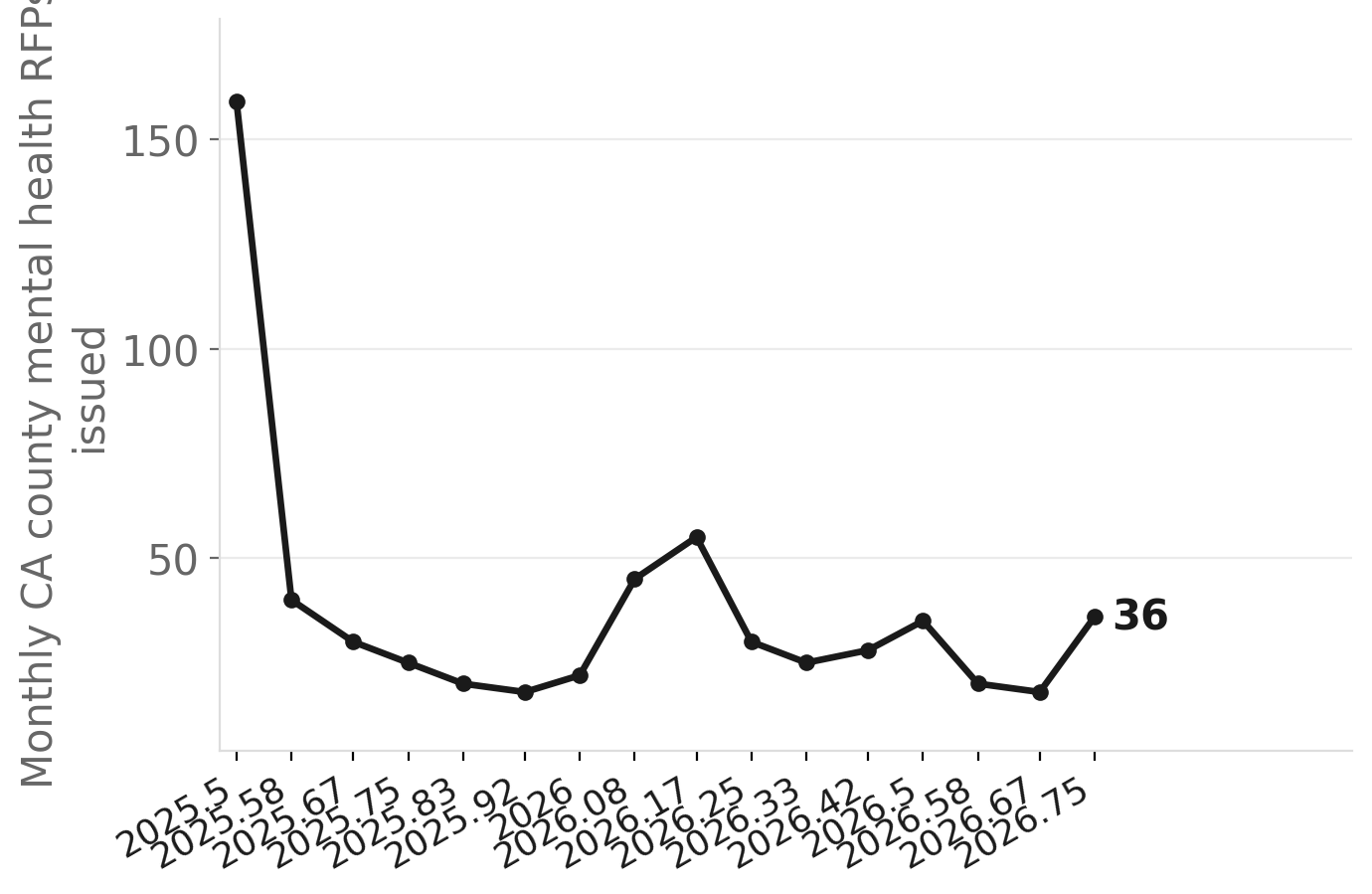
Five California counties, Marin, Napa, Merced, Sonoma, and San Diego, issued their first mental health procurement notices in more than 12 months during the last 30 days, posting a combined 36 requests for proposals that had not appeared in the market since before the state's behavioral health overhaul took hold. The number is modest by volume. As a signal, it is precise: these are the counties that needed the most time to plan, and they are now translating that planning into contracts.
The forcing function is California Proposition 1, approved by voters in March 2024, which replaced the Mental Health Services Act with the Behavioral Health Services Act. All 58 counties faced a hard deadline: submit a three-year Integrated Plan to the Department of Health Care Services by June 30, 2026, and begin implementation July 1. The DHCS Integrated Plan portal left no ambiguity about the timeline. Counties that approved their plans at June Board of Supervisors meetings are only now issuing the downstream RFPs those plans committed them to fund.
The procurement timeline across the state's 18-month stretch makes the October arrivals readable. The first major surge hit in July 2025, when 80 California institutions posted 159 mental health RFPs as BHSA planning formally launched. A secondary cluster appeared in February and March 2026, aligned with the March 31 draft plan submission deadline. The current wave is the trailing edge: five institutions accounting for a fraction of the July 2025 volume, but doing something the earlier wave did not, entering the market for the first time in over a year, which means they are bidding services previously funded through legacy contracts or flexible Mental Health Services Act allocations that no longer exist in the same form.
Source: NationGraph.
The BHSA is what makes those legacy arrangements untenable. The new law imposes rigid spending lanes on the Behavioral Health Services Fund, which is projected to deliver more than $4 billion to California counties in FY 2026-27. The most consequential constraint for procurement is the 30% housing intervention floor: counties must now direct nearly a third of their behavioral health revenue to housing-linked services. For counties like Merced and Napa, which historically ran smaller, more informal service networks under MHSA's flexible categories, the housing mandate requires competitive bids for services they had no prior mechanism to procure publicly. As the California Budget Center explains, the BHSA also mandates Full Service Partnerships, intensive, team-based care models, that similarly require new contracting structures most smaller counties had not built.
The five counties now posting RFPs are not outliers in their slowness; they are the tail of a distribution that tracks board approval calendars and administrative capacity. San Diego County's supervisors approved their Integrated Plan in June and submitted it to DHCS by the state's deadline, according to reporting from the County News Center. Mid-size counties in the Central Valley and Bay Area followed similar paths, with plan approvals stretching from April through June. Each approval started a downstream clock: service specifications had to be written, notices posted, and comment periods cleared before any contract could be signed. October is when that clock runs out for the last cohort.
There is a second pressure accelerating these procurements that has nothing to do with Prop 1's architecture. The 2026-27 state budget proposes making Medi-Cal mobile crisis services optional for counties beginning April 2027, removing a funding backstop that counties had treated as durable. Tara Gamboa-Eastman of the Steinberg Institute noted the proposal "did come as a surprise" given "unanimous support" for mobile crisis funding. Counties that lose that revenue stream will need lower-cost community-based crisis alternatives, precisely the category of service appearing in the current RFP wave. Locking in contracts now, before April 2027, gives counties both the service continuity and the cost baseline they need to absorb the potential cut.
The infrastructure piece runs parallel, not concurrent. The Behavioral Health Infrastructure Bond Act, also passed under Proposition 1, authorized $6.38 billion in state bond funding for capital construction of treatment facilities and supportive housing. That is a separate mechanism from the BHSA's recurring revenue lanes and does not directly drive the service procurement RFPs appearing now. Counties like Riverside ($149 million) and San Joaquin ($137.5 million), which hold active federal Behavioral Health Continuum Infrastructure Program grants for facility construction, are separately procuring the clinical staff to operate those facilities once they open, a distinct contracting need running on a different timeline.
For residents in Marin, Napa, Merced, Sonoma, and San Diego counties, the RFPs are the mechanism through which Proposition 1's commitments become actual services. The plans those counties submitted describe what they intend to fund; the procurements determine who will deliver it and at what price. The next signal to watch is contract awards, expected in the first quarter of 2027, which will show whether local providers have the capacity to absorb the new housing and partnership mandates the BHSA requires, or whether counties will need to expand the vendor pool further before implementation stabilizes.