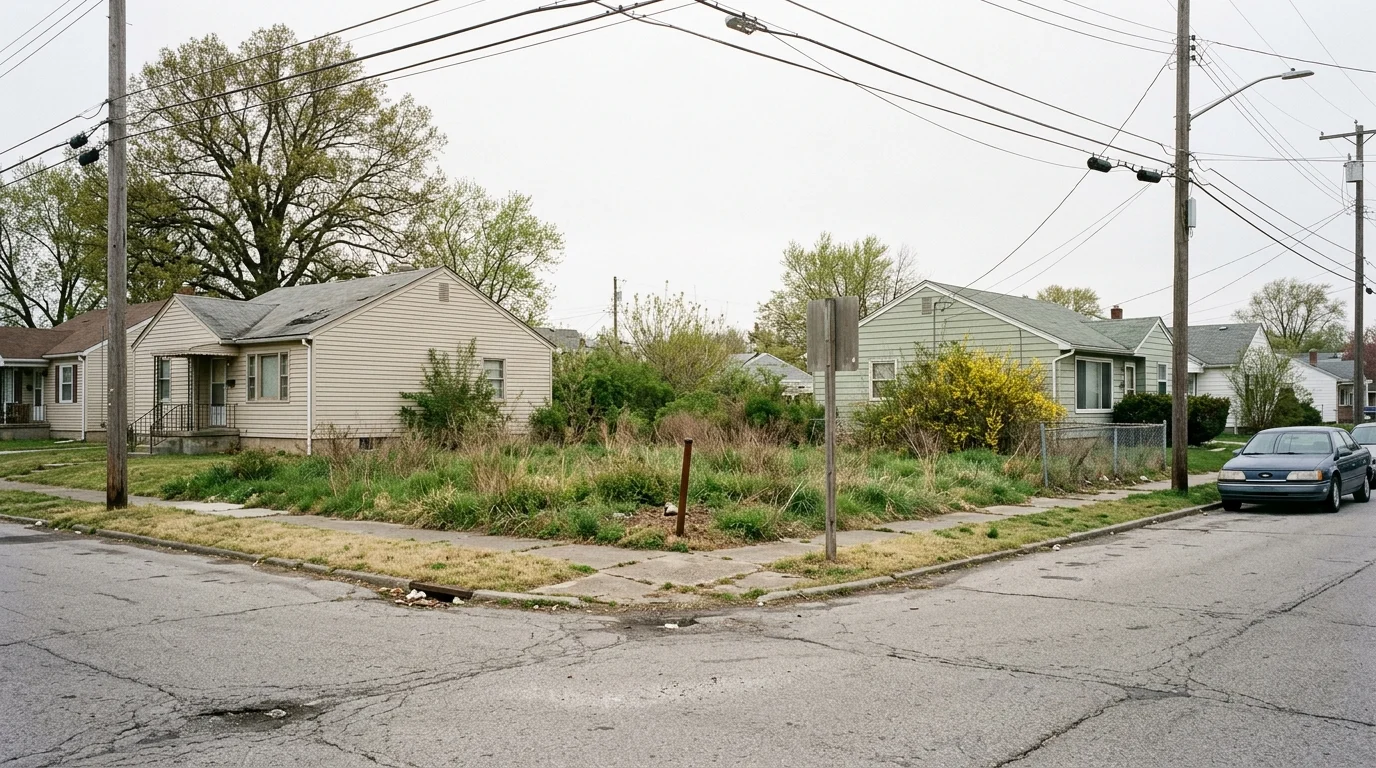
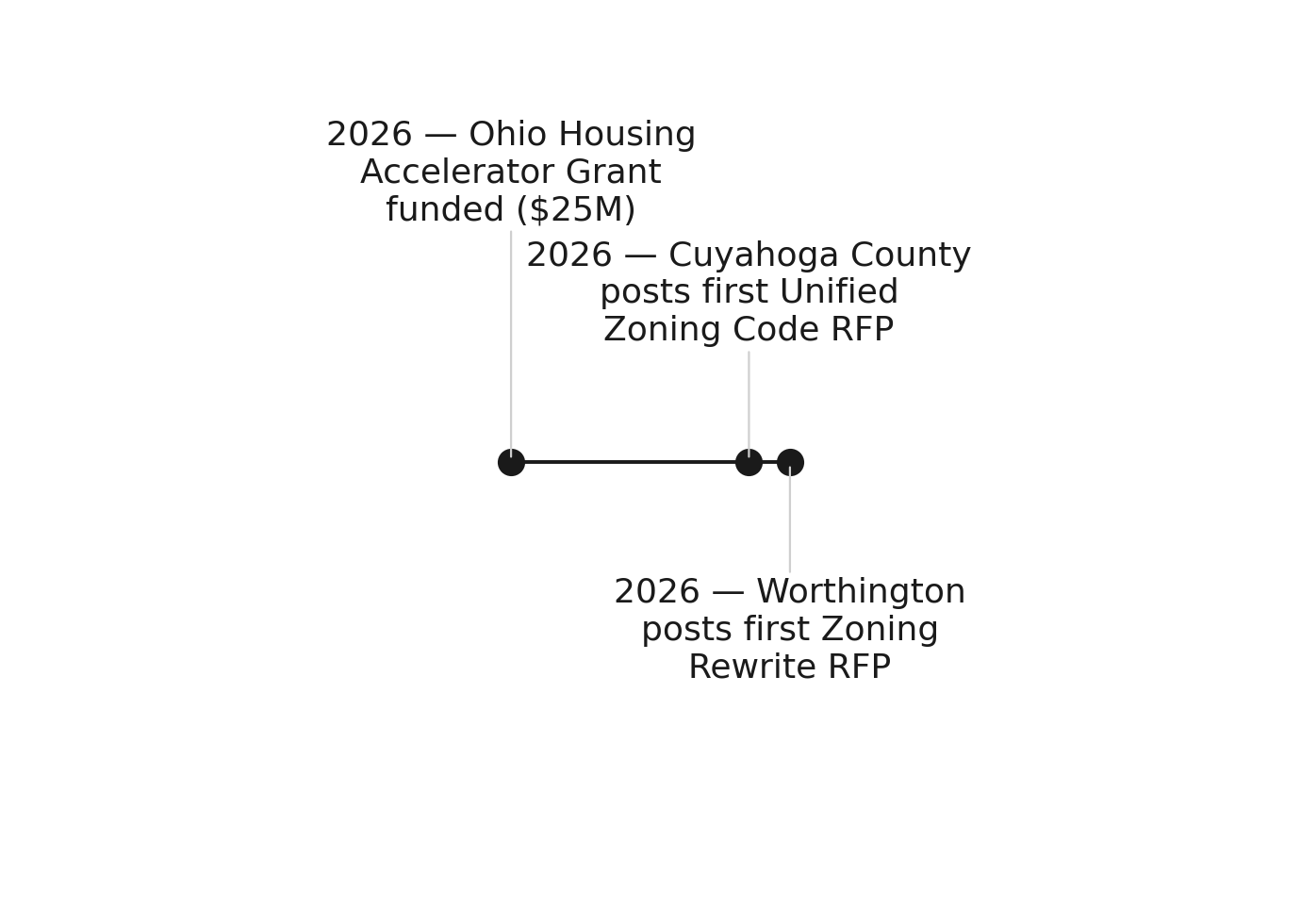
At least three to five Ohio jurisdictions issued competitive housing-planning procurements in September and October 2026, the first such moves on record for each of them in the NationGraph database. The institutions crossing that threshold simultaneously, after years of silence, are not coincidence: a new federal law and a new state grant program have, within weeks of each other, made zoning modernization the prerequisite for accessing a layered stack of housing money.
The most concrete illustration is Cuyahoga County, where Planning Commission Director Mary Cierebiej released a Unified Zoning Code RFP on September 28. The county has 59 municipalities, each with its own incompatible code. That patchwork has made infill development, the only realistic path to new housing in a largely built-out Rust Belt county, unreasonably slow and expensive. The UZC initiative, which Cierebiej publicly framed as a cost-effective shared solution for those 59 communities, would give developers and municipalities a single coherent framework for the first time. That the county chose now to formalize it with an RFP is not accidental.
In parallel, Franklin County's fast-growing Columbus suburbs are moving for different but complementary reasons. Grove City, a community of about 43,000 in Franklin County, posted a Housing Study RFP in September, its first procurement of this kind in the database. Worthington posted a Planning and Zoning Code Rewrite RFP in October. Both communities are absorbing Columbus metro growth and face the opposite problem from Cuyahoga: they have land, but their codes were written for a slower era and don't accommodate the density that the next round of state and federal housing grants will reward.
Source: NationGraph.
The driver is a layered stack of three distinct programs, none of which should be confused with the others.
First: the 21st Century ROAD to Housing Act, signed into law on July 11, 2026 (Public Law 119-101), passed the House 358-32 and the Senate 85-5. Its Title II creates competitive federal grants specifically for zoning code updates and planning studies, directs HUD to publish best-practice zoning frameworks, and expands what CDBG funds can cover, including, now, affordable housing construction up to 20% of a community's annual allocation. Critically, the law does not preempt local zoning authority. It uses incentives, not mandates, which means the rational first move for any jurisdiction seeking to compete is exactly what Cuyahoga and the Franklin County suburbs are doing: commission the study, rewrite the code, get shovel-ready.
Second: Ohio's own Housing Accelerator Grant, created in HB 96 as part of the FY2026-27 state budget. The Ohio Department of Development is administering $10 million in FY2026 and $15 million in FY2027 on a rolling-application basis. To qualify, a county or municipality must be within 20 miles of a major economic development project and must adopt pro-density zoning provisions: higher density, smaller lots, reduced minimum setbacks. That eligibility structure is a direct financial trigger for the kind of zoning rewrites Grove City and Worthington are now procuring.
Third: a $45.6 million federal CDBG block grant already flowing through the Ohio Department of Development, active through 2032, available for housing rehabilitation and community development. The ROAD Act's expansion of CDBG-eligible uses gives communities a new reason to make sure their local codes are current enough to deploy those dollars.
The three programs reach localities through different channels, competitive federal grants, rolling state appropriations, and federal block grants, but they converge on the same behavioral incentive: jurisdictions that invest in planning infrastructure now are positioned to claim money from all three streams. As the Greater Ohio Policy Center noted shortly after the ROAD Act's passage, the law offers promising tools specifically for states like Ohio where older industrial communities and growing suburbs share the same housing pressure but need different policy solutions.
The timing is also shaped by what nearly didn't happen. The Ohio Housing Trust Fund, the state's primary affordable-housing vehicle, was nearly eliminated in the FY2026-27 budget before advocacy restored it in HB 96. That episode left Ohio localities with a clear signal: state support is not guaranteed, and active planning engagement is the best hedge against future cuts.
For residents in Cuyahoga County's 59 municipalities, a unified code could eventually mean faster permit approvals and more infill housing options in neighborhoods where construction has stalled for years. For Grove City and Worthington residents, updated zoning could shape how much and what kind of housing absorbs the next wave of Columbus-area growth. Neither outcome is immediate, these are procurement actions, not groundbreakings. The studies and code rewrites will take 12 to 24 months at minimum before localities can translate them into grant applications.
The next signal to watch is HUD's timeline for publishing the competitive grant guidelines under Title II of the ROAD Act. The law gives HUD up to three years from enactment, meaning July 2029 at the outside, but likely sooner given the political investment. Ohio jurisdictions that finish their zoning work first will be best positioned when that application window opens.