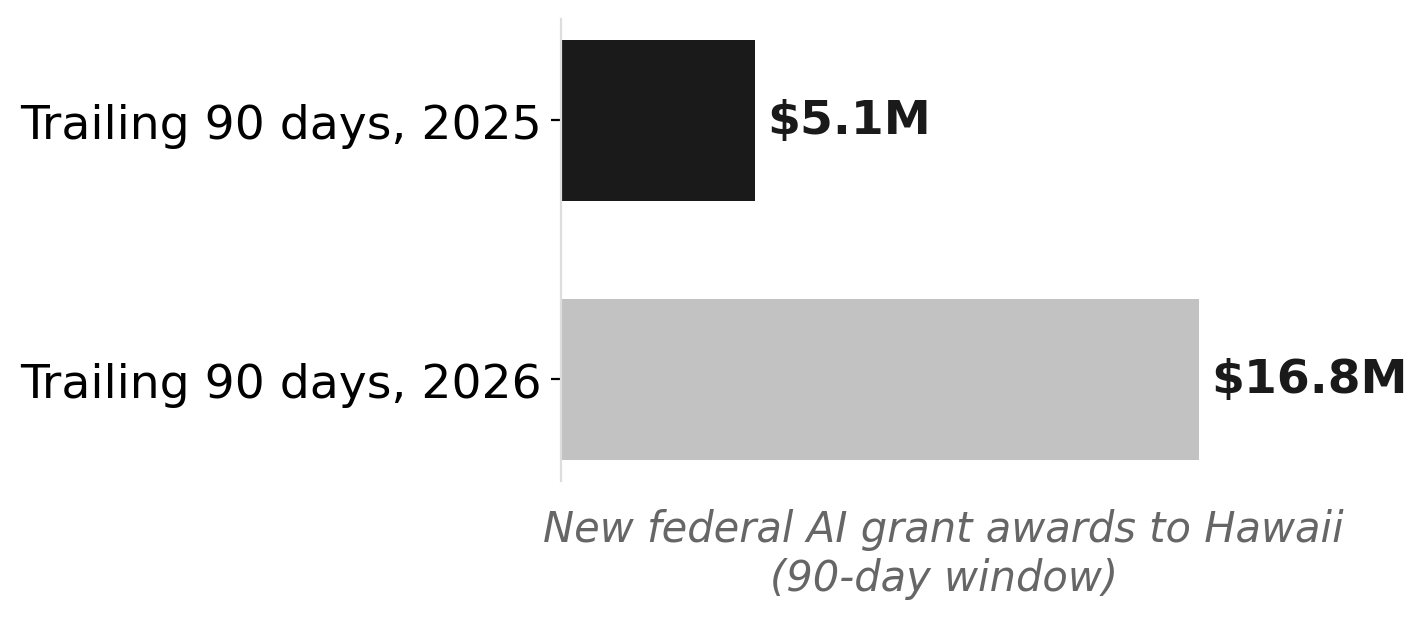
Federal AI grants to Hawaii have hit $16.8 million in the last 90 days, more than triple the $5.1 million awarded in the same window a year ago. The surge did not come from a single program or a coordinated federal push. It came from three separate agencies, operating under entirely different statutory authorities, all landing major commitments at roughly the same moment.
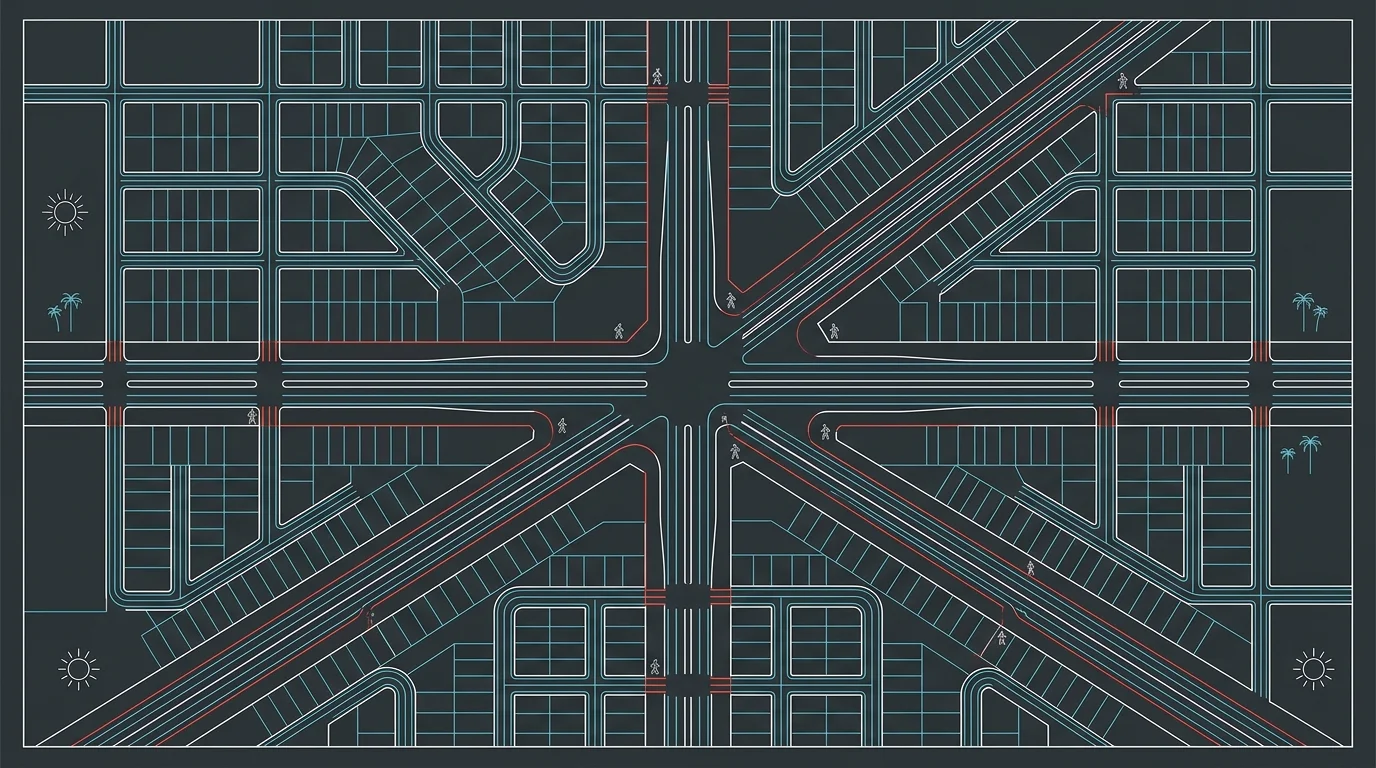
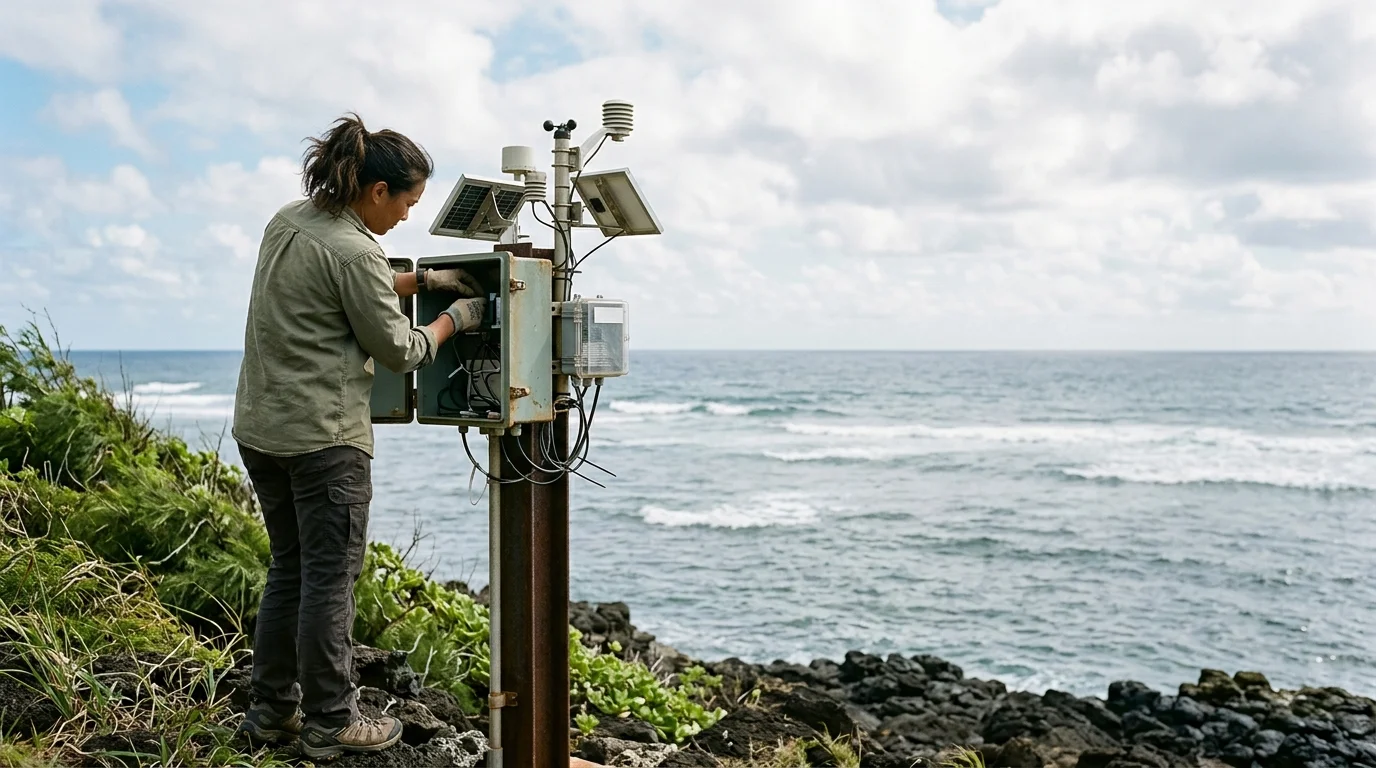
The two anchor awards account for $12.8 million of that total. NOAA and the Department of Commerce committed $8.6 million to the University of Hawaii for the CIMAR cooperative institute, the Pacific's primary federal-university partnership for marine and atmospheric research, running through 2031. Embedded in that renewal is a significant expansion of AI and machine learning methods for Indo-Pacific ecological forecasting: tracking fisheries stress, modeling sea surface temperature anomalies, monitoring the atmospheric systems that govern island weather. The FHWA, through its newly launched AI Deployment Center of Excellence, separately awarded Hawaii DOT $4.2 million to instrument 67 signalized intersections across Honolulu with sensors, cameras, and adaptive routing software, the kind of smart corridor pilot the agency is now actively pushing to state DOTs nationwide. According to NOAA's announcement, the CIMAR award is part of a broader five-year cooperative institute program with a ceiling of up to $210 million across the full portfolio.
The remaining $4 million comes from eight NSF grants spread across the same window, and they are where the specificity gets sharpest. One funds AI workforce training at Hawaii's community colleges. Another supports coastal groundwater modeling using machine learning. A third, awarded to UH Mānoa, targets AI-enabled food-safety threat detection. And one went to Purple Maia Foundation, a Native Hawaiian technology education nonprofit, to build community-resilient edge-AI infrastructure for island farms, running locally-owned compute clusters on recycled hardware in agricultural communities that have no reliable path to mainland cloud services. As UH's announcement describes it, the food-production AI work is designed for the constrained, data-scarce conditions that define island agriculture, not the data-abundant environments where most commercial AI is built and tested.
Source: NationGraph.
These three federal mechanisms share no common origin. NOAA's cooperative institute model is a decades-old competitive framework renewed on five-year cycles. FHWA's AI Deployment Center of Excellence is brand new, stood up in mid-2026 to accelerate transportation AI pilots. NSF's STEM Education, EPSCoR, and CISE programs are peer-reviewed research grants with equity and scientific-excellence criteria. What they share is a recipient: the University of Hawaii at Mānoa holds ten of the twelve awards. Hawaii DOT and Purple Maia Foundation hold one each.
That concentration is structural. Hawaii sits in what its own legislature has called a venture-capital desert. Hawaii HB 2545, passed in the 2026 session, explicitly frames the state's Indo-Pacific location, military installations, and federal research presence as the primary lever for tech R&D investment, precisely because private capital does not flow here at the rate it does to Boston or the Bay Area. The absence of a competing private ecosystem makes UH Mānoa the default concentration point for nearly every federal AI dollar that enters the state.
That same isolation is, paradoxically, part of the competitive argument. Island ecosystems, closed agricultural loops, constrained road networks, and Pacific maritime environments are exactly the conditions where place-specific AI has the most applied value and the fewest existing tools. A model trained to forecast fisheries collapse in the central Pacific has no off-the-shelf equivalent. A smart corridor system calibrated for Honolulu's specific intersection geometry and tourism traffic patterns is not a simple adaptation of a Phoenix deployment. These are genuinely novel environments, and federal agencies looking to stress-test AI at the margins of the American system are finding Hawaii useful.
The near-term competitive pressure sharpens further. NSF launched the State and Regional AI Infrastructure Hubs program in 2026, offering $40 to $100 million nationally with one award per state or region and full proposals due in November 2026. Hawaii has not won that award yet, but the 90-day grant cluster has built exactly the kind of demonstrated ecosystem coherence that a competitive proposal requires: marine forecasting, agricultural resilience, transportation AI, Indigenous data sovereignty, and community college workforce pipelines, all live and federally funded at once.
What changes for someone in Hawaii is less abstract than it sounds. Commuters on the H-1 corridor may see different signal timing within the next year as the DOT pilot goes live at those 67 intersections. Farmers on Maui and the Big Island who work with Purple Maia may gain access to AI tools running on local hardware that does not depend on mainland connectivity. Researchers at the School of Ocean and Earth Science and Technology will have five more years of federal support to build the Pacific forecasting infrastructure that NOAA and the Navy both rely on.
The open question is whether Hawaii can consolidate these parallel investments into a single coherent pitch before the NSF Infrastructure Hubs deadline. Winning that award would move the state from a collection of place-specific pilots into something closer to a regional AI institution. Missing it would leave the current cluster as exactly what it looks like now: three agencies, acting independently, finding Hawaii useful for different reasons at the same moment.