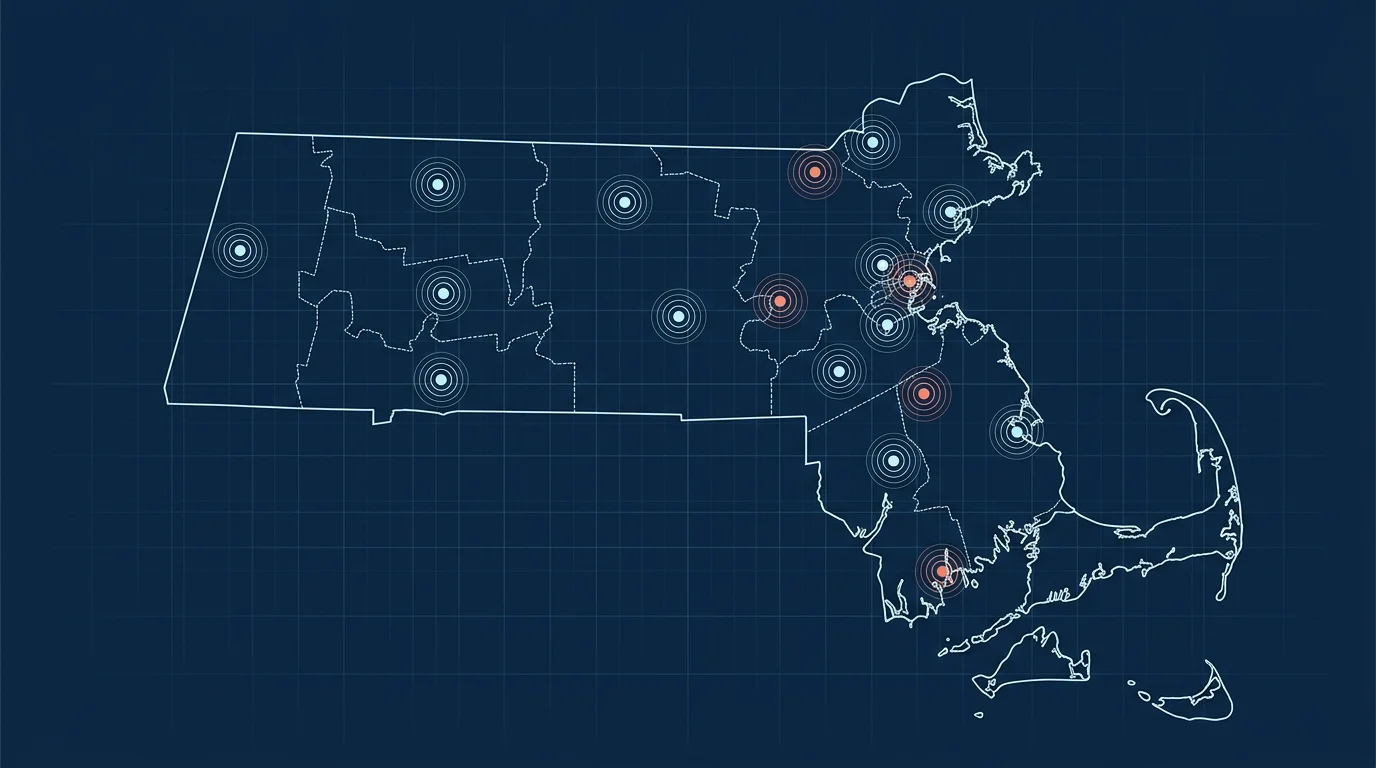
Michigan counties issued 25 opioid settlement RFPs in October 2026, spread across 16 counties from Chippewa in the Upper Peninsula to Oakland in metro Detroit. That is nearly six times the monthly baseline of one to seven RFPs and matches the only comparable spike on record, a brief surge last July. The money behind those solicitations is not a new federal program or a state budget line. It is litigation proceeds that counties have held, in many cases for three years, waiting for someone to make them spend it.
That someone is now AG Dana Nessel. On May 14, 2026, Nessel released formal spending guidance and launched a public spending dashboard that lets anyone see which counties have deployed funds and which have not. The guidance was not advisory. It named allowable uses, cited enforcement authority under the State-Subdivision Agreement, and signaled that counties with unspent reserves would need to explain themselves publicly. For county commissioners already embarrassed by press coverage of their dormant accounts, that signal landed as a hard political deadline.
The second force arrived with the Purdue and Sackler family settlement, which opened for local government sign-on in August 2025 and will bring $154 million to Michigan on top of the approximately $745 million that local governments are already set to receive through 2040 under earlier agreements. The Purdue settlement amended the State-Subdivision Agreement to require annual financial reporting to the Michigan Department of Attorney General beginning in FY2026, with reports due within 60 days of each county's fiscal year close. For the majority of Michigan counties whose fiscal year runs October through September, the first reports under that new requirement come due in December 2026. October is when their new fiscal year opens. The connection is not coincidental.
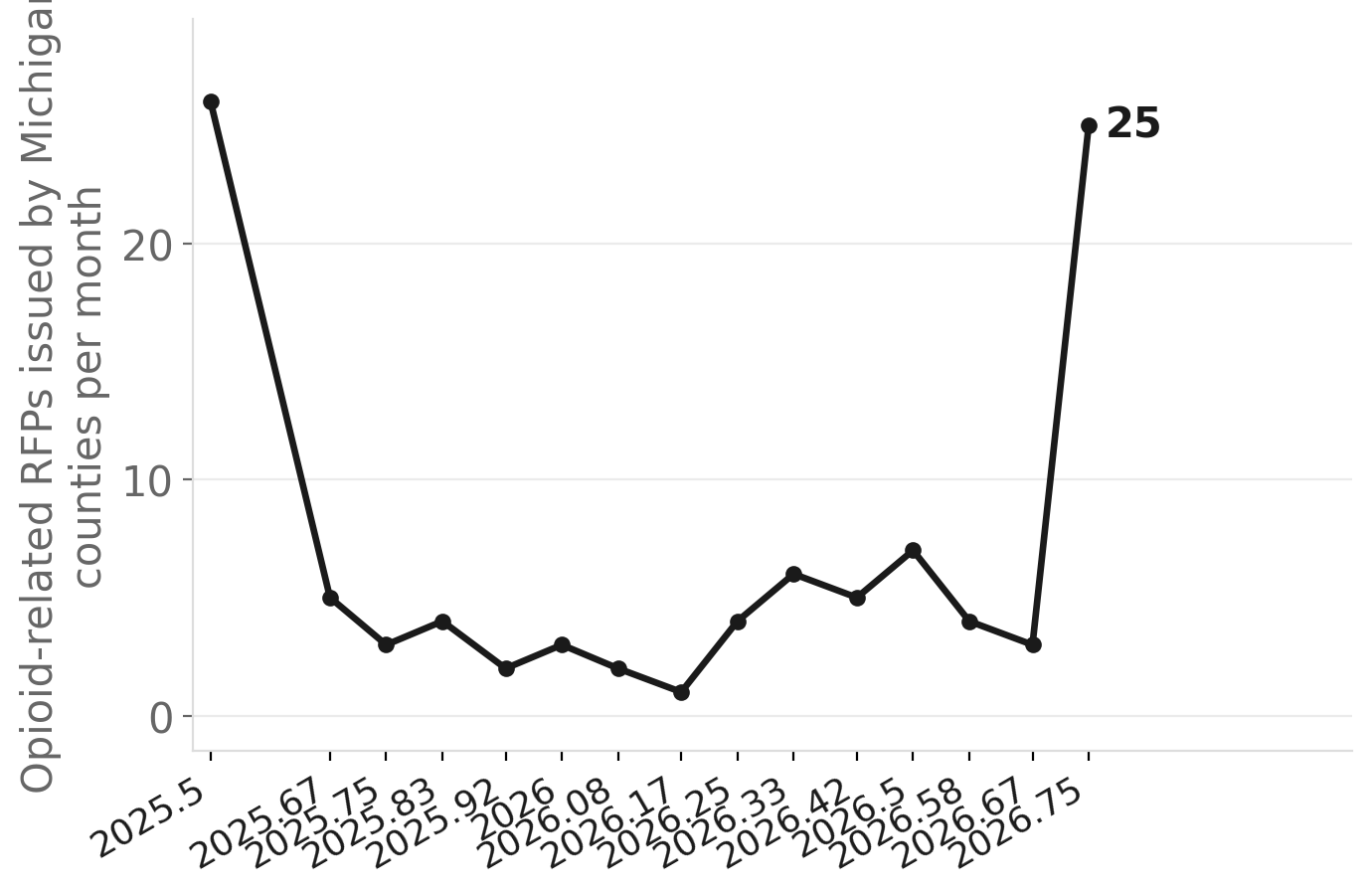
Source: NationGraph.
That accountability squeeze explains why the October RFP titles are so uniform. Across counties as different in size and geography as Washtenaw, Gratiot, Alpena, and Mackinac, the solicitations read almost identically: "Opioid Settlement Funding Opportunity" or "Opioid Remediation Mini-Grants." These are counties writing their own grant programs, disbursing their own litigation proceeds to local providers, under a framework the Michigan Association of Counties has been publishing since the settlements began. The uniformity reflects not coordination but convergence, the same fiscal calendar, the same new reporting clock, and the same political incentive to show documented spending before December.
The unspent-funds story had already become an embarrassment before the October sprint. CBS Detroit and Bridge Michigan reported in April 2026 that some counties had not disbursed a dollar of settlement funds more than three years after payments began in 2023. Isabella County had $1.1 million sitting in an account and was planning its first disbursements in 2026. Eaton County was still described as in a "planning and collecting RFPs" stage. Those are small counties, but the story underscored a statewide pattern: the money arrived before the administrative infrastructure to move it.
Larger counties built that infrastructure first. Kent County, which has received $19.5 million across 13 settlements as of July 2026, adopted a structured two-year FY2027-FY2028 spending plan in July 2024, an approach that gave its commissioners a defensible paper trail well before the AG's guidance dropped. Muskegon County approved $354,000 in community grants for FY2026, a smaller but similarly structured disbursement. Those examples are now the template smaller counties are following, partly because a University of Michigan, Michigan State, and Wayne State Technical Assistance Collaborative, launched in April 2023, has been helping counties design RFPs and structure spending plans, a practical resource that neighboring states running their own settlement cycles lack.
Wisconsin and Minnesota show October spikes of their own, 16 and 10 RFPs respectively, confirming this is a Midwest-wide fiscal-calendar effect tied to the same national settlement agreements. But Michigan leads the region in raw volume and geographic spread, which reflects both the scale of its settlement receipts and the specific pressure of the AG's new reporting requirement. Michigan pursued opioid litigation aggressively beginning in 2019, resulting in settlements totaling more than $1.8 billion, the largest per-capita recovery in the Midwest. That success created an unusually large pot of local money, which in turn created an unusually visible accountability problem when counties were slow to deploy it.
The next signal to watch is December 2026, when the first mandatory county reports under the Purdue settlement amendment come due. The AG's public spending dashboard will show whether the October RFP sprint produced actual contracts and disbursements, or whether counties issued solicitations and left awards pending. For providers in communities still waiting on treatment and harm-reduction funding, the difference between an issued RFP and a signed contract is the question the data cannot yet answer.