Washington school districts issued 24 school safety RFPs in the trailing 30 days through mid-November 2026, against a 12-month monthly average of roughly 4.6. That 5.2x surge did not come from a single crisis or a coordinated statewide campaign. It came from a calendar coincidence: two separate state capital grant programs, administered by the Office of Superintendent of Public Instruction and funded out of the same 2025-27 biennial budget, both hit active procurement phase at the same time.
The proximate trigger is the OSPI School Security and Preparedness Infrastructure Grant, created by SB 5003 and sponsored by Sen. Nikki Torres (R-Pasco). The 2025-27 capital budget appropriated $6 million for the program, with awards up to $500,000 per district, covering secure vestibules, door access control, surveillance systems, and perimeter fencing. The application window for the first grant cycle closed November 12, 2026. Districts that wanted the money had to show procurement progress before submitting, which explains why October and early November produced a wall of RFPs explicitly citing the "OSPI Safety & Security Grant 2026" as the funding source. Soap Lake Elementary's recent RFP names it by that title verbatim.
Running in parallel is a larger and older program: the OSPI School Seismic Safety Grant, established by SSB 5933 in 2022 and now funded at $151 million for the 2025-27 biennium, up from $100 million in the prior cycle and $13.24 million when the program launched. This program covers seismic vulnerability assessment, structural retrofits, and in some cases full school replacement, with priority to campuses facing combined seismic and tsunami hazard. OSPI adopted permanent administrative rules for the program on March 7, 2026 (WSR 26-04-133), clearing the last procedural barrier to disbursement and effectively opening the construction-procurement window. Hoquiam School District, on the Grays Harbor coast, recently issued RFPs for two new school construction projects explicitly citing the Seismic Safety Grant.
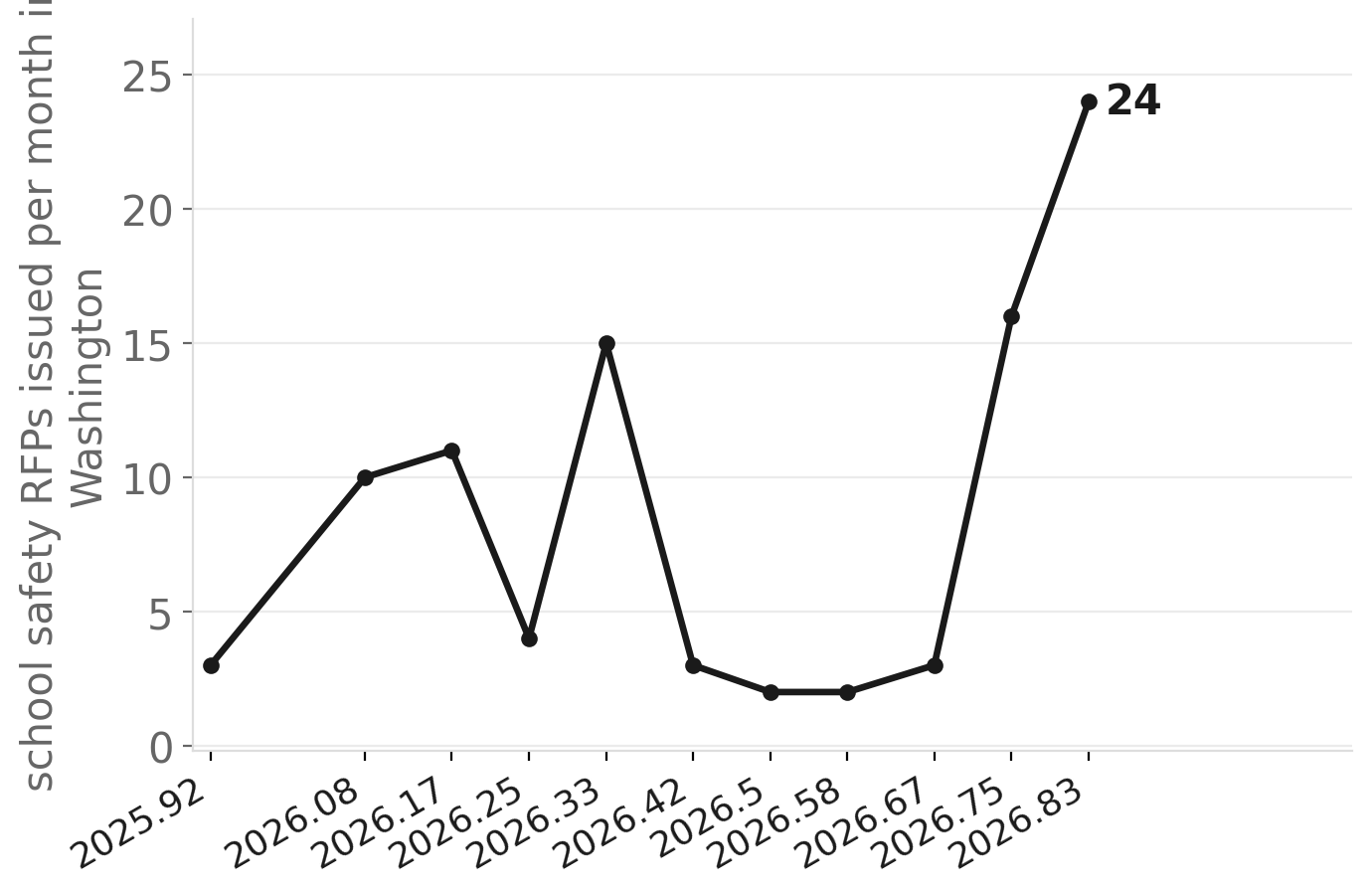
Source: NationGraph.
These are two distinct programs doing different physical work: one installs cameras and vestibule doors; the other pours new foundations or relocates entire buildings. They should not be read as a single unified school safety initiative. What they share is an administrator (OSPI), a funding source (state appropriations), and a biennial clock that brought them both to the spend-or-forfeit stage in the same fall semester.
The 24 recent RFPs came from 18 distinct agencies. That geographic spread matters. Districts from Sequim and North Kitsap on the Olympic Peninsula to Kent, Edmonds, and Bellevue in the metro core have all entered the market within the same 30-day window. This is not a regional construction boom driven by a single large project. It is a statewide procurement surge driven by grant deadlines hitting simultaneously across Washington's 295 school districts, most of which are too small to self-fund capital safety upgrades without state assistance.
The timing also reflects accumulated legislative momentum. SB 5004, Washington's version of Alyssa's Law mandating silent panic-alert buttons in schools, was signed May 19, 2025, as a companion to SB 5003. Together the two bills represented the legislature's first significant funding commitment to school physical security at scale. The seismic program's escalating appropriations, from $13 million to $100 million to $151 million across three biennia, reflect a parallel commitment to a threat that is both older and larger: much of Washington's coastal school stock was built before modern seismic codes, and some campuses sit in tsunami inundation zones.
According to an OSPI workshop document distributed to districts, the SSPI grant application window closed November 12, 2026, and OSPI is expected to announce awards in early 2027. Districts that receive awards will then enter formal design and construction procurement, meaning the current RFP surge is a preview of a larger construction wave beginning next year.
For school administrators and contractors in Washington, the near-term signal is clear: the 2026 procurement surge is not the peak. OSPI has already filed a $49.2 million supplemental budget request for additional seismic funding in the 2027-29 biennium, signaling that the pipeline extends well beyond the current cycle. The security hardening work funded by this biennium's SSPI grants will produce its own wave of design contracts once awards are announced. And Alyssa's Law compliance timelines will push districts that have not yet begun procurement into the market in the next legislative session.
The question for the 2027 legislative session is whether the seismic supplemental request clears the capital budget at $49.2 million or gets trimmed, and whether OSPI seeks a second SSPI appropriation to cover districts that missed the first cycle. Both answers will determine whether the fall 2026 procurement surge is a one-time compression of deferred work or the beginning of a sustained elevated baseline.