New York received $222.1 million in newly started federal mental health grants in the 90 days ending October 25, 2026, a 62% jump over the same window last year. Before that number gets read as a mental health investment, follow the calendar: $135.1 million of it, roughly 61% of the total, arrived in September alone, the final month of the federal fiscal year.
That timing is the story. NIH is required to obligate its full extramural budget by September 30 each year. In FY2026, a 43-day government shutdown at the start of the fiscal year compressed the agency's entire grantmaking calendar into the back half of the year. NIMH, NIH's mental health arm, warned in March 2026 that it was staring at up to $500 million in potentially unspent funds and needed scientists to help with grants administration just to clear the backlog. According to reporting in Science, NIH ultimately spent its entire $35.3 billion extramural budget by the deadline, but the total number of new research grants in FY2026 was still about 11% below the 2021–24 average. The sprint was real; the expansion was not.
In New York, that sprint hit harder than almost anywhere else, because New York is where the academic medical centers are. NYU pulled in $48.9 million across 48 grants in the window. Icahn School of Medicine at Mount Sinai received $41.3 million. Weill Cornell took $35.8 million, Columbia $28.8 million. Those four institutions alone account for roughly $155 million of the $222 million total, and their grants fund basic and translational research into mental health conditions, not care delivery. The money goes to labs, not to community clinics, crisis centers, or patients.
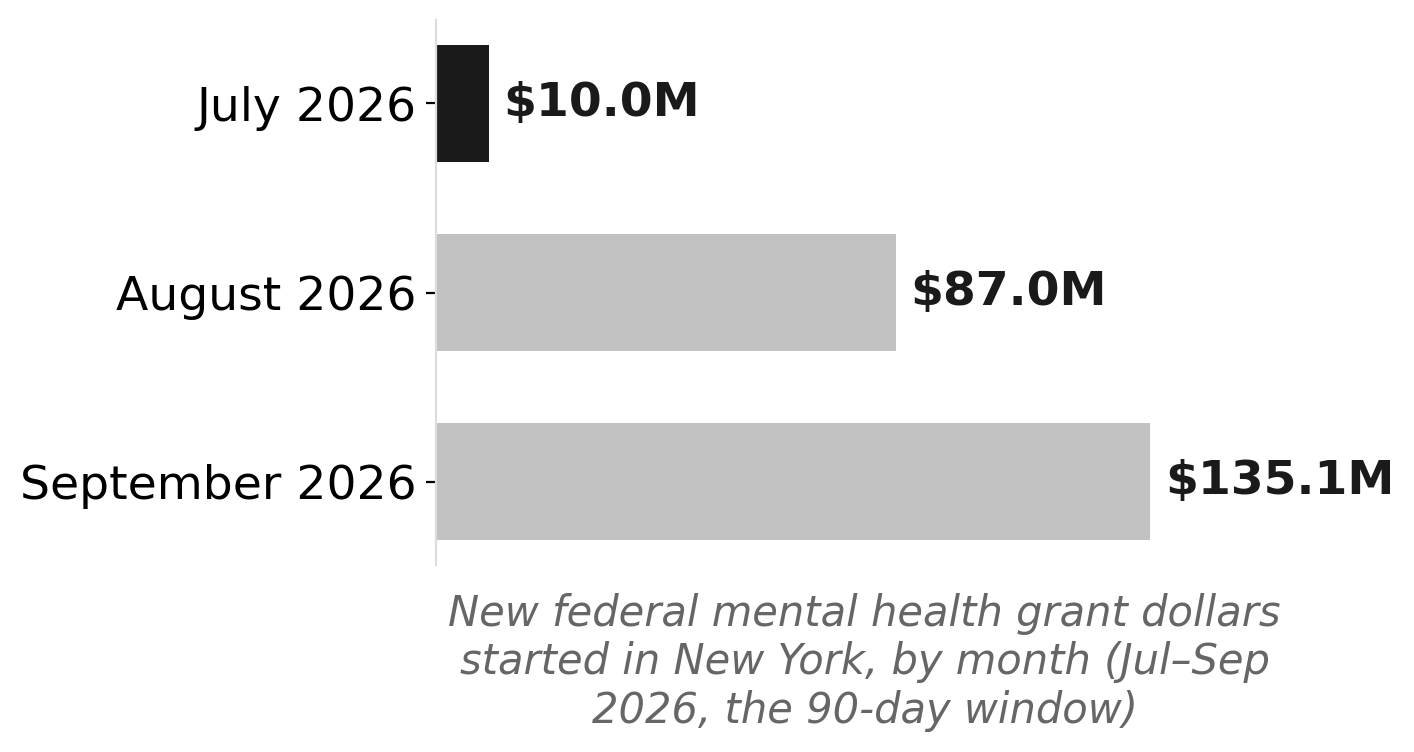
Source: NationGraph.
The state ranks second nationally in 90-day mental health grant intake, behind California ($330 million) and ahead of Texas ($170 million). That ranking tracks almost perfectly with each state's density of top NIH recipients, not with any state's mental health policy agenda. New York's position near the top of this metric is a structural feature of its research university landscape, which means it is also structurally exposed to NIH fiscal-year-end timing effects. When NIH rushes to close out the year, New York institutions capture a disproportionate share.
The one exception in this window, and it matters, is the $17.8 million SAMHSA 988 crisis services grant awarded to the New York State Office of Mental Health on September 30, 2026. That award, the single largest grant in the 90-day window by recipient type, funds crisis line operations and follow-up programs under a separate appropriation: the FY2026 Consolidated Appropriations Act (P.L. 119-75), which funded SAMHSA's mental health programs at $2.79 billion, roughly flat compared to prior years. A related $255 million five-year administrator grant for the 988 Suicide and Crisis Lifeline went to NYC-based Vibrant Emotional Health in May 2026, as HHS announced. The 988 awards are a different mechanism serving a different purpose, they fund direct crisis services, and they follow a different policy lever than NIH research grants. Treating them as part of a unified mental health spending surge obscures what each program actually does.
The broader context is worth holding in mind. New York's active federal mental health grant portfolio stands at $3.82 billion across 899 HHS grants, with $2.42 billion already disbursed. The $222 million in new 90-day awards is a 6% addition to an enormous existing base, and a previous NationGraph analysis identified this same dynamic playing out earlier in 2026, when a January SAMHSA termination-and-reversal produced a single-month spike. The headline metric for New York mental health grants has now twice in one fiscal year reflected budget-cycle turbulence rather than durable policy momentum.
For New Yorkers who rely on community mental health services, that distinction is not academic. The $189 million flowing to research universities in August and September will eventually produce findings that inform clinical practice, on timelines measured in years, not budget quarters. The $17.8 million going to the Office of Mental Health for 988 operations is the portion of this surge that directly touches the crisis care system. The gap between those two figures is a reasonable measure of the gap between what the headline implies and what is actually changing on the ground.
The next signal to watch is the FY2027 appropriations process, now underway. NIH's research budget for FY2027 was proposed at a significant cut in the administration's initial request; if enacted at reduced levels, the August–September sprint that generated this year's surge will not repeat at the same scale. For New York's academic medical centers, that would be felt. For community mental health providers, the more relevant number remains SAMHSA's block grant line, and that has not moved much in either direction.