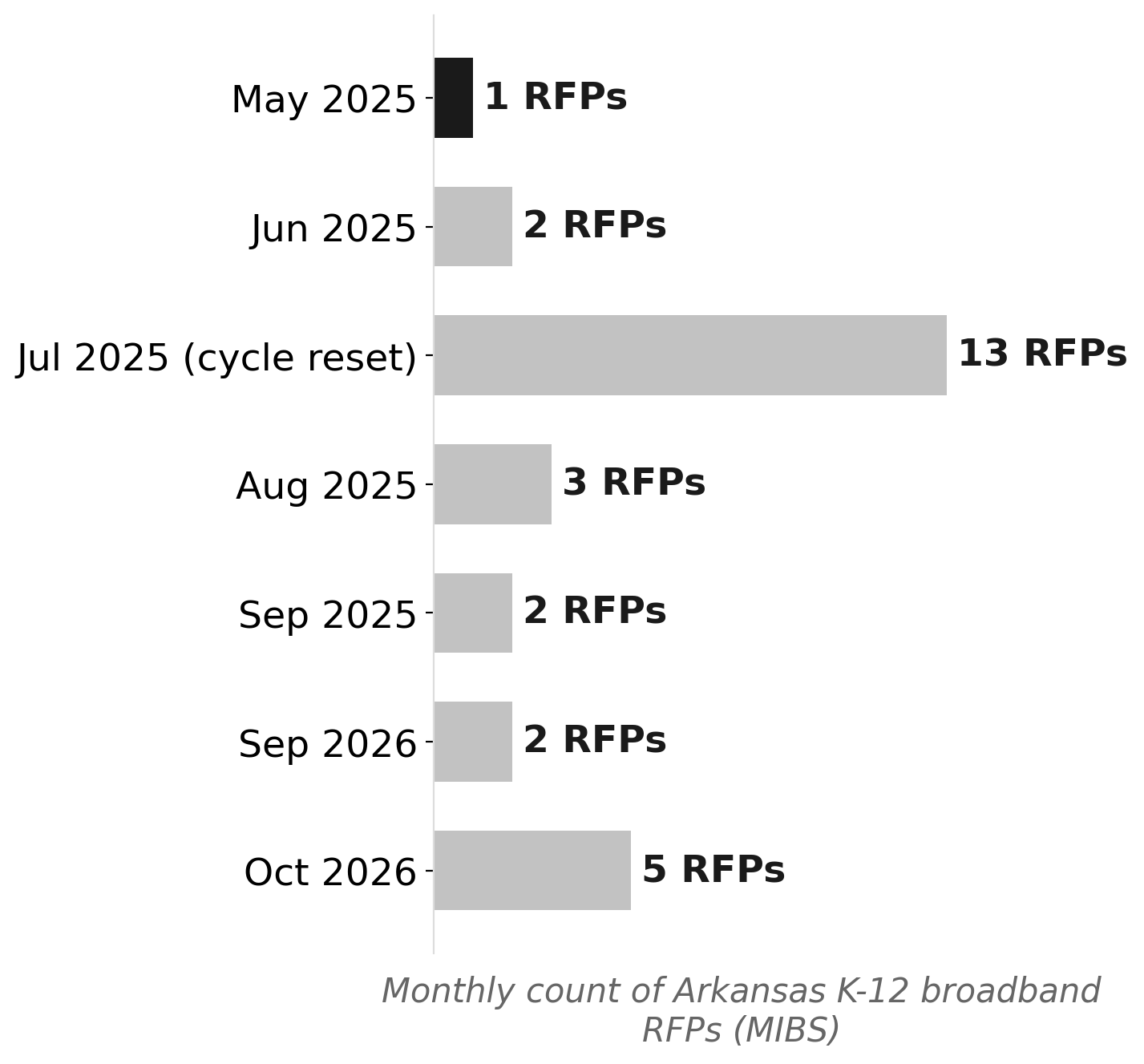
Arkansas issued five broadband RFPs in the last 30 days, roughly ten times its monthly average, and every single one of them is a school Wi-Fi bid. None of them are connected to the state's $1.024 billion BEAD construction program. Understanding why separates two federal broadband stories that look alike on the surface but operate through entirely different pipes.
All five solicitations are Managed Internal Broadband Service bids from K-12 districts: South Side School District in Van Buren County, Stuttgart School District in Arkansas County, and Southside School District in Independence County (two of the five are re-posts of earlier solicitations, so the effective count is three unique districts). The bids are not about laying fiber to unserved homes. They are about upgrading routers, switches, and managed Wi-Fi inside school buildings that are already connected to the internet.
The driver is the FCC's E-Rate Category 2 program, which reset its five-year funding cycle on July 1, 2025. The reset raised the per-student internal broadband budget to $201.57, a 20.7% increase over the prior cycle. Each district's five-year spending cap reset to zero. Eligible schools can receive discounts of up to 85 percent on internal networking costs, with a $30,175 per-school floor. The catch is structural: funds not spent by FY2030 are forfeited. That use-it-or-lose-it deadline is now running, and it creates a procurement obligation. Before a district can file a funding request with the Universal Service Administrative Company, which administers the program under FCC authority, it must first complete a competitive bidding process by posting an FCC Form 470. The RFP spike is that bidding process, visible in procurement data.
Source: NationGraph.
This is not a new dynamic. Arkansas saw 13 broadband RFPs in July 2025, also entirely E-Rate MIBS bids, from districts including Fort Smith, Cabot, Berryville, Pine Bluff, and Camden-Fairview. October's five-RFP cluster is the same machinery completing its second pass through the annual cycle, with Form 471 funding requests for FY2026 services anticipated by an April 2026 deadline.
There is an added urgency this cycle. The FCC opened a program review in June 2026 that raised questions about whether managed internal broadband services should remain eligible under E-Rate in future cycles. Any eligibility changes would take effect no earlier than FY2028, according to program observers tracking the review. That uncertainty is giving districts reason to lock in multi-year managed service contracts now, before the rules shift.
The districts driving the current wave are small and rural. Van Buren County has a population of roughly 16,000; Independence County, roughly 37,000. These are exactly the communities where E-Rate's sliding discount scale matters most: districts with the lowest income levels qualify for the 85 percent maximum subsidy, meaning a $500,000 internal networking project costs the district $75,000 out of pocket. Without the program, most of these schools cannot afford to refresh aging infrastructure.
The BEAD program, which is the larger broadband story in Arkansas, is doing something categorically different. NTIA approved Arkansas's BEAD Final Proposal on November 25, 2025, and the state received a Notice of Award for $1.024 billion in January 2026. The Arkansas Legislative Council approved the first award batch of $126.1 million for 14 ISPs covering more than 51,000 locations in February 2026. ARConnect, the state broadband office, signed its first BEAD agreement with Amazon's Kuiper satellite service in June 2026, a $1.76 million contract for approximately 1,700 locations. State Broadband Director Glen Howie has described BEAD as a construction program targeting 79,293 unserved locations across the state.
BEAD flows to ISP subgrantees, not to school districts. It is administered by ARConnect under NTIA authority, funded through the Infrastructure Investment and Jobs Act. E-Rate is administered by USAC under FCC authority, funded through telecommunications service provider fees. The two programs share no mechanism, no administering agency, and no target recipient. A fiber line BEAD pays to run to a rural home does not enter the building where an E-Rate-funded Wi-Fi access point is installed.
For Arkansas school administrators, the practical signal is the same one it was in July: the Category 2 cycle clock is running, the per-student budget is the highest it has ever been, and the competitive bidding window for FY2026 funding is open now. Districts that have not yet posted a Form 470 for this cycle are leaving money on the table.
For anyone watching Arkansas broadband data, the cleaner signal to track is ISP subgrant agreements flowing through ARConnect, not school district RFPs. The procurement spike you see in October is the E-Rate program doing what it has done every five years, at slightly higher dollar figures, under a funding review that may eventually narrow what it covers.