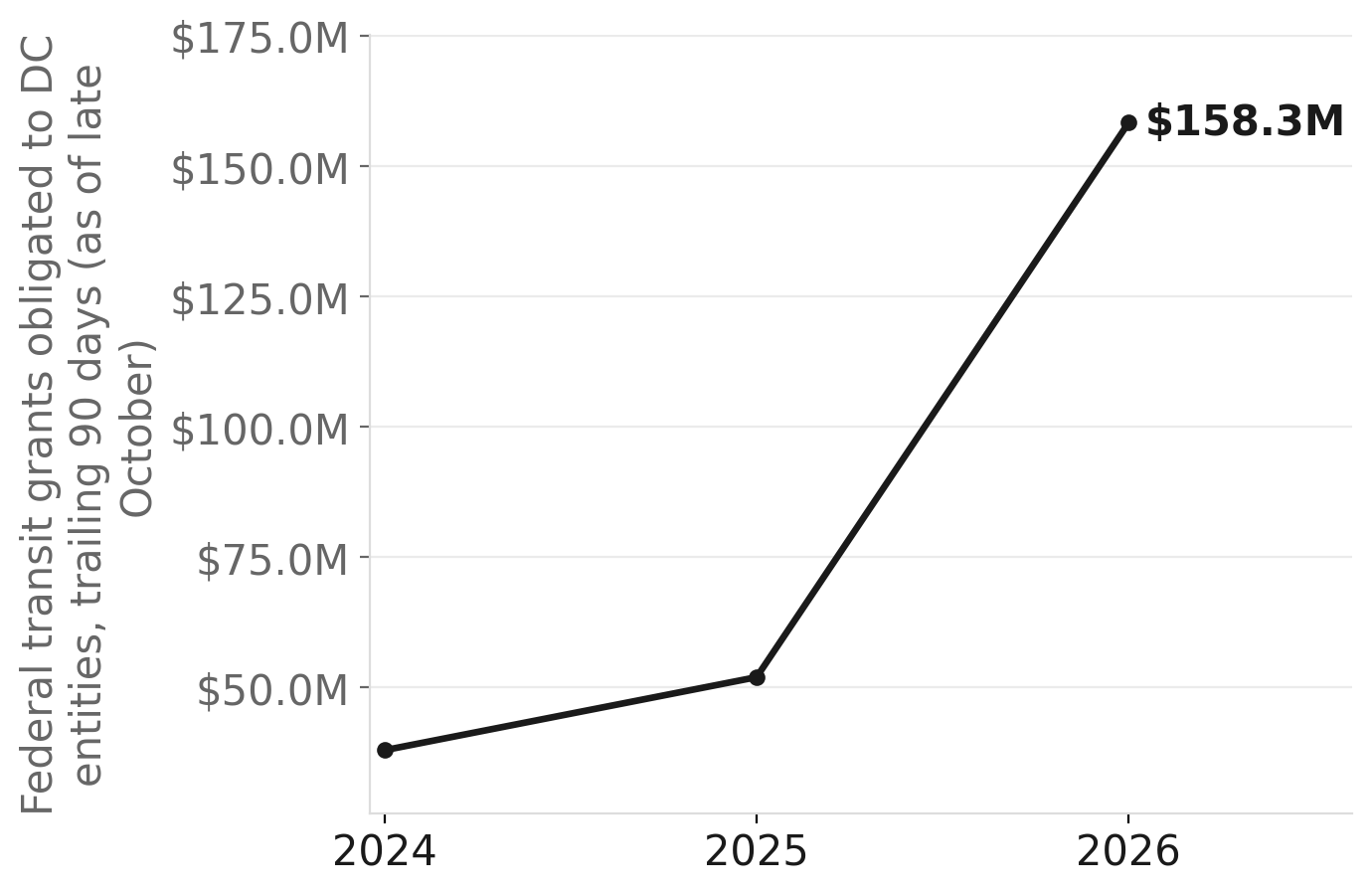
Federal transit grants newly obligated to District of Columbia entities reached $158.3 million in the trailing 90 days, against $38.0 million in the same window a year ago, a 317% increase driven almost entirely by a single award. On September 3, 2026, the Federal Transit Administration obligated a $143.5 million PRIIA capital grant to WMATA, covering escalator replacement, tunnel water leak mitigation, platform rehabilitation, automatic train control upgrades, and radio infrastructure, with a performance period running to June 2032. That same day, President Trump signed a stopgap bill extending surface-transportation programs only through December 11, 2026, without restoring the advance appropriations that had anchored the IIJA's funding architecture.
The timing was not coincidental. The Infrastructure Investment and Jobs Act authorized $108 billion in federal transit and transportation funding through FY2026, and its surface-transportation provisions expired September 30. Agencies across the country raced to obligate funds before the authorization structure changed. WMATA's $143.5 million PRIIA grant, designated DC-2026-015, was the FY2026 installment in an annual cadence the agency has maintained since 2023, the same dollar figure landed in FY2023, FY2024, and FY2025. What changed this year was what came after: according to the American Public Transportation Association, the stopgap bill amounts to an over 80% cut to federal passenger rail investment and a 20% cut to public transit investment for new commitments.
The PRIIA grant is not interchangeable with the other federal dollars WMATA receives. Created by Congress and re-authorized under IIJA Sections 30019(b) and (c), PRIIA (CFDA 20.524) is a WMATA-specific statutory program, no other transit agency in the country receives it. That structural reality shapes everything about DC's federal transit exposure. WMATA cannot be capitalized through state DOT channels the way the MTA in New York or transit agencies in California can. When PRIIA funds are at risk, there is no state-level backstop. The agency's FY2026-2031 Capital Improvement Program, a $12.9 billion plan approved by the WMATA Board on April 10, 2025, counts on $861 million in PRIIA funds over the six-year window, roughly $143.5 million per year, indexed to nothing.
Source: NationGraph.
Beyond PRIIA, WMATA also holds active FTA Formula Grants under Section 5307 (Urbanized Area Formula) and Section 5337 (State of Good Repair), as well as bus and facility grants under Section 5339, including Low or No Emissions funding. These are nationwide formula programs, distinct from PRIIA in both purpose and eligibility: the formula grants support capital and operating needs across all large transit systems based on ridership and route miles, while the bus programs target fleet replacement and zero-emission procurement. IIJA had dramatically expanded the Low-No component from $55 million per year nationally to $1.1 billion, that increase is now at risk under proposed reauthorization. WMATA's total active DOT grant portfolio stands at approximately $1.21 billion across 16 FTA awards, the most recent running through 2032.
The Trump administration's proposed FY2027 budget would cut FTA funding by roughly 22%, a reduction of approximately $4.8 billion from current levels. Congress extended IIJA authorizations to December 11 via H.R. 6500, but without the advance appropriations that allowed agencies to plan multi-year capital programs with confidence. The Bipartisan Policy Center has noted that the IIJA's unusual funding structure, blending advance appropriations with formula programs and competitive grants, makes reauthorization negotiations particularly complicated, since each mechanism requires a different legislative fix.
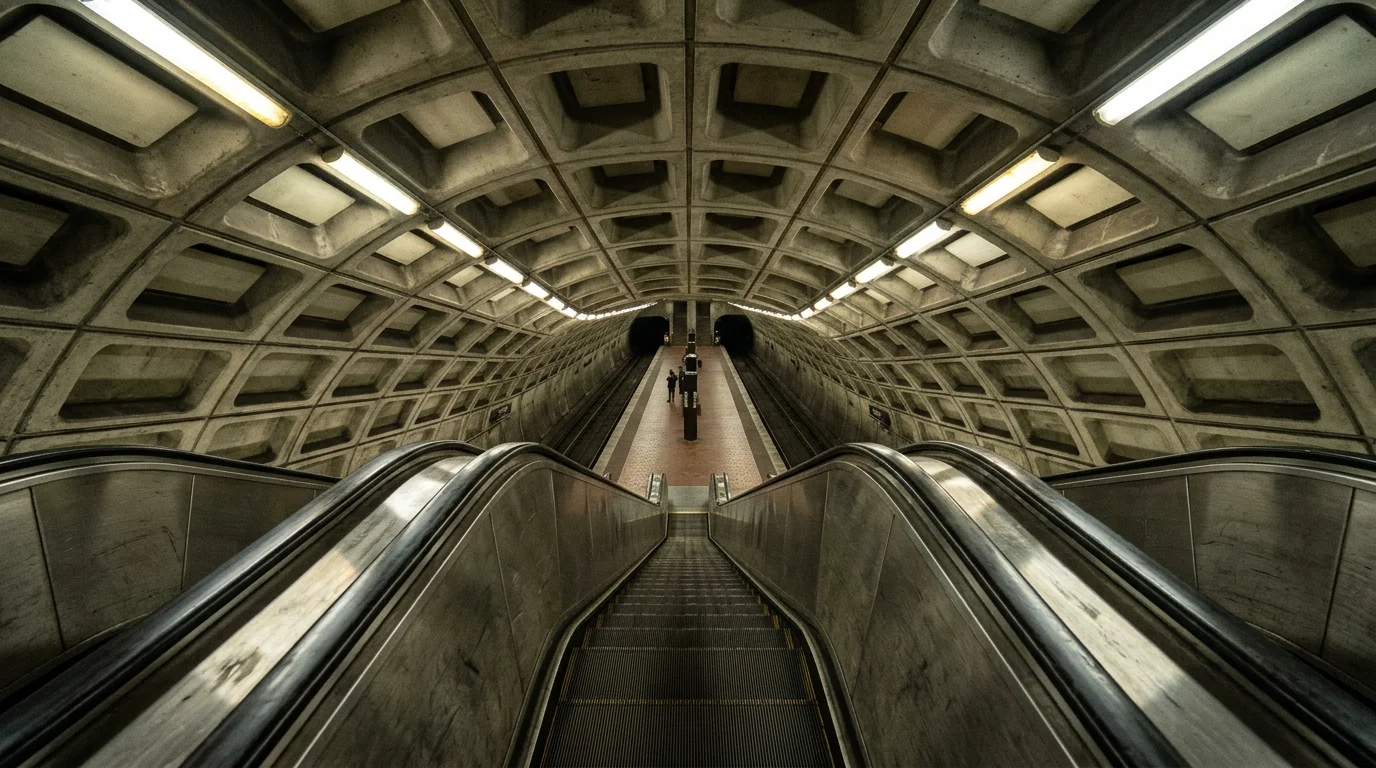
For riders on the Metro system, which logged roughly 307 million trips in 2025 and approximately 890,000 boardings per weekday as of Q1 2026, the September 3 grant means the escalators, tunnel drainage systems, and train control equipment covered under DC-2026-015 are funded through 2032. That is meaningful. WMATA's deferred maintenance backlog has been a persistent operational risk, and the platform rehabilitation and automatic train control work included in this grant are prerequisites for the kind of reliability the agency needs to sustain ridership growth.
What is less certain is what comes next. WMATA faces what its own financial planning describes as a structural funding cliff after FY2029, as debt capacity shrinks and PRIIA funds remain flat in nominal terms. The December 11 deadline for surface-transportation reauthorization is the next concrete signal to watch: if Congress does not act, the formula programs that feed WMATA's operating budget will continue at reduced stopgap levels, and the advance-appropriations framework that made the $143.5 million annual PRIIA cadence predictable will remain suspended. The FY2026 grant is locked. The FY2027 installment is not.