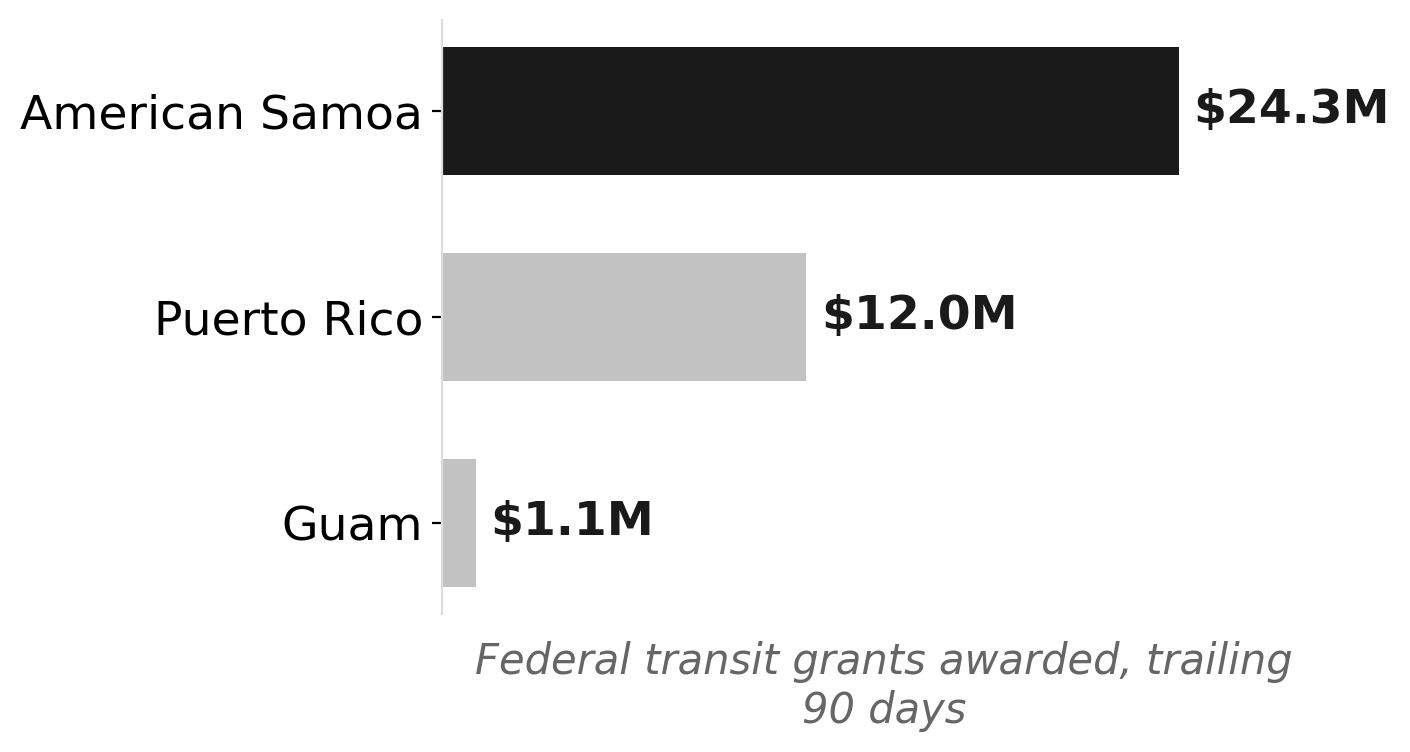
American Samoa received $24.3 million in federal transit grants in the last 90 days, a 1,172 percent increase over the same window last year, and nearly every dollar traces back to a single vessel-acquisition project that has been waiting to begin since the Obama administration.
The number at the center of this spike is a $21.25 million competitive capital grant from the Federal Transit Administration's Ferry Service for Rural Communities Program, authorized under Section 71102 of the Bipartisan Infrastructure Law (Public Law 117-58). The grant was publicly announced on November 30, 2023, as part of a $220.2 million multi-state FTA ferry package. American Samoa's award was the second-largest in that round, behind only Alaska's $131.3 million. But the grant's formal period of performance didn't begin until September 9, 2026, nearly 34 months after the announcement, which is why the year-over-year metric looks so dramatic now. The money isn't new. The clock just started.
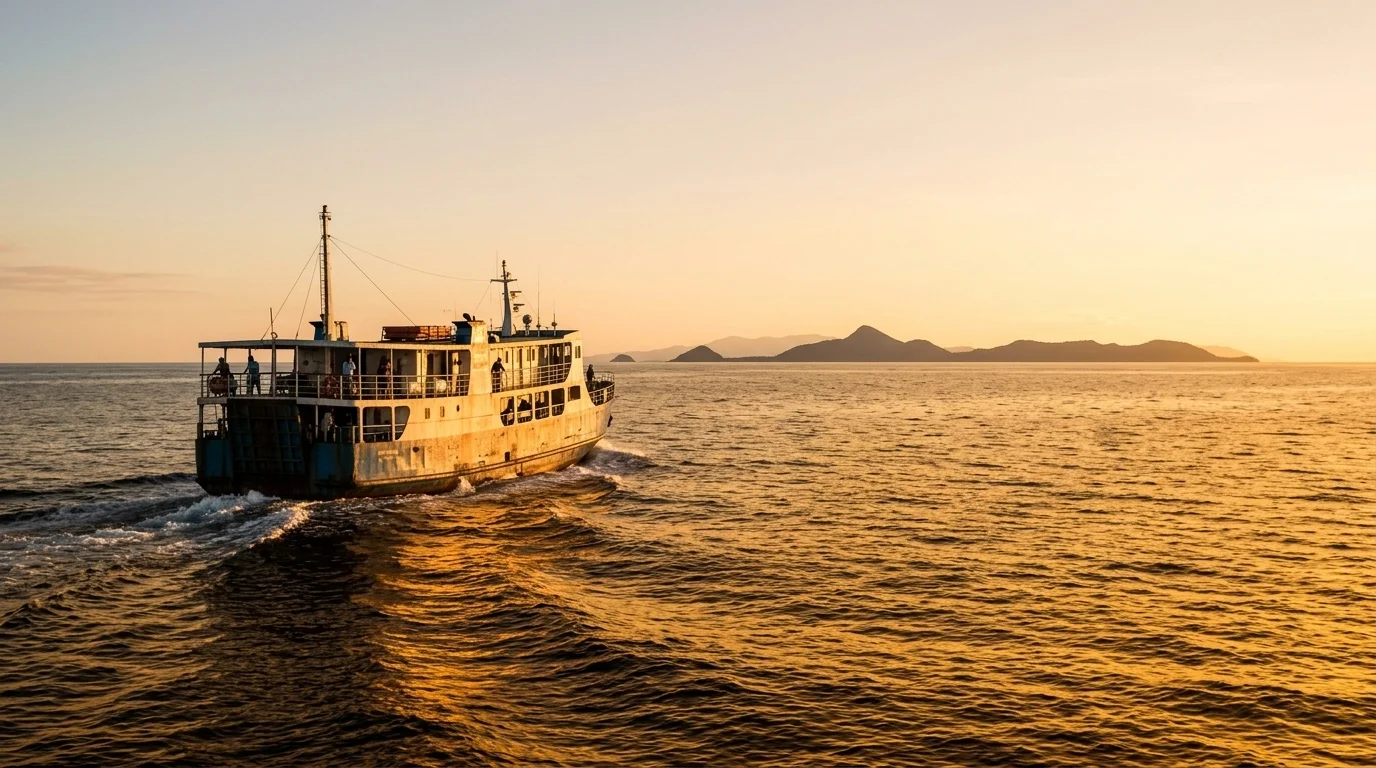
The project it funds is straightforward in purpose, if not in execution: replace the MV Sili, which has been out of service since 2018, and add vessel capacity alongside the MV Manuatele on the 50-mile open-ocean route between Tutuila and the Manu'a islands. For residents of Ta'ū and Ofu, that route is not a commuter convenience. It is the connection to hospitals, government offices, and the supply chain for basic goods. For the past eight years, that connection has rested entirely on a single aging vessel. The $21.25 million grant, managed by the American Samoa Department of Public Works, is intended to fund two new low-emission ferry vessels and close that single-point-of-failure risk before the period of performance expires in April 2029.
Source: NationGraph.
Separate from the ferry capital grant, American Samoa also received a $1.44 million FTA Section 5311 Formula Grants for Rural Areas allocation in the same window. That program is a distinct annual entitlement for rural transit operations and capital across all modes, operating under a different statutory authority and eligible-use rules than the competitive ferry grant. The Section 5311 funds can cover operating expenses; the ferry capital grant cannot. Both are federal dollars flowing through FTA, but they are not the same program, and the Section 5311 piece would have arrived on roughly the same schedule regardless of the ferry project's status.
The roughly three-year lag between announcement and performance-period start is consistent with what remote insular territories typically face in complex vessel procurement: environmental review, vessel specification, procurement solicitation, and contracting all take time, and American Samoa's geographic isolation, approximately 2,600 miles southwest of Hawaii, compounds every step. The delay is not unusual by federal infrastructure standards, but its human cost has been real. The FTA's FY2026 Notice of Funding Opportunity for passenger ferry programs has since opened an additional $657 million in competitive grants across three programs, with a May 2026 application deadline, meaning a second competitive round is already in the pipeline. American Samoa could potentially access that round as well, though any new award would face its own procurement timeline.
Congresswoman Uifa'atali Amata championed the original grant, calling it a historic investment for the territory. Her office has continued to track transportation funding through the BIL cycle. The American Samoa Department of Public Works, which proposed the vessel acquisition, is now the executing agency responsible for moving the project from obligation to procurement.
In the 90-day comparison window, American Samoa's $24.3 million outpaces every other U.S. territory: Puerto Rico received $12.0 million across 12 grants, Guam $1.1 million. That gap is almost entirely a function of timing, not of ongoing federal prioritization. No prior quarter since at least 2022 came close to this level for American Samoa; the next-largest recent quarter was Q3 2022 at $5.4 million across four grants.
The number to watch now is not the grant total but the procurement calendar. The performance period runs through April 30, 2029. If the Department of Public Works can move through vessel specification and contracting in the next 18 to 24 months, the Manu'a route could have two operational ferries before the period closes. If procurement stalls, the grant's expiration becomes its own deadline pressure. For the outer islands, the difference between those two outcomes is measured in something more concrete than dollars.