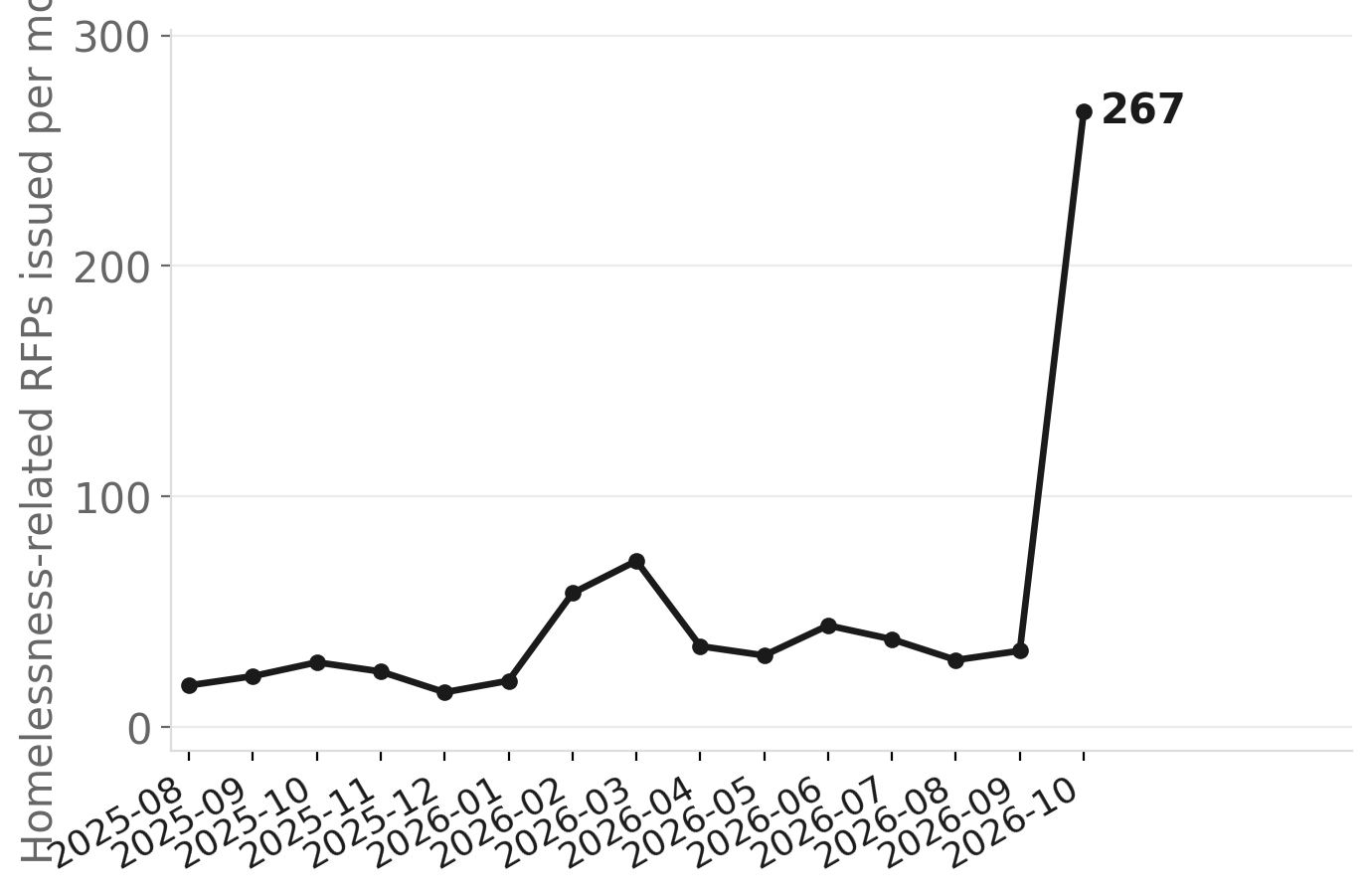
Two hundred sixty-seven homelessness-related procurement notices went out across 22 states in October 2026 alone, against a prior 12-month monthly average of roughly 50. That is not a seasonal blip. It is the largest single-month homelessness procurement surge on record, and it was produced almost entirely by nine months of legal chaos around a single $4.04 billion federal grant.
The grant is HUD's Continuum of Care (CoC) program, the primary federal funding vehicle for local homelessness housing and services. Its FY2026 competition began unraveling in December 2025, when a coalition of 21 state attorneys general sued to block it after HUD withdrew the original notice of funding opportunity. HUD reissued the notice on June 1, 2026, with a major structural change: it redirected $1.3 billion toward transitional housing projects, up from roughly $218 million in FY2024, and cut Tier 1 renewal funding from 90 percent to 60 percent. A second coalition of 21 AGs and two governors challenged the revised notice on July 7. U.S. District Judge Mary S. McElroy, sitting in Rhode Island, vacated it on August 7 for violating the Administrative Procedure Act. The First Circuit stayed that vacatur on September 16. HUD immediately reopened its e-snaps portal and set a September 30 submission deadline, giving local Continuum of Care leads roughly 14 days to decide whether to bet on money a federal judge had already thrown out once.
Most of them filed. And most of them simultaneously opened local procurement competitions to cover the gap if the money evaporated again.
Source: NationGraph.
That dual-track response is what produced October's spike. The five states generating the most RFPs, California (85), Washington (21), New York (19), New Jersey (17), and North Carolina (14), overlap almost exactly with the plaintiff states that have sued HUD twice. These are not states that expect the federal money to arrive on schedule or in its original form. California alone holds roughly $2.53 billion in active CoC-adjacent federal grants, New York $540 million, Washington $336 million, and New Jersey $309 million. The CBPP has documented that even California's state-level backstop, $500 million restored for its Homeless Housing Assistance and Prevention program plus $100 million for encampment response, funded entirely through state appropriations, amounts to roughly half of prior federal levels. That math explains the procurement volume: states are not replacing federal funding, they are competitively sourcing every layer of the service system at once to find out what they can actually afford.
North Carolina's position is worth noting separately. It ranked fifth nationally with 14 RFPs despite having no comparable state backstop program. Its municipalities are running competitions out of exposure, not from a position of strength, racing to lock in service operators before provider networks fragment under the uncertainty.
The restructuring of the CoC award itself is also driving a new round of operator competitions independent of the litigation. The shift of $1.3 billion into transitional housing and supportive services, away from permanent supportive housing renewals, changes which types of providers can win contracts. Organizations that have operated permanent supportive housing for years may not qualify under the new criteria. That structural pivot is prompting localities to open fresh competitions for transitional housing operators, coordinated entry system managers, and encampment response teams simultaneously, rather than simply renewing existing agreements. California's October RFP filings show exactly this layering: Homekey-plus affordable housing developers, HHAP transitional housing operators, warming shelter operators, and encampment response teams all appearing in the same procurement window.
Alameda County officials warned explicitly that the revised CoC NOFO could leave a $26 million local gap requiring backfill. Los Angeles's 2026 point-in-time count reversed a two-year decline, rising 3.4 percent, with paused federal subsidies cited as a primary driver even after LA County committed $300 million to a new homelessness department. These are leading indicators of what happens when the pipeline from federal competition to funded services stretches from months to years.
The October procurement surge is distinct from an earlier, smaller spike. RFPs rose briefly in February and March 2026, peaking at roughly 29 in California alone, after Congress's Consolidated Appropriations Act signed February 3 gave HUD a June 1 NOFO deadline and a December 1 funding deadline. That spike was driven by a legislative milestone creating a predictable calendar. October's surge was driven by the opposite: a court-imposed deadline, a stayed ruling, and a 14-day federal window that no one had planned for. The two episodes together show that procurement behavior in this sector tracks legal and legislative events almost in real time.
The CoC competition, as of this writing, remains open. HUD's e-snaps portal accepted applications through September 30, and awards under the FY2026 NOFO, assuming the litigation does not produce another vacatur, are expected before December 1. Whether the First Circuit's stay holds through a full merits review, whether Congress acts before the December funding deadline, and whether HUD's $1.3 billion transitional housing reallocation survives further court scrutiny are the three variables that will determine whether October's procurement sprint becomes a permanent feature of how American cities fund homelessness services.