Stormwater management RFPs reached 712 in October 2026 alone, roughly four times the prior 12-month monthly average of about 155, with procurement activity spanning 47 states and more than 1,700 institutions in the last 60 days. No flood triggered this. No new federal spending program explains it. The cause is simpler and more structural: five-year permit clocks that were set in 2020 and 2021 have been running ever since, and this year they ran out nearly everywhere at once.
The driver is the federal NPDES MS4 permit renewal cycle, which requires municipalities that operate storm sewer systems to renew their National Pollutant Discharge Elimination System permits every five years under Clean Water Act Section 402(p). What makes 2025 and 2026 unusual is the convergence. Pennsylvania's PAG-13 general permit, which covers 1,059 small municipal storm sewer systems, expires October 31, 2026. Oregon's new Phase II MS4 General Permit took effect July 1, 2026. Illinois reissued its MS4 general permit effective August 1, 2025. Utah renewed its general MS4 permit in May 2026. Each state's renewal cycle runs independently, but a critical mass of large, heavily populated states happened to land in the same two-year window, producing a procurement surge with no modern precedent in scale.
A second, distinct pressure compounds the permit renewals: the EPA's NPDES Electronic Reporting Rule Phase 2, which took effect December 21, 2025, requiring MS4 annual program reports to be submitted electronically for the first time. The eRule is not the same as a permit renewal. It mandates a systems upgrade, not a new stormwater management plan, and it hits every MS4 in the country simultaneously rather than on a state-by-state schedule. Municipalities that were already procuring engineering help for permit compliance found themselves also shopping for reporting software and data management consultants in the same budget cycle.
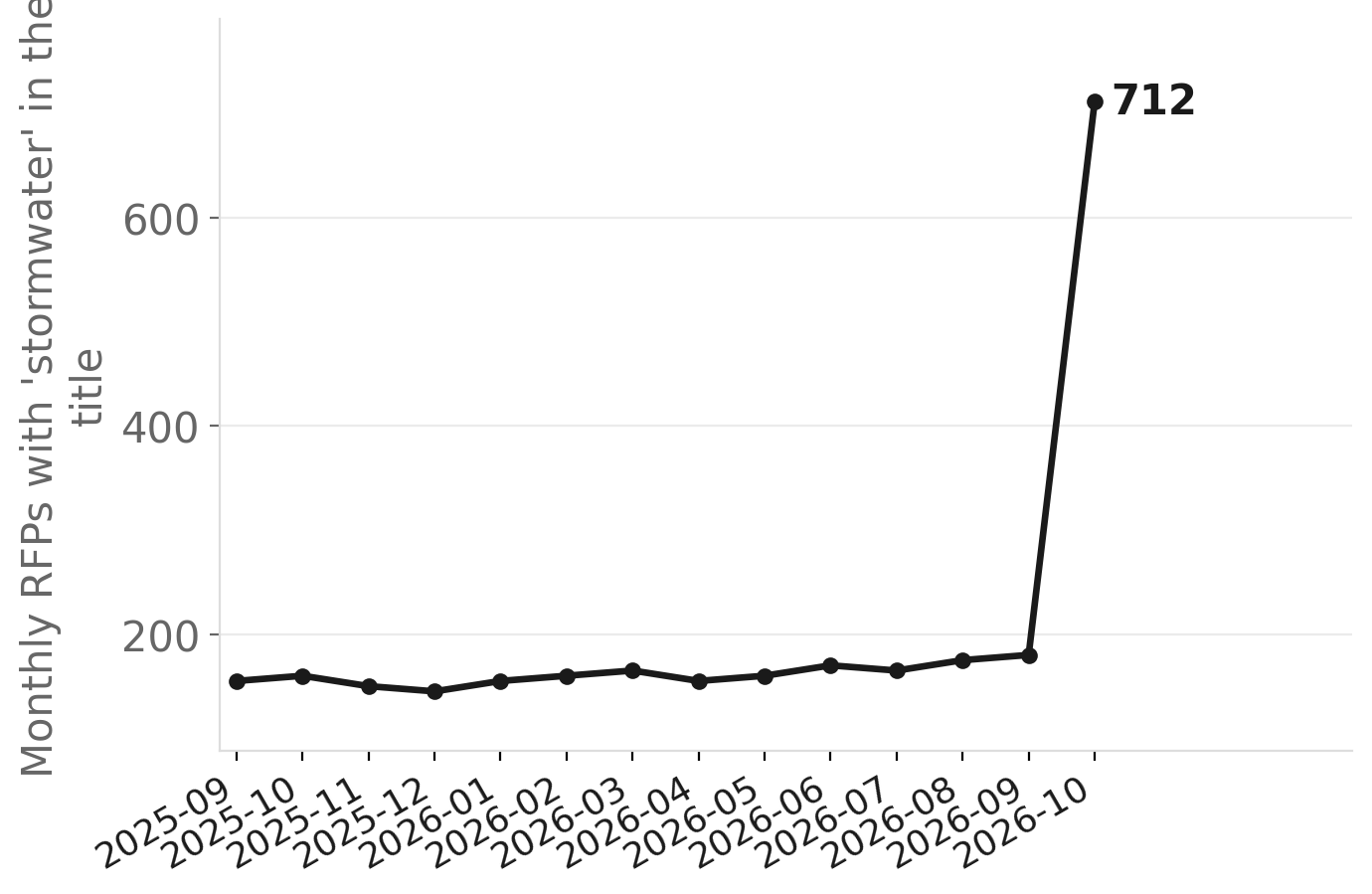
Source: NationGraph.
Pennsylvania illustrates how complicated the moment has become. The state's DEP circulated a draft of the new PAG-13 general permit in January 2025 and originally targeted a September 30, 2026 deadline for municipalities to submit Notices of Intent. But the final permit has not been published, leaving all 1,059 covered municipalities preparing compliance programs against a ruleset that isn't final. Municipal engineers in Cumberland County have warned borough councils directly that renewal "will carry costs" and that jurisdictions should budget for compliance projects now rather than purchasing credits later. Pennsylvania's new permit also adds stormwater volume controls on top of traditional pollutant-reduction requirements, a substantive tightening that demands new engineering work regardless of what a municipality did under the previous permit term.
The RFPs flowing out of this pressure span the full compliance stack. Cities are issuing solicitations for stormwater master plans, basin rehabilitation projects, utility billing system upgrades, private stormwater oversight contracts, and pump station evaluations. Florida leads the 60-day title-match count with 79 RFPs, followed by Pennsylvania (69), California (59), Washington (48), and Georgia (40). New Jersey, South Carolina, North Carolina, and Missouri each generated more than 20 stormwater-specific RFPs in the same window. The breadth across regions, population sizes, and political contexts reinforces that this is a regulatory calendar event, not a regional disaster response.
Funding for compliance projects comes primarily from local stormwater utility fees and state revolving fund loans, not from a dedicated federal stormwater grant program. The EPA's Clean Water State Revolving Fund carries an $11.7 billion national capitalization and municipalities can draw on it for green infrastructure and MS4 compliance capital projects, but CWSRF loans must be repaid and the stormwater-eligible share is not separately tracked. A recent peer-reviewed study on Mid-Atlantic MS4 utilities found that stormwater utilities "continue to report funding gaps that limit their ability to meet long-term infrastructure and resilience needs", a conclusion that helps explain why the procurement surge looks the way it does: municipalities are not flush with new federal dollars, they are scrambling to identify what they can afford before deadlines arrive.
For anyone living in a municipality with a municipal storm sewer system, the practical signal to watch is local budget hearings. Stormwater utility fee increases and new engineering contracts are the first visible symptoms of permit compliance costs reaching the municipal level. Pennsylvania's permit status is the most immediate open question: until DEP publishes the final PAG-13, every one of the state's 1,059 small MS4s is preparing for a moving target. Oregon's new permit, now in effect through 2031, sets the next five-year clock; the states that renew in 2026 will return to this moment in 2031, and the cycle will begin again.