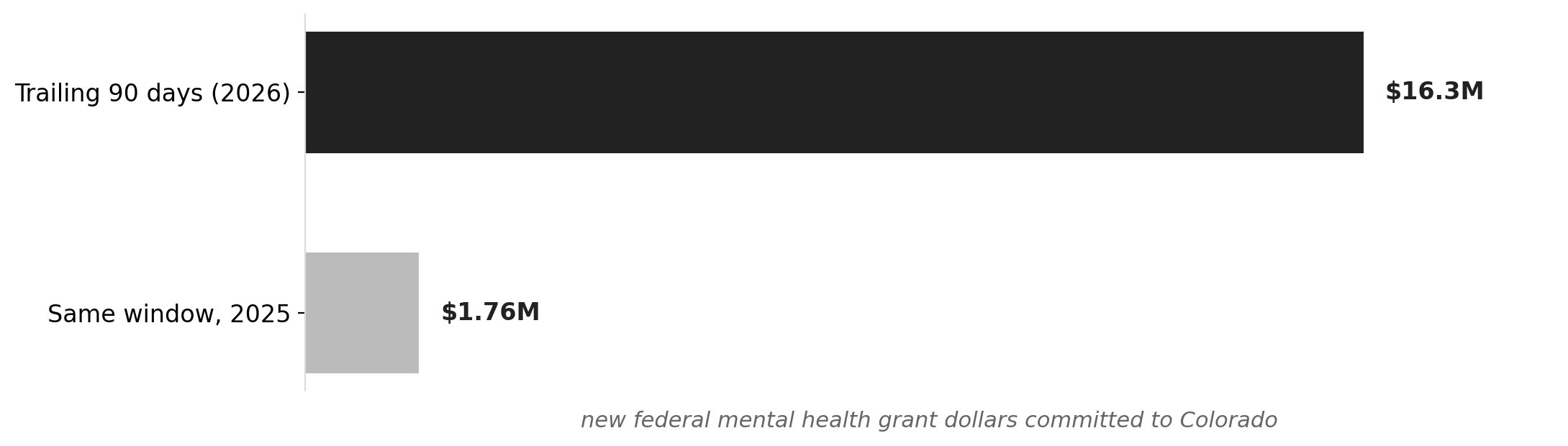
Federal mental health grants newly committed to Colorado have reached $16.3 million in the last 90 days, up 827% from $1.76 million in the same window a year ago. That surge is not a coincidence of timing. It is the payoff from a multi-year strategy to pull Colorado into the center of federal behavioral health infrastructure, culminating in a selection the state has been chasing since 2016.
On May 28, 2026, HHS, CMS, and SAMHSA announced Colorado as one of 10 new states chosen for the CCBHC Medicaid Demonstration Program, which delivers roughly a 15% enhanced federal Medicaid match for certified community behavioral health clinics over four years. The program is authorized under the Bipartisan Safer Communities Act, and Colorado's selection is the first time the state has landed a federal behavioral health demonstration since it was passed over in the original 2016 cohort. The pathway to that win traces back to a $1 million SAMHSA CCBHC Planning Grant awarded to Colorado in December 2024, followed by the state submitting a full four-year demonstration application on March 31, 2026. A decade after the door closed the first time, it is now open at a significantly larger scale.
The grant count tells the story as clearly as the dollars: 23 new federal awards in the current 90-day window versus 5 in the same period last year. Twenty-two of those 23 flow to the University of Colorado, across HHS programs covering mental health research, drug use and addiction, neurosciences, and aging research, with commitments running to 2028 through 2031. These are not one-year bridge grants. They are multi-year research infrastructure awards that will shape Colorado's academic behavioral health footprint for the next half-decade. Colorado State University holds the remaining grant, a $78,000 child health award. Among comparable states in the same 90-day window, Colorado's $17.6 million in total new federal mental health grants ranks fourth nationally, behind California, New York, and Texas, a notable position for a state of Colorado's population size.
Source: NationGraph.
The urgency behind locking in these commitments is real. In January 2026, SAMHSA abruptly terminated approximately $2 billion in mental health grants to more than 2,000 organizations across the country, then reversed the decision within 24 hours following bipartisan pressure. Colorado providers were among those briefly cut off. Senators Bennet and Hickenlooper celebrated the CCBHC selection on June 5, with Bennet framing it as a guarantee that crisis treatment would be stable and accessible regardless of zip code or ability to pay. The subtext of that framing is practical: Medicaid demonstration funding is structurally more durable than discretionary grants, which can be terminated overnight.
Colorado is not starting from zero. The state already carries $263 million in active HHS mental health grants, alongside $26.6 million from DOJ, $15.7 million from HUD, and $11.3 million from the Department of Education. Its 17 community mental health centers, operating under no-bid Medicaid contracts, draw a combined $437 million in public funds annually. Governor Polis stood up a dedicated Behavioral Health Administration in 2022 specifically to manage this scale of investment and coordinate across agencies. The new CCBHC Demonstration funding layers on top of that base, with a specific mandate to certify clinics that provide 24/7 crisis services, primary care integration, and care coordination for the highest-need patients.
The state legislative environment is reinforcing the federal push. Colorado HB 25-1002, which took effect January 1, 2026, requires private insurers to use nationally recognized clinical criteria when making behavioral health coverage decisions, closing an enforcement gap that had allowed carriers to apply looser standards to mental health benefits than to physical health. SB25-042, passed in 2025, directs the Behavioral Health Administration and Department of Public Safety to map gaps in crisis response statewide and report funding options to the legislature by January 2027. That report will land at the same moment Colorado is in the first year of its CCBHC Demonstration, creating a built-in mechanism to redirect Medicaid funding toward whatever gaps the mapping exercise identifies.
For Coloradans who interact with the behavioral health system, the most direct near-term change is an expanded network of clinics obligated to provide same-day access to crisis services regardless of insurance status or ability to pay. Youth suicide in Colorado rose 51% over the prior decade; insufficient residential psychiatric capacity has been a persistent complaint from providers and families. The CCBHC model does not directly add beds, but it restructures the front door of the system so that fewer people arrive at emergency rooms or jails as their first point of contact.
The next signal to watch is the January 2027 legislative report from the Behavioral Health Administration. That document will reveal how Colorado intends to use the enhanced Medicaid match, which clinics are on track for CCBHC certification, and where the crisis-response mapping found the deepest holes. How the state answers those questions will determine whether the $16.3 million arriving now becomes a foundation or a one-time windfall.