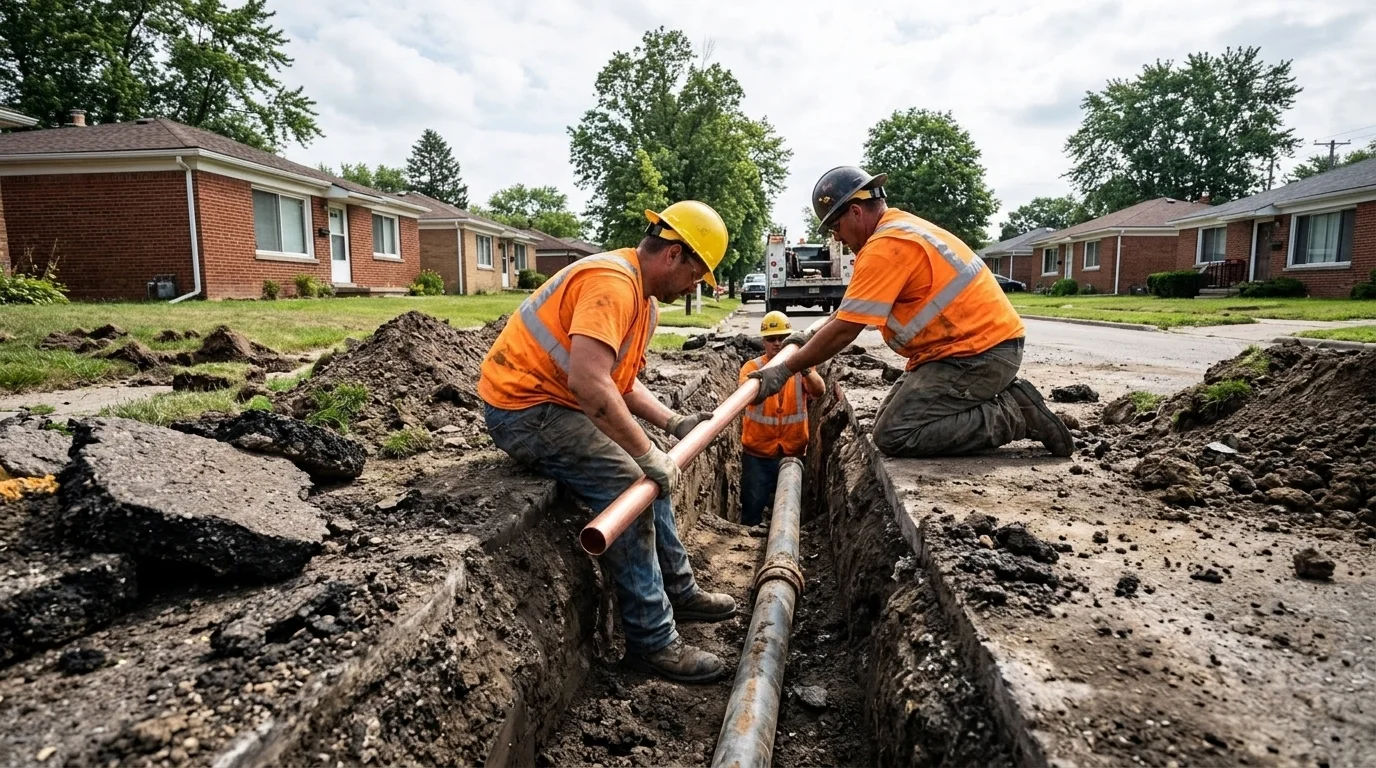
Fifteen Michigan municipalities issued lead-pipe replacement RFPs in the last 30 days, against a trailing 12-month average of roughly 1.5 per month. That 10x spike, spread across Wayne, Macomb, Oakland, Jackson, Bay, and at least six other counties, is not a reaction to any new contamination event. It is a procurement response to two federal deadlines closing in on the same 12-month window.
The first deadline is financial. FY2026 is the final year of the Infrastructure Investment and Jobs Act's $3 billion annual appropriation for lead service line replacement, channeled through the EPA's Drinking Water State Revolving Fund. The EPA announced the last round, $2.9 billion nationally after a $125 million rescission, on May 20, 2026. After this cycle closes, no dedicated federal lead-line funding is guaranteed to follow. Michigan's share flows through EGLE, which under its FY2026 Intended Use Plan offers 49% principal forgiveness on DWSRF loans for lead service line work, making nearly half of eligible project costs effectively grant money. Miss the application window and that subsidy disappears.
The second deadline is regulatory. The EPA's Lead and Copper Rule Improvements, finalized October 30, 2024, requires every water system in the country to submit a baseline inventory and a funded replacement plan by November 1, 2027, then replace at least 10 percent of its remaining lead and galvanized lines every year after that. EGLE's FY2026 IUP ties the two instruments together operationally: principal forgiveness is conditioned on replacement scopes that comply with the LCRI. That linkage gives municipalities a narrow slot in which federal money and regulatory credit align, and that slot is now.
Michigan enters this window with more exposure than almost any other state. An estimated 294,000 lead and galvanized service lines remain statewide, the fourth-highest count nationally behind Illinois, Ohio, and New York. At the 2025 replacement pace of 28,332 lines per year, the state is already running behind the 10-year clock implied by the LCRI's mandatory rate. At the October 2024 inventory deadline, Michigan water systems reported 203,050 confirmed lead lines and an additional 315,372 of unknown material. Those unknown lines must now be classified, and any that turn out to be lead or galvanized-requiring-replacement go onto the mandatory replacement list. The practical effect is that the total count could grow before it shrinks.
The procuring entities in the current spike illustrate the breadth of the mobilization. Wayne County and Clinton Township anchor the southeast, where population density concentrates the exposure. Chesterfield Township, the City of Jackson, and Sault Ste. Marie extend the geography north and west. The City of Fennville and the City of Hartford represent smaller systems that have historically lacked the administrative capacity to pursue DWSRF financing on their own. Their appearance in the RFP queue suggests that EGLE's technical assistance pipeline is working, pushing smaller jurisdictions into procurement before the grant cycle closes.
Flint's trajectory is the reference point for how long full-scale replacement actually takes. The city removed its last active lead service line on July 31, 2026, ten years after replacement efforts began in 2016, after replacing roughly 11,600 lines. Detroit Water and Sewerage still lists more than 80,000 lead service lines, by far the largest remaining concentration in the state. Detroit's procurement posture in the current cycle will be the most consequential single variable in whether Michigan meets the LCRI's 10-year replacement clock statewide.
Michigan's institutional position is worth noting. The state adopted its own Lead and Copper Rule in 2018, stricter than the then-current federal baseline, and has required 5% annual replacement since 2021. EGLE has built more administrative infrastructure for this work than most state environmental agencies. That capacity is part of why the current RFP surge is geographically dispersed rather than concentrated in one or two anchor cities. When EGLE moves, it moves systems across all 10 million residents, not just the ones with the loudest advocates.
What changes for a Michigan resident is partly symbolic and partly material. The 49% principal forgiveness means the gap between what a municipality can borrow cheaply and what it must fund on its own narrows sharply after FY2026. Future replacements will still happen, but they will cost local ratepayers more. The LCRI's 10%/year mandatory rate also means that utilities cannot slow-walk the work: a system that files a funded plan in November 2027 and then misses its annual replacement target faces federal enforcement, not just a letter.
The next signal to watch is EGLE's FY2026 DWSRF project list, expected to be finalized later this year, which will show how many of the current RFPs convert into funded contracts. Any municipality that completes procurement but misses the DWSRF application cutoff will face a stark choice: delay replacement and risk LCRI enforcement, or proceed without the 49% subsidy. That gap is what the current 10x RFP spike is trying to close.