Twenty-two homelessness-response RFPs entered North Carolina's procurement database in the last 30 days, a 12-fold spike over the trailing monthly average of 1.8, with 13 distinct agencies issuing contracts across nine counties. This is not a single city catching up on a backlog. It is a statewide rush to build shelter capacity before the General Assembly reconvenes this month and potentially hands local governments a legal liability they cannot pay.
The liability in question comes from HB 437, the 'Drug-Free Zones/Unauthorized Public Camping' bill, vetoed by Governor Josh Stein on July 8 as an "unfunded mandate" and a "poorly constructed" piece of legislation. The bill passed both chambers by margins that suggest a veto-proof majority: 73-40 in the House, 26-16 in the Senate. House Speaker Destin Hall pledged an override immediately after the veto, and HB 437 has been on the House override calendar for the November session, which begins now. If the override succeeds, municipalities without sufficient shelter beds would be required to fund and staff designated encampment sites themselves, with no state dollars attached, and citizens could sue local governments for failure to comply.
That combination, an unfunded mandate paired with a private right of action, is what is driving the procurement wave. Cities across Wake, Mecklenburg, Forsyth, Guilford, Durham, New Hanover, Gaston, Cumberland, and Orange counties are racing to have shelter operators under contract, housing assessments completed, and HMIS systems operational before the override clock runs out. A prior spike of 26 RFPs appeared in July 2025, when HB 437 first passed the House, suggesting municipalities have been responding to this legislative threat for more than a year. The November session has concentrated that anxiety into weeks.
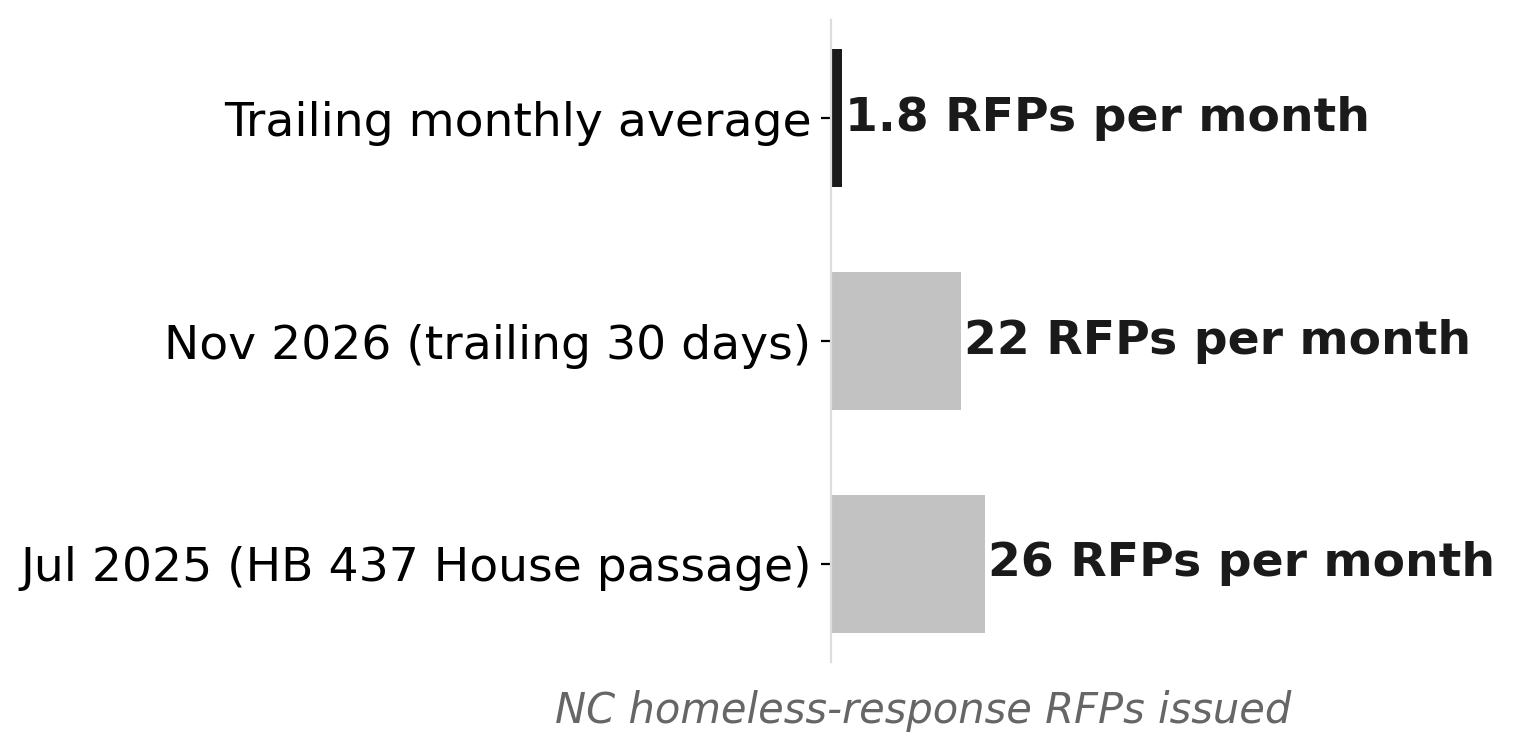
Source: NationGraph.
Two distinct forces are driving the surge, and they should not be confused. HB 437 is the sword: a state mandate with no funding that creates legal exposure. Wake County's $22 million 'Wake at Home' initiative, launched in July 2026, is the shield: a separately funded, two-year program targeting the housing of 1,400 households by December 2027, structured through the Wake Continuum of Care. Wake County has issued six of the 22 RFPs in the trailing 30 days, covering HMIS software, shelter operators, White Flag emergency shelter partners, medical respite, and housing services. The initiative has roughly $12 million committed from the county and partners, with a $10 million gap to be filled through philanthropic and health-system contributions. Wake at Home generates its own procurement wave for reasons entirely internal to the county. But it is operating on the same compressed timeline as every other jurisdiction watching the override calendar.
Wilmington issued four RFPs in the same window, including a housing and homeless market assessment. Gastonia issued two, including one referencing HOME-ARP federal funds for non-congregate shelter property acquisition. These are not large cities with deep administrative infrastructure. The NC Coalition to End Homelessness has argued that smaller municipalities lack the capacity the bill envisions, a concern echoed by Wilmington Mayor Bill Saffo.
The federal funding context adds another layer of pressure. HUD has obligated $887 million in homelessness-related grants to NC entities since 2025, across Continuum of Care awards, Emergency Solutions Grants, and Section 8 Housing Choice Vouchers. NC DHHS received $5.17 million in ESG funding starting January 2026; the city of Charlotte received an additional $1 million separately. A conservative op-ed in the Carolina Journal argued that without the override, NC could lose up to $46 million in federal homelessness funding, citing a new HUD Notice of Funding Opportunity released in June 2026. That framing inverts the fiscal argument opponents have made: the unfunded-mandate critique assumes state inaction is costless, but supporters of the override contend federal dollars are contingent on demonstrating a regulatory framework.
HB 437 is modeled on legislation drafted by the Cicero Institute, a conservative think tank whose camping-ban template has been enacted in Arizona, Missouri, Tennessee, Iowa, Georgia, Florida, Wisconsin, and Kentucky. NC would join that list if the override succeeds, inheriting both the enforcement framework and the legal challenges that have followed those laws elsewhere.
North Carolina counted roughly 11,500 people experiencing homelessness in 2024. Wake County's own 2026 count found 1,150, with unsheltered homelessness more than doubling since 2020. The procurement activity now underway reflects an attempt to close that gap under a deadline set not by housing conditions, but by a legislative calendar. The override vote, if it comes, will tell local governments whether the contracts they are signing now are sufficient or merely a down payment on a mandate they cannot yet price.