Federal mental health grants flowing into Maryland have hit $79.3 million in the trailing 90 days, a 68% jump from $47.1 million in the same window last year. The number looks like a behavioral health windfall. It largely is not, at least not for someone trying to get a therapist or reach a crisis line.
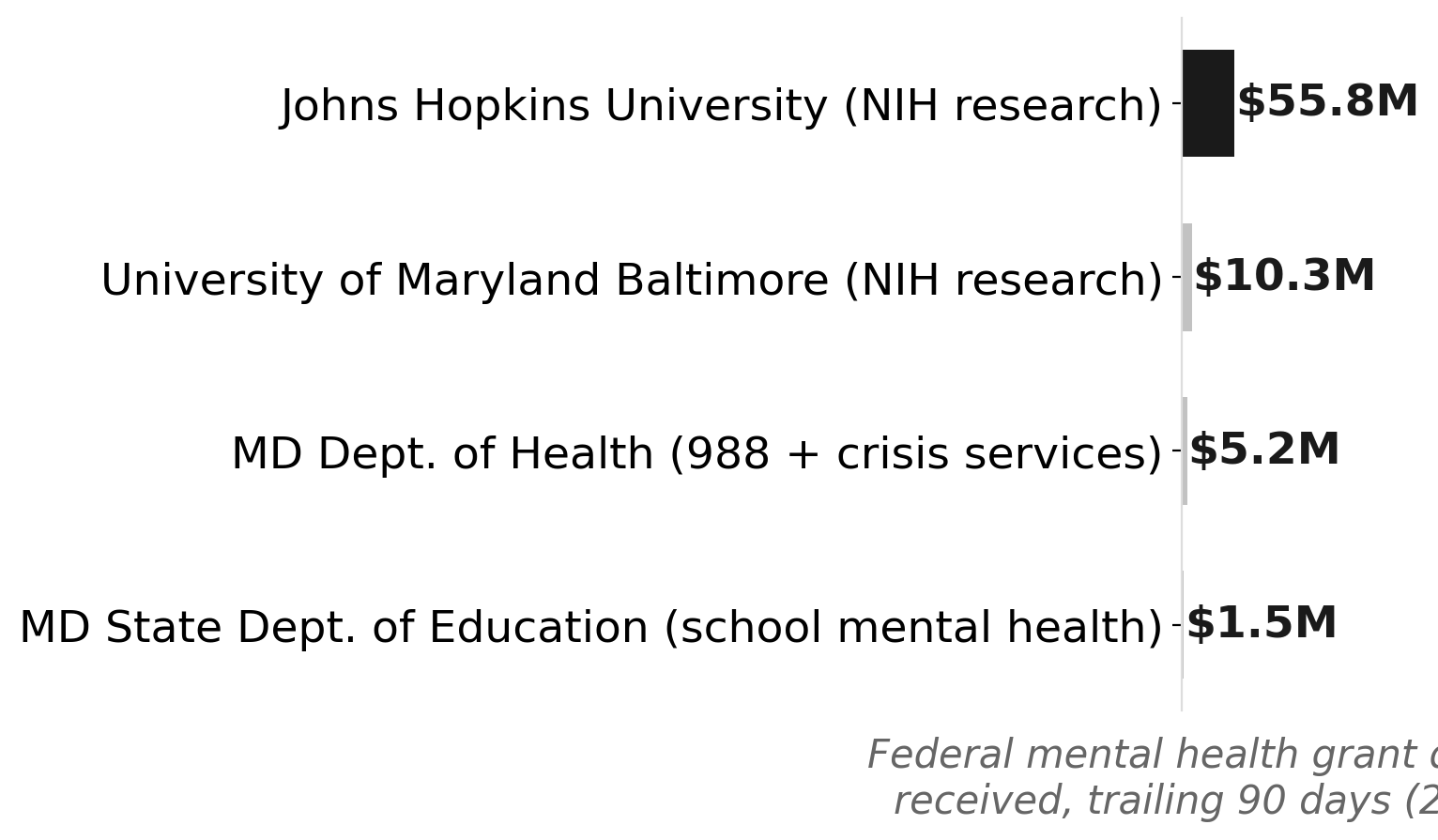
The surge is driven by two distinct forces that have almost nothing to do with each other. The first is NIH biomedical research dollars landing at Johns Hopkins University ($55.8 million across 64 grants) and the University of Maryland Baltimore ($10.3 million across 16 grants). The second is a much smaller stream of SAMHSA service grants, including a $4.5 million cooperative agreement for 988 crisis services awarded to the Maryland Department of Health on September 30, 2026, and a $1.5 million SAMHSA grant to the Maryland State Department of Education for school-based mental health. These are not one trend. They are two separate federal programs, operating under different statutory authorities, serving entirely different populations.
The Hopkins and UMD awards are research grants. They fund laboratories, clinical trials, and behavioral science studies with no direct mandate to deliver care. Maryland's outsized share of national mental health grant dollars, which puts it above Virginia ($47.1 million in the same window) and New Jersey ($34.6 million), is a byproduct of institutional density, not policy. Hopkins alone received $866 million in total NIH funding in FY2025. When NIH compresses its award calendar because the Office of Management and Budget delayed releasing FY2026 funds until mid-March 2026, the August and September spike that results lands disproportionately in states with large research universities. That is what is happening here.
Source: NationGraph.
The SAMHSA dollars are different in kind. Maryland's $4.5 million 988 award is part of a national $383.4 million behavioral health investment announced by HHS on September 8, 2026, timed explicitly to '988 Day,' with $252 million of that total earmarked for suicide prevention, crisis hotlines, and mobile crisis response. Maryland's share is real services money, and it will run through 2029. The Maryland State Department of Education's $1.5 million grant targets school-based mental health programming. Both awards matter to communities. Combined, they total roughly $6 million out of $79.3 million.
The paradox sharpens when you look at what the state itself is doing. Maryland mental health advocates spent much of early 2025 fighting a proposed $116 million cut to behavioral health services proposed by Governor Moore as part of his response to a $3 billion structural deficit. The General Assembly pushed back and partially restored funding, but the Consortium on Coordinated Community Supports, the state's main vehicle for school-based mental health under the Blueprint for Maryland's Future education reform, ended up at $70 million for FY2026, down from the $130 million Moore had originally envisioned when the program launched. The 988 line and community-based services took smaller cuts as well before partial restoration.
The Behavioral Health Administration's total FY2026 budget is $3.4 billion, a 2.5% increase driven partly by renewed federal substance use disorder grants. But that headline number obscures the internal composition: the federal research dollars measured in the 90-day grant window do not touch that budget at all. They go to universities. The community mental health system, the part of the system a resident in crisis actually contacts, runs on SAMHSA grants and state appropriations, both of which have been under pressure.
There is also a recent history of instability in the NIH pipeline itself. Johns Hopkins reported 43% less federal funding for new and ongoing research in FY2025 after the Trump administration froze and then terminated dozens of NIH grants on DEI-related grounds. Hopkins had 19 grants terminated, second only to Columbia, before federal court orders required reinstatements beginning in mid-2025. The rebound visible in this 90-day window is partly that restoration cycle completing, combined with the compressed award calendar. It is a recovery from an artificial trough, not a new high-water mark.
For Marylanders watching the behavioral health system, the signal worth tracking is not the aggregate federal grant figure. It is the fate of the state's FY2027 budget negotiations, which will determine whether the Consortium on Coordinated Community Supports holds at $70 million or faces another reduction, and whether the SAMHSA 988 award translates into expanded call center capacity before the next fiscal year ends. The federal research money will keep flowing to Hopkins and UMD as long as NIH appropriations hold. The crisis infrastructure is on a shorter leash.