
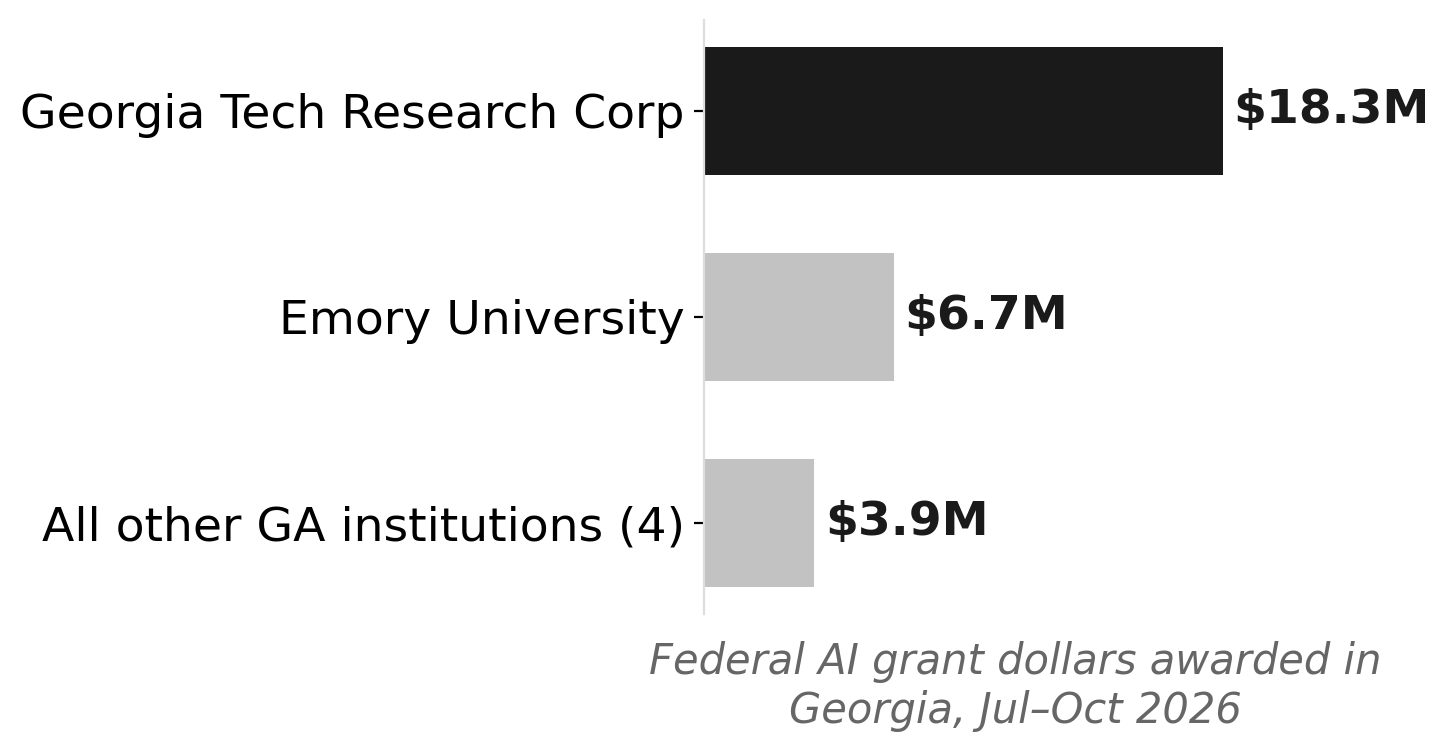
Federal AI grants newly started in Georgia over the past 90 days total $28.9 million across 35 awards, more than double the $14.3 million awarded in the same window a year ago. Most of that money lands at one address: Georgia Tech Research Corp collected $18.3 million across 17 grants, accounting for 63 cents of every new federal AI dollar in the state.
That concentration is not a coincidence. It is the result of two separate federal programs, both reaching peak payout at the same moment, both treating Georgia Tech as a primary recipient.
The first is the NSF National AI Research Institutes program, which funds multi-year university research consortia at roughly $4 million per year per institute. Georgia Tech hosts three active institutes simultaneously: AI4OPT, focused on energy systems, supply chains, and semiconductor manufacturing; AI-ALOE, targeting AI applications in adult learning and online STEM education; and AI-CARING, which applies AI to assistive care and aging. At least two of those institutes hit renewal tranches in this 90-day window, contributing $7.8 million to the current surge. NSF has now invested more than $60 million in Georgia Tech's AI institutes cumulatively, and the renewal structure means the university isn't competing for new grants so much as it is collecting on long-term commitments it already secured.
Source: NationGraph.
The second program is structurally distinct. The White House Genesis Mission, launched by executive order in November 2025 and formally awarded on July 22, 2026, channels DOE, NSF, NIH, and more than a dozen other agencies toward AI-for-science projects. The administration announced more than $5 billion in commitments across 278 DOE-selected projects, described by the department as the largest response to any DOE funding opportunity in its history. Georgia Tech was selected for multiple Genesis Mission awards spanning engineering, earth sciences, and energy. Those awards flow through DOE and NSF program offices, entirely separate from the AI Institutes mechanism, but they land on the same research teams and reinforce the same institutional priorities. The AI4OPT renewal, for instance, explicitly cites the White House AI Action Plan, aligning its semiconductor and energy-systems work with Genesis Mission framing.
Georgia Tech also broke ground this year on Nexus, a $20 million NSF-funded national AI supercomputer expected to come online in spring 2026. That infrastructure investment is not counted in the 90-day grant totals, but it is part of why Georgia Tech is positioned to absorb compute-heavy Genesis Mission workloads that smaller universities cannot.
The second-largest recipient in the state, Emory University, collected $6.7 million across nine grants, almost entirely from NIH and HHS programs applying AI to oncology, neuroscience, and cardiovascular research. Emory's awards are meaningful at the institutional level but operate in a separate lane: biomedical AI research rather than the engineering and physical-science domains that define the Georgia Tech surge.
One grant in the current window points toward something beyond pure research. A $3.2 million Department of Commerce NIST Manufacturing Extension Partnership award to Georgia Tech's GAMEP program, running from October 2026 through September 2031, is specifically designed to help small and mid-size Georgia manufacturers adopt AI tools. That is federal science funding moving one step closer to the shop floor, using Georgia Tech as the delivery mechanism for the state's manufacturing base.
For context, Georgia ranks fourth among Southern states in AI grant flow over this window, behind Texas at $59.7 million, North Carolina at $47.8 million, and Florida at $33.9 million. The state is not competing with Texas on volume, but on concentration: the $28.9 million flowing into Georgia is going to six institutions, with one holding nearly two-thirds of it. That structural advantage compounds. An institution running three NSF AI Institutes simultaneously has three separate renewal windows, three separate Genesis Mission project leads, and three separate bodies of preliminary work that qualify for follow-on awards.
One smaller signal is worth noting. Clark Atlanta University, an HBCU, received a $444,000 NSF ExpandAI grant in the same 90-day window. The dollar figure is modest against the Georgia Tech totals, but ExpandAI is NSF's explicit capacity-building tier for institutions that don't yet have the infrastructure to compete for full institute awards. It is, in effect, the program that builds the next cohort of Georgia Tech-scale AI recipients, and it is now active in Georgia.
The next signal to watch is the full disclosure of individual Genesis Mission award amounts. The July 22 announcement named Georgia Tech as a multi-award recipient but did not itemize project-level dollar figures in public records. When those numbers become available, the 90-day totals for this window will almost certainly be revised upward, and the degree to which one university has concentrated the state's AI research infrastructure into a single node will become clearer still.