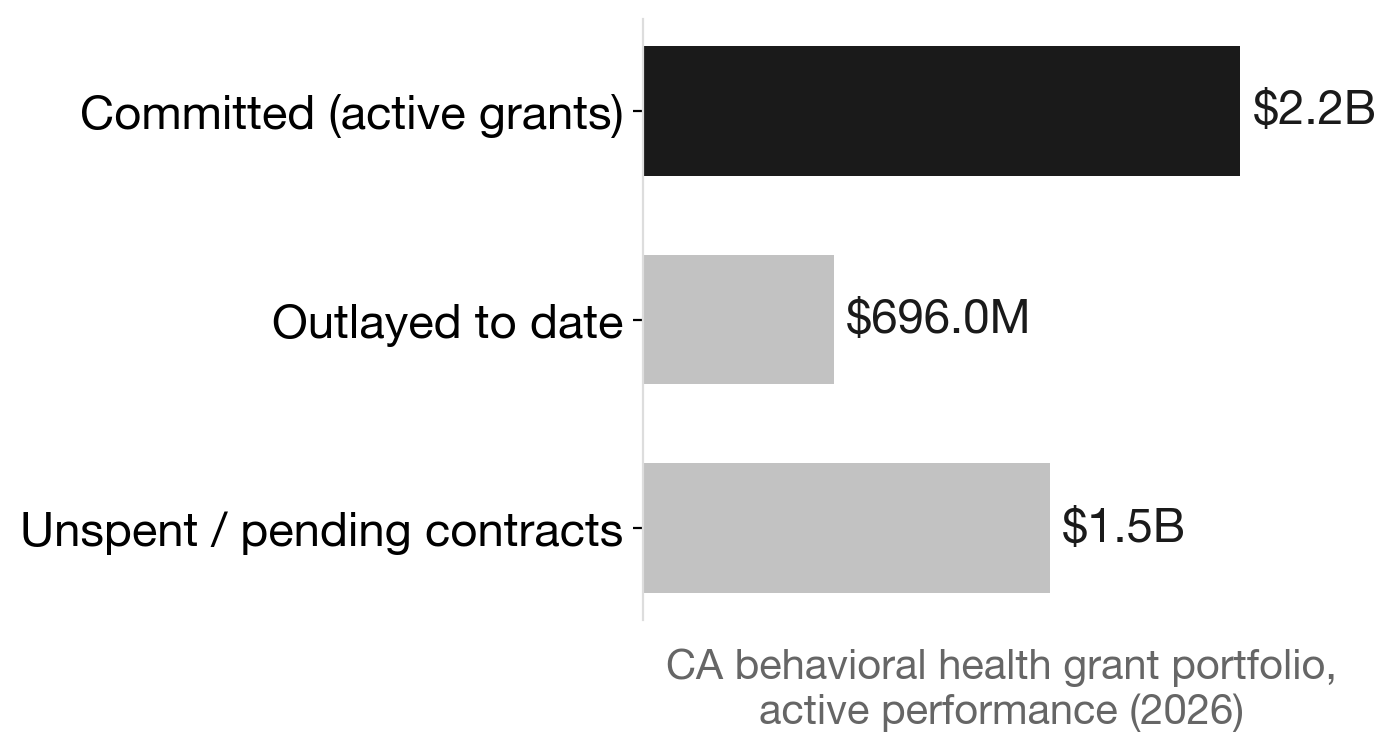
California has committed $4.17 billion to behavioral health infrastructure, but only about a third of it has actually moved. Of the $2.18 billion in active state and federal behavioral health grants currently in performance across 574 awards, just $696 million has been outlayed, leaving roughly $1.5 billion in committed capital waiting to become contracts. In the last 30 days, six California institutions issued a mental health RFP for the first time in over a year. That number is small, but the timing is not a coincidence.
The reason those institutions went quiet and are now re-entering the market at the same moment traces directly to two events. In March 2026, Governor Newsom announced $1.18 billion in Bond BHCIP Round 1 awards covering 66 new projects at 130 facilities. Then, on July 2, 2026, Proposition 1's Behavioral Health Services Act went into full statewide effect across all 58 counties, replacing the older Mental Health Services Act framework that had governed county spending since 2004. Under the new law, counties must now submit Integrated Plans for Behavioral Health Services and Outcomes. A voluntary spending framework became a compliance obligation overnight.
The practical effect: grantees who received capital awards in mid-2025 and spent months navigating DHCS bureaucracy are now issuing the construction and services RFPs those awards were always meant to fund. Sonoma County posted a BHCIP Round 1 Mental Health Rehabilitation Center and SUD Facility RFQ/RFP on August 2, 2026, directly backed by a $7 million DHCS behavioral health strategic enhancement grant that has been active since July 2024. The gap between grant activation and first public solicitation was more than two years. Colton Joint Unified School District in San Bernardino County issued a mental health facility construction bid on July 9, 2026, a signal that the procurement wave is reaching institutions well outside the major urban health systems.
Source: NationGraph.
The larger county grantees have been in construction longer. The BHCIP active portfolio already includes $83.7 million to the City of Lancaster, $62.4 million to Alameda Health System, $45.5 million to Sacramento County, and $21.3 million to San Francisco's Department of Public Health, all currently in construction phase. But those awards came in earlier rounds, and the institutions receiving them had existing procurement infrastructure to move quickly. The six institutions now posting their first RFP in 12 months represent a different cohort: smaller jurisdictions, school districts, and rural counties that either waited for later award rounds or needed the July 2026 compliance deadline to pull the trigger.
Monthly mental health RFP issuances in California peaked at 139 across 69 institutions in July 2025, then settled into a range of 27 to 75 per month as that initial cohort absorbed its awards and moved into execution. The current re-entrants are not a continuation of that 2025 surge. They are a new procurement cohort, unlocked by the Spring 2026 announcements and the BHSA activation, and they are just beginning.
The scale of what is still ahead clarifies why that matters. Proposition 1, passed by California voters in March 2024, authorizes $6.38 billion in total bond funding. The $4.17 billion in BHCIP grants awarded to date is projected to create more than 6,900 residential treatment beds and 27,500 outpatient slots statewide once all projects reach completion. DHCS has also released an $800 million Round 2 "Unmet Needs" RFA that specifically prioritizes rural and previously unserved jurisdictions, precisely the smaller-county cohort now entering procurement for the first time. Round 2 award announcements came in Spring 2026, meaning those grantees are several months behind the Sonoma and Colton timelines and have not yet begun issuing solicitations.
For contractors, architects, and behavioral health service providers, the next 12 months represent the densest procurement window California's mental health buildout has yet produced. For residents in smaller counties and rural jurisdictions, the facilities being designed and bid right now are the ones that will determine whether Proposition 1's promised capacity expansion reaches communities that have historically had the least access to residential treatment and outpatient care.
The signal to watch is whether Round 2 grantees follow the same two-year gap between award and first RFP, or whether the BHSA compliance requirements compress that timeline. County Integrated Plans are due on a rolling basis through 2026 and 2027. How quickly those plans convert into solicitations will determine whether the $1.5 billion in unspent committed capital moves in the next budget cycle or the one after it.