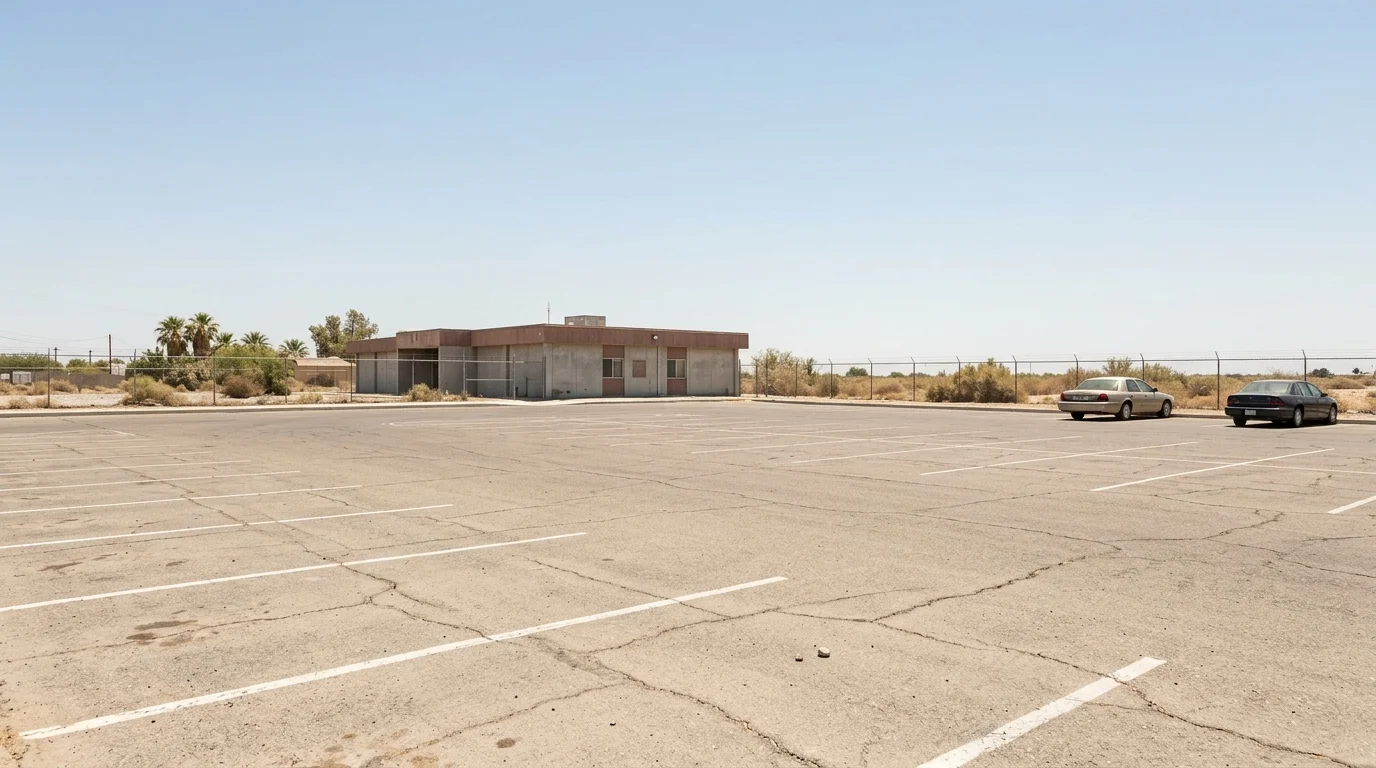
The City of Imperial, California, population 21,742, sitting in one of the state's poorest counties along the Mexican border, issued its first EV charging station RFP in over a year last month. It is not alone. In the trailing 30 days, at least six California public institutions have entered EV charging procurement for the first time in more than 12 months, a list that also includes the City of San Jose, CSU Long Beach, and Marin County. Taken together, they represent something the EV infrastructure industry has not previously seen: a statewide compliance wave that reaches from Silicon Valley to the rural Southeast corner of the state.
The force driving this is not enthusiasm. It is a deadline that arrived January 1, 2026.
California's updated Title 24 (Part 6 energy code) and CALGreen 2025 edition, which took effect at the start of this year, require installed Level 2 EV charging hardware at the majority of residential and common-area parking stalls in new multifamily and institutional construction. Prior code cycles required only conduit, the rough plumbing for a future charger. The 2025 edition requires the charger itself. For any institution breaking ground on a parking facility, that distinction is the difference between a passive plan and a procurement obligation.
Source: NationGraph.
Layered on top of that mandate is a separate and distinct financial pressure: the California Energy Commission's active NEVI solicitation pipeline. California received a $384 million federal NEVI allocation, and the CEC is distributing it through a sequence of competitive grant rounds. The NEVI-3 round, solicitation GFO-25-602, opened $79 million for DC fast chargers along Alternative Fuel Corridors, with an application deadline of March 25, 2026. NEVI-4 and NEVI-5 deadlines have been extended to May and June 2026. These are use-it-or-lose-it federal dollars, and municipalities that are not ready to apply cannot compete. The code mandate compels action; the NEVI deadlines attach a clock to it.
These are two distinct policy levers, and it matters to keep them separate. Title 24 and CALGreen provide no money. They impose a compliance cost on developers and institutions building new facilities. The NEVI solicitations are competitive federal grants administered by the CEC for public charging installations that meet NEVI technical standards. An institution like CSU Long Beach, procuring EV infrastructure alongside parking lot repairs at Lot E8, is likely responding primarily to the code mandate. San Jose's RFP, explicitly titled a Community EV Charging Access Project and consistent with CEC grant criteria targeting disadvantaged communities, may be positioning itself for NEVI funding as well. Imperial, with its lower municipal budget and rural geography, is procuring under both pressures simultaneously.
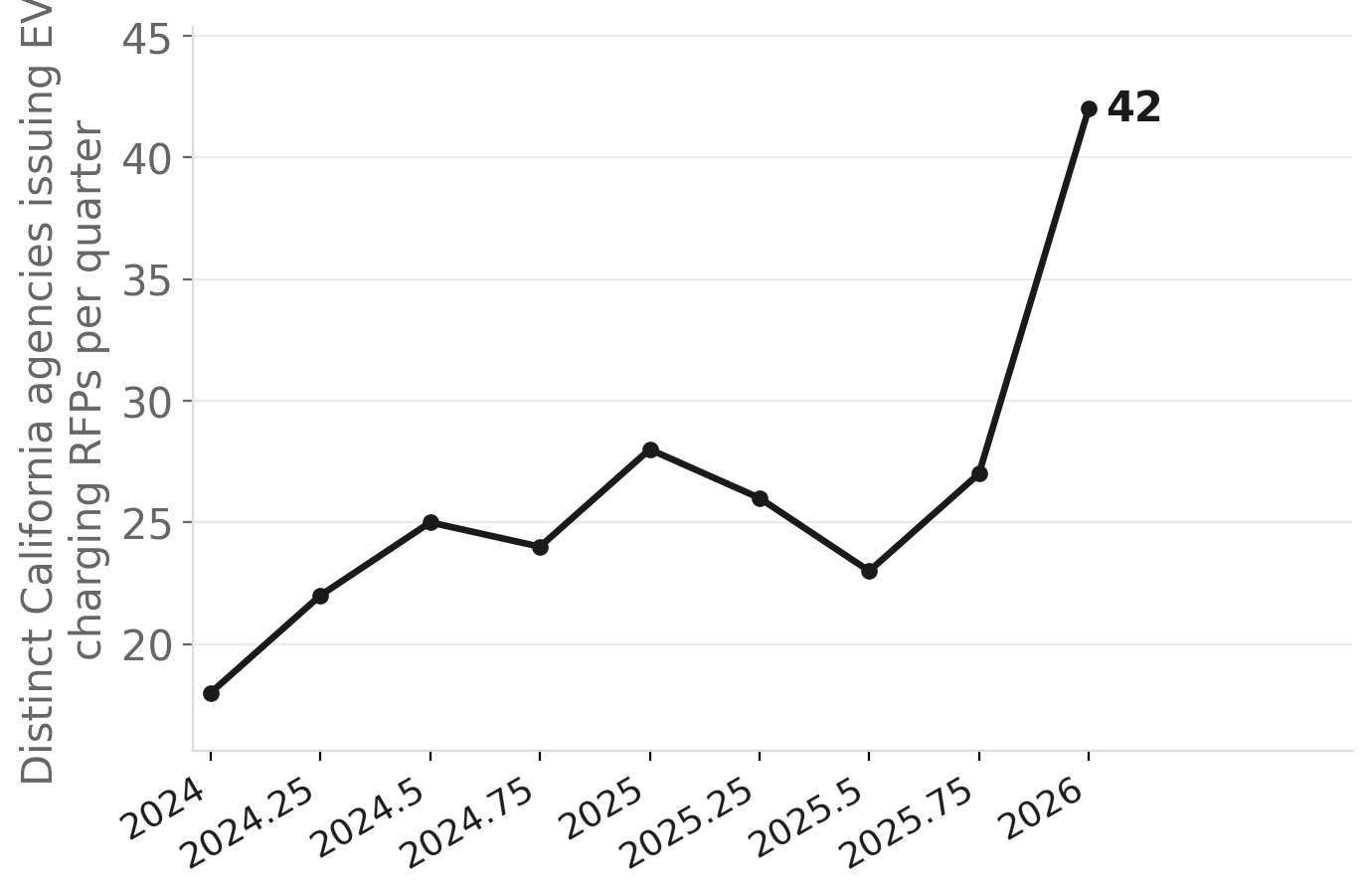
The breadth of this moment shows up in the quarterly numbers. Forty-two distinct California agencies issued EV charging RFPs in Q1 2026, the highest single-quarter agency count in two trailing years. That number matters not because of its size alone but because of who is in it. Previous surges in California EV procurement were concentrated in larger coastal jurisdictions with dedicated sustainability staff and existing EV programs. This quarter's list spans geography and institutional type in a way earlier waves did not.
The broader financial backdrop is substantial. California's CEC tracks several federal EV infrastructure programs, and grant commitments to the state have been large and sequential: $503 million committed in October 2024, $458 million in January 2025, $227 million in December 2025. That money is now moving from commitment to implementation, which is part of what makes the spring 2026 NEVI application deadlines consequential. Institutions that complete procurement now are positioned to receive reimbursement; institutions that wait may miss the round.
Governor Newsom's proposed $200 million state ZEV rebate program for FY2026-27 adds a separate layer of context. The proposal is a demand-side consumer incentive intended to replace the expired federal $7,500 EV tax credit, and if enacted, it would accelerate vehicle adoption and increase pressure on charging networks. But it does not fund municipal or institutional charger installation, and it should not be read as the cause of the current procurement wave. The mandate and the grant deadlines are doing that work independently.
For residents in jurisdictions now entering procurement, the near-term effect is straightforward: public charging access in places that previously had none or very little. For Imperial, that baseline shift matters more than it would in San Jose. For the institutions themselves, the next signal to watch is whether NEVI-4 and NEVI-5 applications, due May and June 2026, attract the first-timers who issued RFPs this spring or whether procurement alone proves to be the ceiling of their ambition.