Utah issued five electric vehicle infrastructure RFPs in the last 30 days, more than three times its 12-month average of roughly 1.5 per month. The surge is not a coincidence. It is the direct consequence of a legal ruling that handed state officials their money back, followed almost immediately by a congressional vote that took a portion of the remaining pot away, leaving procurement officers statewide with a clear message: obligate now or risk losing the rest.
The legal trigger came on January 23, 2026, when U.S. District Judge Tana Lin of the Western District of Washington permanently barred the U.S. Department of Transportation and FHWA from suspending previously approved state NEVI plans or withholding formula funds. The court found the Trump administration's 2025 freeze of National Electric Vehicle Infrastructure funds arbitrary and capricious. Six days later, on January 29, the Utah Department of Transportation formalized five NEVI grants totaling approximately $28.8 million. Then, in February, Congress rescinded roughly $879 million in unobligated NEVI funds through an appropriations act, leaving an estimated $4.12 billion intact but shrinking the runway for states still waiting to obligate their FY2026 apportionments. The message to every state DOT was the same: the courts will protect what you have already obligated, but only what you have already obligated.
UDOT moved accordingly. The agency finalized its NEVI Phase II Request for Applications on August 27, 2026, extending the program beyond interstate corridors to secondary highways and underserved rural areas. The applicant deadline is October 8. That RFA, and the Stage 1 Re-Qualification RFP issued September 20, account for the bulk of the recent procurement activity. Utah's five-year NEVI apportionment totals approximately $43 million, and the state has aggressively pursued every dollar of it. Its total EV-related federal grant portfolio over the last three years reaches $120.8 million, the highest among neighboring states, Arizona holds $103.7 million, Nevada $33.9 million, Colorado $6.3 million.
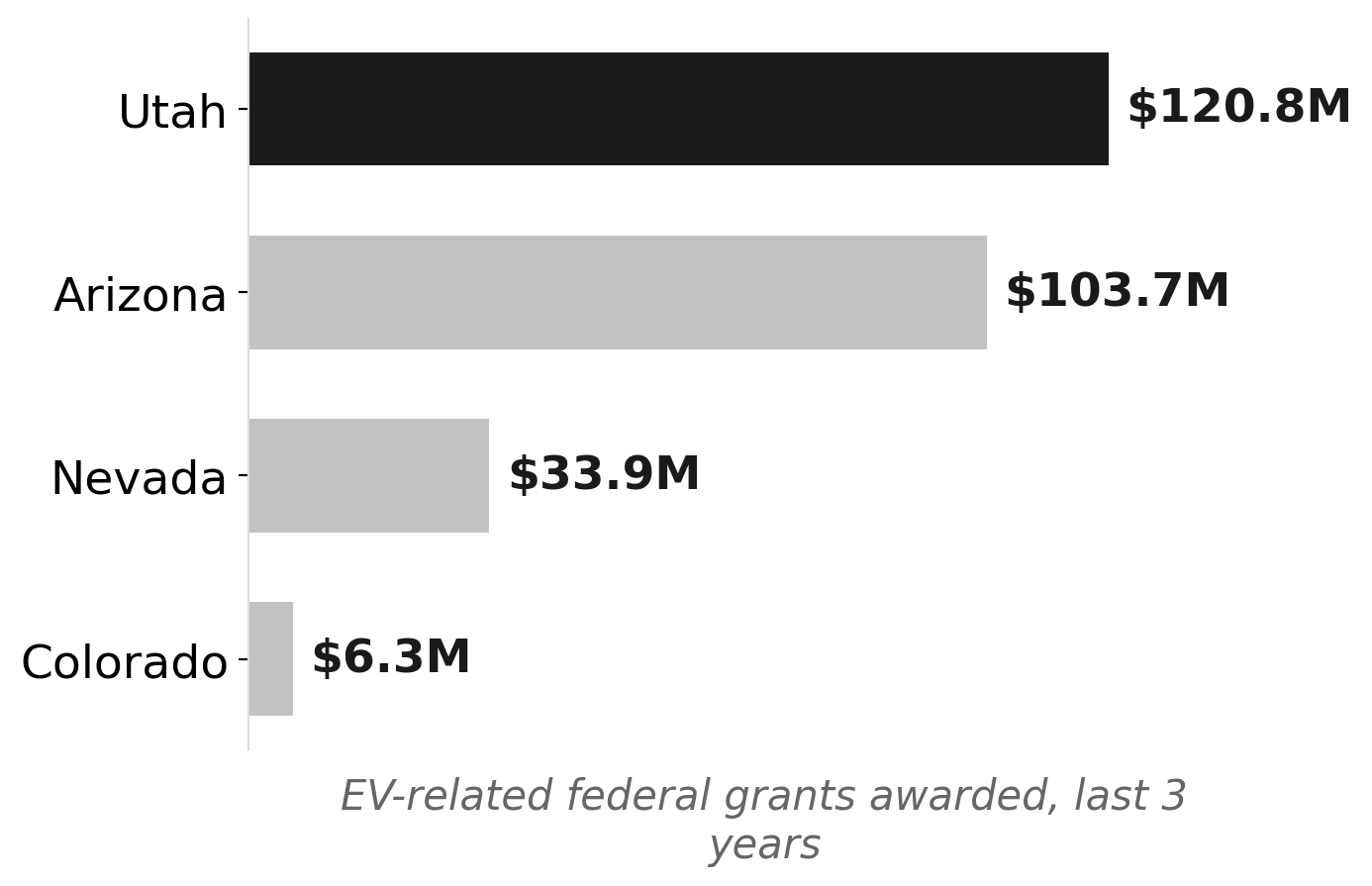
Source: NationGraph.
The figure that makes Utah's procurement sprint most legible is this: of $120.8 million in committed EV grants, only about $434,000 has been outlayed. Nearly the entire portfolio is locked in but undeployed. That gap between obligation and outlay is not unusual in the early years of a capital program, but it means Utah is simultaneously managing a massive, nearly untouched pipeline while racing to add new obligations before Congress acts again.
The second procurement track running in parallel is separate in purpose and actor. The Utah Inland Port Authority issued its own EV Infrastructure Planning Support RFP on October 7, updated October 14, as part of its Clean Ports Program targeting the Salt Lake City Intermodal Terminal. Where NEVI funds UDOT-administered DC fast-charging for passenger and commercial vehicles along designated corridors, the EPA's Clean Ports Program is aimed at freight: drayage trucks and cargo-handling equipment at the SLCIT specifically. The Division of Air Quality is preparing incentive applications that would cover 75 to 90 percent of the cost of new electric drayage trucks, and UIPA is coordinating with PacifiCorp/Rocky Mountain Power on grid planning for the terminal. These are distinct federal programs targeting different vehicles, different actors, and different procurement channels, but they are moving on nearly identical timelines, which is what makes the 30-day RFP count so striking.
A third pipeline, slower-moving, runs through Utah DEQ: a $74.7 million EPA Climate Pollution Reduction Grant awarded in October 2024 and running through 2029. That grant funds broader decarbonization investments rather than chargers directly, and it remains in very early disbursement. It is not driving the current procurement spike, but it represents additional federal capital that will eventually require its own solicitation cycle.
Utah is an unusual protagonist in this story. The state's Republican leadership has maintained political distance from EV mandates, but UDOT's geographic logic has been consistent for years: long interstate corridors through rural terrain and national parks made Utah an early NEVI candidate, and EV registrations are growing at roughly 48 percent year over year. The convergence of corridor charging and freight electrification in one state at one moment is less a policy choice than a collision of federal program timelines, a court calendar, and a congressional appropriations bill.
The next signal to watch is the October 8 NEVI Phase II applicant deadline. Whatever obligations UDOT formalizes from that process will be the ones the *Washington v. USDOT* ruling protects. What remains unobligated after that window closes will be exposed to whatever Congress does next with the roughly $4.12 billion still sitting in unspent NEVI reserves.