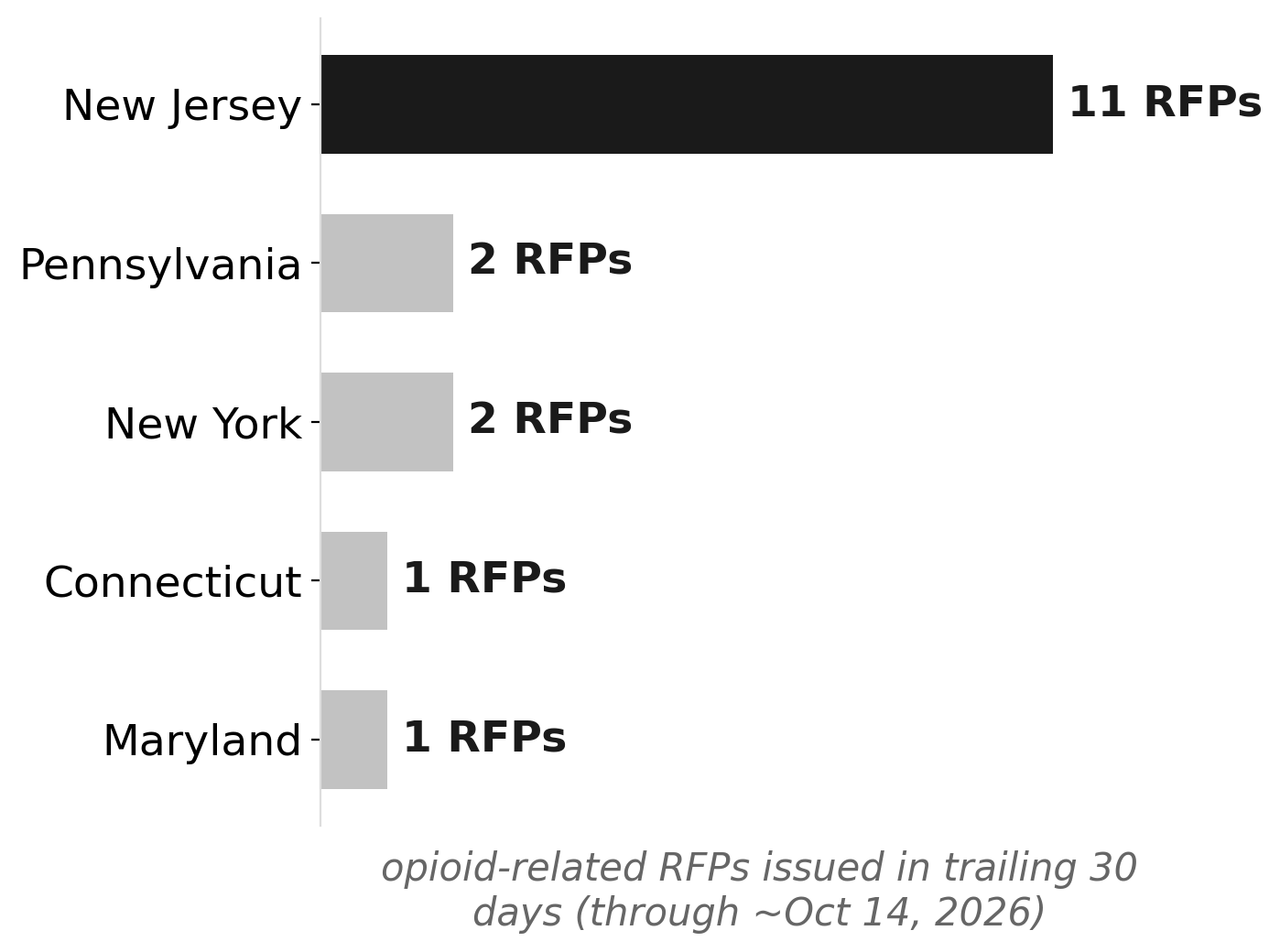
New Jersey counties issued 11 opioid-response procurement solicitations in the 30 days ending October 14, 2026, more than double the 12-month monthly average of roughly 5.2, and the timing is not a coincidence. It landed in the same week the state released documents showing what happened to the last round of money.
On October 1, the New Jersey Department of Human Services published fiscal-year spending reports for all 262 counties and municipalities that received opioid settlement funds in the year ended June 30, 2026. The reports covered more than $60 million in litigation proceeds from the national settlements with Johnson & Johnson, McKesson, Cardinal Health, and AmerisourceBergen, money designated for treatment, prevention, and harm reduction. What the reports showed, according to advocates who reviewed them immediately, was something closer to a general municipal slush fund: ice cream events, bounce houses, police SUVs, and surveillance cameras alongside legitimate case management contracts. An NJ.com investigation found that Washington Township had spent settlement funds on Chevrolet Tahoes and Flock cameras while reporting the expenditure to the state as "drug education."
The NJ Office of the State Comptroller has identified the structural reason this is possible: DHS is designated by law as the lead oversight agency, but DHS maintains it has no authority over local spending beyond collecting annual self-reported summaries. No receipts are required. No documentation standard is enforced. Towns certify their own compliance.
Source: NationGraph.
Into that accountability vacuum, counties are now pouring fresh solicitations. Atlantic County leads the current 30-day wave with five RFPs, including an $850,000 allocation for case management, treatment, and prevention services. Cumberland County follows with four. Ocean, Sussex, Camden, Bergen, and Hudson counties have each issued one. The concentration in Atlantic and Cumberland is not random: both counties have active Human Services divisions that have built procurement infrastructure around settlement funds, and both are under pressure to obligate money before calendar-year-end deadlines that govern how the funds are held.
This is the third identifiable spike in the NJ opioid RFP data. There were 13 solicitations in December 2025 and 19 in February 2026, each tied to county fiscal or grant-reporting cycles. The pattern reveals that the settlement's decentralized architecture, half the $1.1 billion going to the state, half flowing directly to 262 local subdivisions via an Independent Trustee, produces procurement bursts rather than steady programming. Counties spend when deadlines arrive, not necessarily when services are needed.
No neighboring state is generating anything close to this volume. Pennsylvania, New York, Connecticut, and Maryland combined issued four opioid-related RFPs in the same 30-day window. New Jersey's surge is a product of its specific settlement structure, not a regional public-health shift.
Complicated by all of this is a $45 million hole that has not been filled. In June 2025, the state legislature diverted $45 million from the Opioid Recovery and Remediation Trust Fund to four hospital systems, Hackensack University Medical Center, RWJBarnabas Health, Cooper University Hospital, and Atlantic Health System, in what was effectively a budget maneuver. Former Attorney General Matt Platkin called it "a slap in the face to every family that lost a loved one." A restoration bill, S3017/A4180, passed the Senate health committee in February 2026 but has not been signed into law. The uncertainty over whether that money returns to the fund is one reason counties with procurement capacity are moving now: locking in service contracts while the baseline funding is still intact.
Separate from the settlement, SAMHSA's federal COSSAP program has directed roughly $800,000 and $750,000 in recent awards to Rutgers and the Rutgers School of Osteopathic Medicine for law-enforcement diversion and treatment research. That federal stream supports institutional infrastructure but is not what is driving the county RFP wave. The two funding mechanisms serve overlapping purposes through entirely different channels, and conflating them obscures where accountability gaps actually sit.
For residents of Atlantic or Cumberland counties, the immediate practical reality is that new service contracts for treatment and case management are entering the market now. Whether those contracts will be structured around clinical outcomes or simply around spending obligations is harder to determine, because the state has not built a system to require that distinction.
Governor Mikie Sherrill, who took office in January 2026, has not yet taken a public position on the restoration bill or on the oversight gap the Comptroller identified. Her administration's posture on both questions will be the clearest signal of whether New Jersey's $1.1 billion commitment produces a durable public-health infrastructure or a recurring cycle of fiscal-deadline procurement with self-certified results.