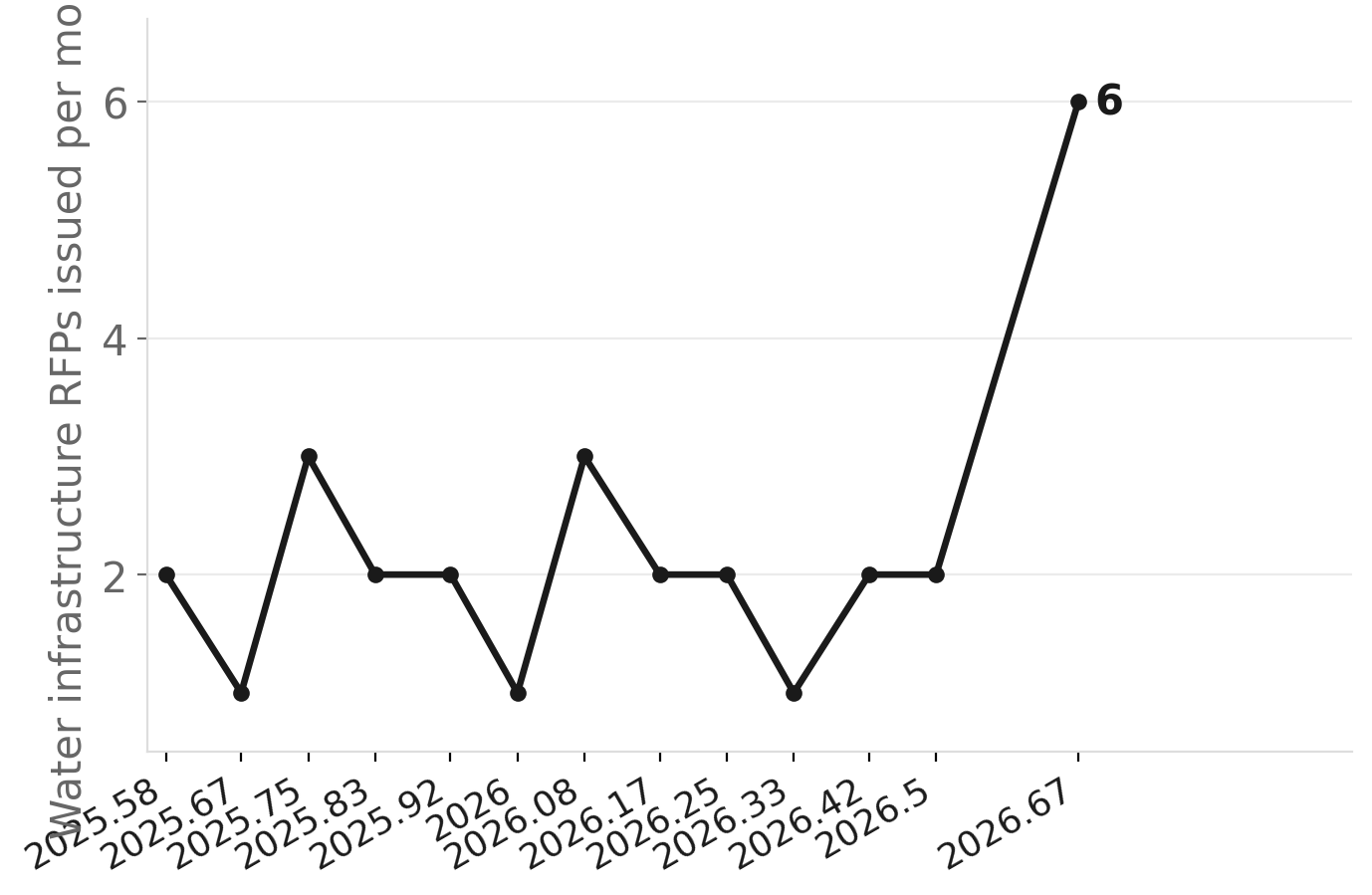
Maryland issued six water infrastructure RFPs in August 2026 alone, the highest single-month total in at least 13 months, against a baseline of roughly two per month. Five more have landed in the trailing 30 days. The 2.5x spike is not a regional artifact: Virginia matched Maryland's pace, Pennsylvania logged three, and West Virginia one, but Maryland's procurement surge is being driven by a combination of forces that do not apply equally across the region.
Two clocks are running simultaneously. The first is statutory. The Infrastructure Investment and Jobs Act's water program authorization expires September 30, 2026, 25 days from now. Under IIJA, the federal government has been capitalizing the Clean Water and Drinking Water State Revolving Funds at $2.6 billion each per year in FY25 and FY26, the highest annual levels in the program's history. Those funds flow from EPA to Maryland's Water Infrastructure Financing Administration, which then sub-awards low-interest loans and principal forgiveness to local governments for specific capital projects. The catch is that municipalities must have shovel-ready projects in MWIFA's Intended Use Plan queue before the authorization expires. Once the clock runs out, the funding cliff is real: the White House's FY2026 budget proposed a 31.5% cut to SRF appropriations, and analysts do not expect the one-time IIJA capital surge to be replaced.
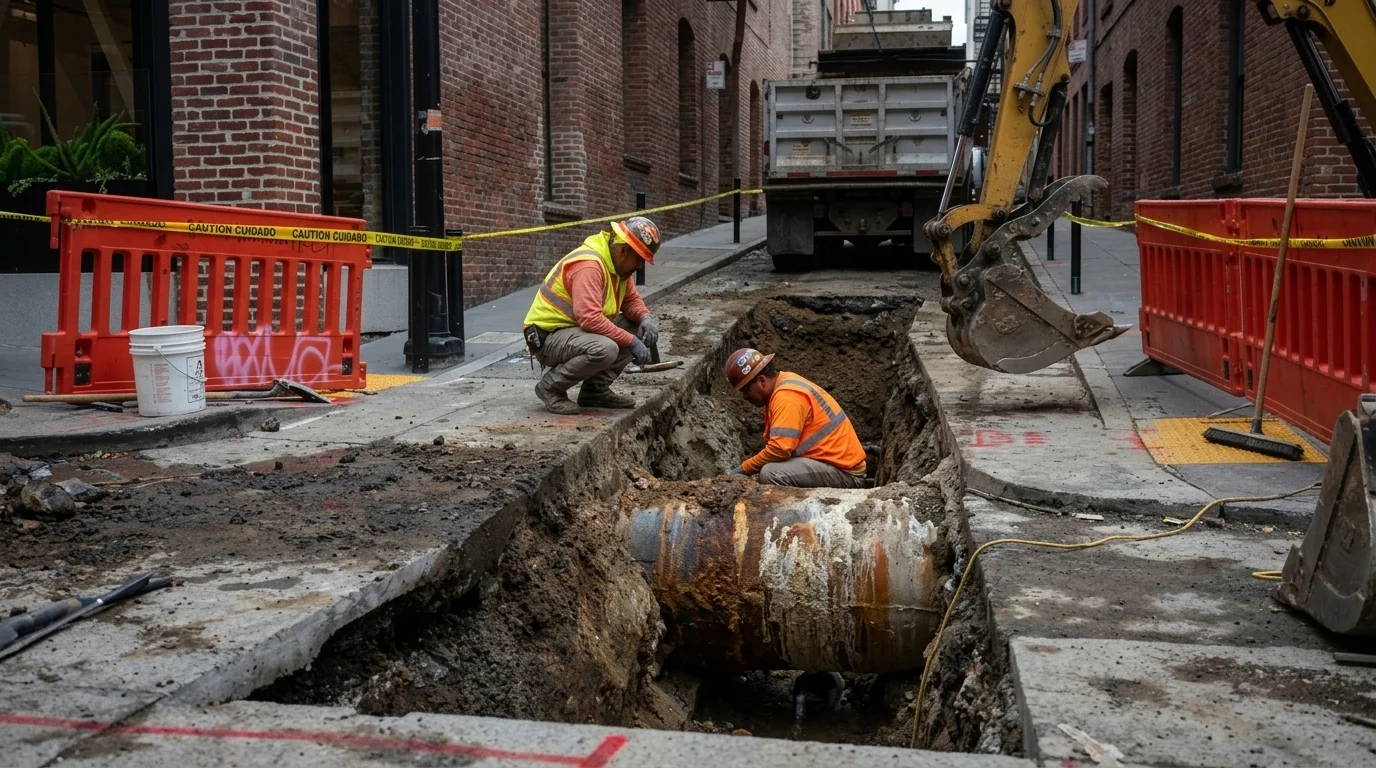
The second clock started ticking on January 19, 2026, when the Potomac Interceptor, a major sewer trunk line running from Montgomery County into DC, ruptured and discharged an estimated 240 million gallons of raw sewage into the Potomac River over eight days. Maryland Attorney General Anthony Brown and MDE Secretary Serena McIlwain filed suit against DC Water in April 2026, and the DOJ filed its own complaint the same month. The collapse was technically a DC Water failure, but the Potomac Interceptor physically crosses into Montgomery County, and the downstream damage hit Maryland waterways and shoreline businesses. The political effect inside Maryland was unambiguous: deferred pipe maintenance stopped being an abstraction.
Source: NationGraph.
EPA has committed $253.7 million to Maryland water infrastructure across 28 grants since January 2025, dominated by $108.5 million in Clean Water SRF awards and $101.4 million in Drinking Water SRF funding, all running through 2032. An additional $14.2 million DHS Safeguarding Tomorrow Revolving Loan Fund grant reached the Maryland Department of Emergency Management in August 2026. These are distinct programs doing distinct things, the SRF money supports wastewater and drinking water capital improvements through MWIFA's loan pipeline; the DHS grant funds hazard mitigation infrastructure through a separate revolving mechanism, but both are now landing in Maryland at the same moment procurement officers are issuing RFPs to absorb them.
The agencies driving the current procurement wave illustrate how concentrated the need is. Baltimore County's Department of Public Works is pursuing Phase I urgent water infrastructure rehabilitation. Baltimore City DPW, executing a $1.9 billion six-year capital improvement program across 3,800 miles of mains, many of them more than 80 years old, has issued its own Phase II FY27 urgent rehab RFP. The Maryland Board of Public Works unanimously approved $74 million for seven Baltimore City water projects in April 2025 and an additional $29 million in January 2026. Worcester County, St. Mary's County, and Charles County have all issued their own competitive solicitations in the past 30 days, suggesting the urgency is not confined to the Baltimore metro.
Governor Wes Moore included more than $400 million for Chesapeake Bay and clean water projects in his FY26 budget. That state appropriation moves through the Board of Public Works and does not share the September 30 deadline, but it compounds the same local dynamic: jurisdictions that have been planning around federal SRF money, state budget commitments, and Chesapeake Bay restoration obligations are now converting years of planning into active procurements at the same time.
For residents of the Baltimore metro and the counties surrounding the Chesapeake, the immediate consequence is construction activity on water and sewer systems that have been under-maintained for decades. Baltimore City DPW has already proposed rate adjustments, water up 3%, sewer up 15%, to partially fund its capital program. The larger question is what happens after September 30. The National League of Cities has warned that cities are entering an uncertain period on water funding as IIJA's peak capitalization years close out, and no replacement at the federal level has been authorized.
The next signal to watch is how many of the current RFPs convert to signed contracts before the authorization window closes, and whether MWIFA's IUP queue is fully obligated before September 30. Projects that miss the deadline will compete for a smaller pool of annual SRF appropriations in FY2027, in a budget environment that has already proposed cutting those appropriations by nearly a third.